

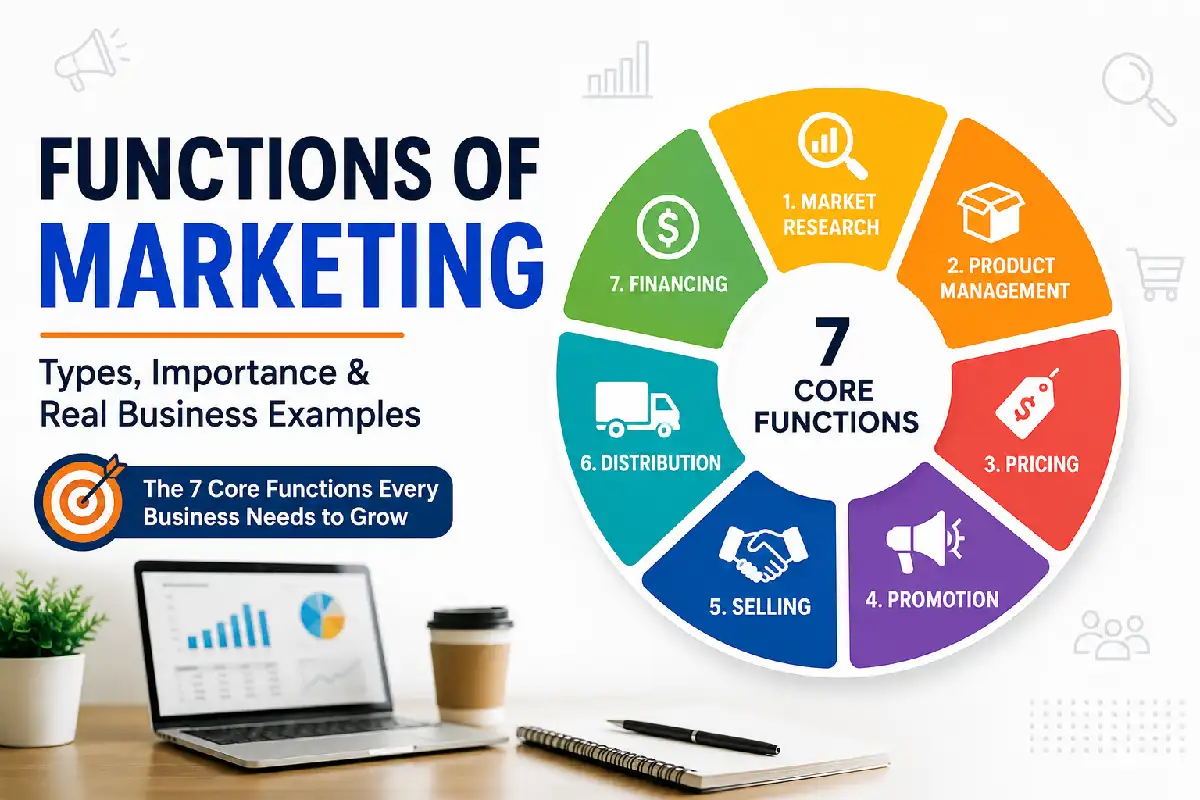


One of the most crucial pillar in marketing of every successful business today. No matter what type of business it is, startup or service provider, eCommerce brand or a global company; the elements and workings of marketing play an important role, in not only getting potential customers but also ensuring revenue growth and their long-term sustainability.
Marketing is no longer confined to advertising or selling products in this very competitive digital era. Seo branding customer research on customer relationship management, pricing strategies content marketing social media advanced marketing
Businesses that understand the key functions of marketing can:
- Build stronger customer relationships
- Improve brand awareness
- Increase sales conversions
- Retain loyal customers
- Competing effectively in their industry
This guide explains the functions of marketing, their importance, Latest marketing strategies, real world business examples, challenges, future trends, and practical functioning methods businesses can use in 2026 and beyond.
Table of Contents
What Are the Functions of Marketing?
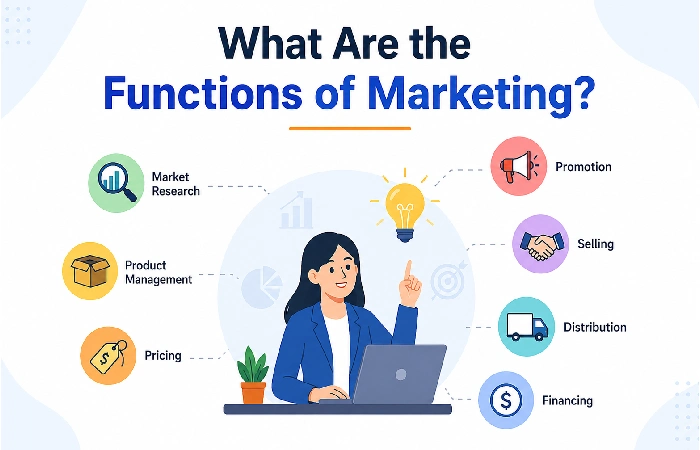
The functions of marketing are the activities that businesses assume to identify customer’s needs, products (goods or services), classify them suitably, deliver value and achieve customer satisfaction successfully.
In simple terms:
Marketing functions help businesses get in connect with customers with products and services in the most successful way possible.
These functions ensure that businesses can:
- Understand customer demand
- Create value-driven products
- Promote products effectively
- Deliver products efficiently
- Maintain long term customer relationships
Marketing functions work together to achieve structural goals while satisfying customer needs.
Definition of Marketing
Marketing can be defined as:
The process of recognizing customer needs, creating valuable products or services, promoting them effectively, and delivering satisfaction profitably.
According to modern marketing concepts, customer satisfaction is the foundation of business success.
Evolution of Marketing Functions
Marketing in changing the world Fastly over the years.
Traditional Marketing Era
Earlier marketing mainly focused on:
- Newspaper ads
- Television commercials
- Radio advertising
- Billboards
- Direct sales
The primary goal was simply selling products.
Modern Marketing Era
Today, marketing aims on:
- Customer experience
- Personalization
- SEO
- Social media marketing
- Influencer marketing
- AI-driven campaigns
- Data analytics
Modern businesses use marketing not just to sell but to get trust and to make long-term relationships.
Importance of Marketing Functions
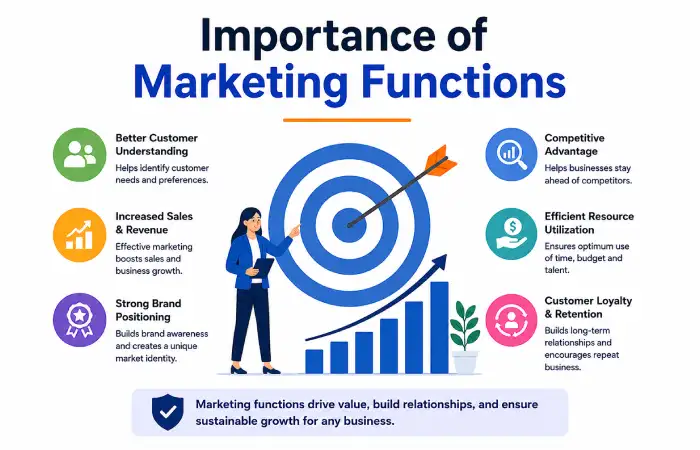
The importance of marketing functions has increased dramatically because customer behavior and digital competition continue to evolve.
1. Helps Businesses Understand Customers
Marketing research allows companies to understand:
- Customer preferences
- Buying behavior
- Pain points
- Expectations
- Market demand
Without understanding customers, businesses cannot create successful products.
2. Builds Brand Awareness
Marketing functions help many businesses to become visible online and offline.
Strong marketing increases:
- Brand recognition
- Customer trust
- Market credibility
For example:
Many Businesses using SEO and social media marketing can achieve millions of users naturally.
3. Increases Sales and Revenue
One of the largest roles and functions of marketing is leading revenue growth.
Marketing strategies help businesses:
- Generate leads
- Convert prospects
- Increase customer retention
- Improve conversion rates
4. Creates Competitive Advantage
Businesses with strong marketing have best competitors because they:
- Understand trends faster
- Build stronger branding
- Reach audiences effectively
5. Improves Customer Satisfaction
Modern marketing aims heavily at customer experience.
Satisfied customers are more possible to:
- Purchase again
- Recommend brands
- Leave positive reviews
6. Supports Business Expansion
Marketing helps businesses:
- Enter new markets
- Launch new products
- Expand globally
- Scale operations
Primary Functions of Marketing
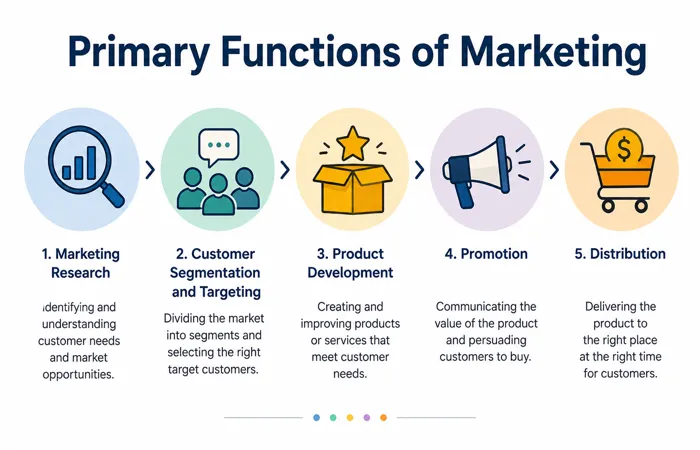
The primary functions of marketing include several interconnected activities that support business growth.
1. Market Research
Market research is one of the most valuable functions of marketing management.
It involves grouping and analyzing information about:
- Customers
- Competitors
- Industry trends
- Consumer behavior
Objectives of Market Research
Businesses manage market research to:
- Identify customer needs
- Analyze competitors
- Find market opportunities
- Reduce business risks
- Improve product development
Types of Market Research
Primary Research
Primary research means collecting original data straight from customers through:
- Surveys
- Interviews
- Questionnaires
- Focus groups
Secondary Research
Secondary research means analyzing existing data from:
- Industry reports
- Government statistics
- Online databases
- Competitor analysis
Real Business Example
A skincare company researching:
- Popular ingredients
- Customer skin concerns
- Product reviews
- Competitor pricing
can create better products that customers want.
Tools Used for Market Research in 2026
Modern businesses use:
- Google Trends
- Ahrefs
- SEMrush
- Statista
- AI analytics tools
- Social listening platforms
Importance of Market Research
Without research:
- Products may fail
- Marketing campaigns become ineffective
- Businesses waste money
Market research helps reduce doubt and improve decision-making.
2. Product Development
Product development aims on creating products that solve customer problems successfully.
This function includes:
- Product design
- Packaging
- Features
- Branding
- User experience
Product Development Process
Step 1: Idea Generation
Businesses find customer difficulties and market opportunities.
Step 2: Product Design
Make products according to customer expectations.
Step 3: Testing
Businesses test products before beginning to identify improvements.
Step 4: Launch
The final launch of product at the market.
Example of Effective Product Development
Apple focuses heavily on:
- Simplicity
- User experience
- Design consistency
This customer centrical approach supports Apple maintain premium pricing.
Importance of Product Development
Good product development:
- Improve customer satisfaction
- Increases brand loyalty
- Enhances market competitiveness
3. Pricing Function
Pricing is one of the most significant functions of marketing because it exactly affects:
- Sales
- Profitability
- Brand perception
Business must set their pricing strategies before to ensure long term relationships.
Factors Affecting Pricing
Businesses consider:
- Production cost
- Market demand
- Competitor pricing
- Brand positioning
- Customer affordability
Types of Pricing Strategies
Diffusion Pricing
Low prices are used initially to attract customers quickly.
Example
Streaming services offering low simple prices.
Premium Pricing
High prices make luxury perception.
Example
Luxury and costly fashion brands like Gucci.
Competitive Pricing
Businesses match competitor prices.
Psychological Pricing
Dropping a price by just one rupee powerfully shifts buyer psychology.
Dynamic Pricing
Prices change according to:
- Demand
- Season
- Customer behavior
Example
Airline ticket price.
Importance of Pricing
Correct pricing:
- Maximizes profits
- Improves competitiveness
- Attracts target audiences
4. Promotion and Advertising
Promotion in one of the strongest marketing functions which helps businesses to get customers, increases sales graph and beat competition.
It helps businesses:
- Increase awareness
- Generate leads
- Improve conversions
- Build brand recognition
Types of Promotional Activities
Traditional Advertising
Includes:
- Television ads
- Newspapers
- Radio
- Billboards
Digital Advertising
Includes:
- Google Ads
- Facebook Ads
- YouTube Ads
- Instagram promotions
Search Engine Optimization (SEO)
SEO is one of the most powerful latest marketing functions. It helps businesses to rank on Google for various keywords.
Benefits of SEO
SEO benefits businesses:
- Increase organic traffic
- Build authority
- Generate long-term leads
- Reduce ad dependency
Important SEO Components
On-Page SEO
Includes:
- Keyword optimization
- Meta tags
- Internal linking
- Content optimization
Technical SEO
Includes:
- Speed
- Mobile responsiveness
- Schema markup
- Core Web Vitals
Off-Page SEO
Includes:
- Backlinks
- Brand mentions
- Authority building
Social Media Marketing
As per current situation, social media marketing is important for business growth by which they can get customer engagements.
Businesses use platforms like:
- TikTok
- YouTube
to engage audiences.
Advantages of Social Media Marketing
- Improves visibility
- Builds communities
- Increased engagement
- Generates leads
Influencer Marketing
Influencer marketing helps businesses to grow targeted viewers with the help of content creators.
Example
Beauty brands work together with influencers to:
- Demonstrate products
- Build trust
- Increase conversions
Email Marketing
The best way to get good returns on investment is email marketing. Email marketing helps businesses very well
Businesses use emails for:
- Promotions
- Newsletters
- Customer retention
- Product launches
Content Marketing
Creating Strong content by using content marketing. It also helps businesses to build authority and trust.
Popular content formats include:
- Blog posts
- Videos
- Podcasts
- Infographics
- Webinars
Importance of Content Marketing
Content marketing:
- Builds authority
- Improves SEO
- Educates customers
- Increase trust
5. Distribution Function
Distribution ensures products reach customers efficiently.
This includes:
- Transportation
- Warehousing
- Inventory management
- Logistics
Types of Distribution Channels
Direct Distribution
Businesses sell directly to customers.
Example
Brand-owned websites.
Indirect Distribution
Products are sold through intermediaries.
Example
Retail stores and wholesalers.
Importance of Distribution
Efficient distribution:
- Improve customer satisfaction
- Reduces delays
- Increases operational efficiency
Example: Amazon
Amazon dominates eCommerce because of:
- Fast delivery systems
- Smart logistics
- Warehouse automation
6. Selling Function
Selling converts possibilities into paying customers.
This function includes:
- Sales communication
- Negotiation
- Lead nurturing
- Customer interaction
Types of Selling
Direct Selling
Face-to-face product selling.
Online Selling
Selling through websites and marketplaces.
Consultative Selling
Solving customer problems and approaching selling products is the work of sales and support teams
Importance of Selling
Effective selling:
- Increases revenue
- Build relationships
- Improve customer confidence
7. Branding Function
Branding creates a unique business identity.
It includes:
- Logos
- Brand voice
- Messaging
- Visual design
- Customer perception
Why Branding Is Important
Strong branding:
- Builds trust
- Creates recognition
- Increases loyalty
- Supports premium pricing
Example: Nike
Nike uses emotional branding focused on:
- Motivation
- Inspiration
- Performance
Their Bold promotions build strong emotional connections.
8. Customer Relationship Management (CRM)
For maintaining good customer relationships in business, they need CRM.
CRM Activities Include
- Customer support
- Loyalty programs
- Feedback management
- Personalized communication
Popular CRM Tools
- Salesforce
- HubSpot
- Zoho CRM
Benefits of CRM
CRM helps businesses:
- Improve retention
- Increase customer lifetime value
- Build loyalty
9. Financing Function
Marketing promotions want financial planning.
Businesses allocate budgets for:
- SEO
- Advertising
- Influencer campaigns
- Product launches
Significance of Financial Planning in Marketing
Proper budgeting:
- Improvement ROI
- Prevents overspending
- Maximizes campaign effectiveness
10. Risk Management
Marketing teams identify potential business risks.
These include:
- Reputation issues
- Product failures
- Negative reviews
- Market changes
Example
For avoiding PR cases, Brand response fast on social media to customer complaints.
Modern Functions of Marketing
Technical innovations and AI combination have basically redesigned modern marketing functions.
AI-Powered Marketing
Businesses now use AI for:
- Personalized recommendations
- Predictive analytics
- Chatbots
- Automated campaigns
Example
Based on viewers behavior, AI recommend content in Netflix
Marketing Automation
Businesses requires Marketing Automation tools
- Schedule campaigns
- Send automated emails
- Track customer behavior
Benefits of Automation
- Saves time
- Improves efficiency
- Increases scalability
Data Analytics
Data driven marketing develops decision-making.
Businesses analyze:
- Traffic
- Conversions
- User behavior
- ROI
Common Analytics Tools
- Google Analytics
- Hotjar
- Looker Studio
Video Marketing
Video marketing is ruling digital platforms.
Popular video formats include:
- Short-form videos
- Tutorials
- Product demos
- Live streams
Importance of Video Marketing
Videos:
- Increase engagement
- Improve retention
- Boost conversions
Voice Search Optimization
Voice search is growing fast.
Businesses now enhance for:
- Conversational keywords
- Question-based searches
- Local SEO
Types of Marketing Functions
Marketing functions are generally divided into three categories.
1. Exchange Functions
These involve:
- Buying
- Selling
They help transfer ownership of goods.
2. Physical Functions
These include:
- Storage
- Transportation
- Warehousing
They ensure products reach customers safely.
3. Facilitating Functions
These support marketing through:
- Financing
- Market information
- Risk management
- Standardization
Role and Functions of Marketing in Business Growth
The role and functions of marketing influence business performance.
Marketing Helps Generate Leads
Businesses use:
- SEO
- Social media
- Ads
- Content marketing
to attract customers.
Marketing Builds Trust
Consistent branding and quality content growth credibility.
Marketing Improves Customer Retention
Customer focused marketing increases loyalty.
Marketing Supports Product Launches
Effective campaigns generate awareness for new products.
Real Business Examples of Marketing Functions
Starbucks
Starbucks focuses on:
- Customer experience
- Loyalty programs
- Personalized marketing
This improves retention significantly.
Amazon
Amazon excels in:
- Logistics
- Customer service
- Product recommendations
- Conversion optimization
Coca-Cola
Coca-Cola uses emotional narration to maintain global brand identification.
Tesla
Tesla relies heavily on:
- Brand positioning
- Social influence
- Product innovation
instead of traditional advertising.
Challenges in Marketing Functions
Modern businesses face various marketing challenges.
Increasing Competition
Every industry is becoming highly competitive.
Algorithm Changes
SEO and social platforms constantly update algorithms.
Customer Trust Issues
Customers believe in transparency and authenticity.
Data Privacy Regulations
Businesses must obey privacy laws and data protection policies.
Rising Advertising Costs
Paid advertising costs continue increasing yearly.
Common Mistakes Businesses Make in Marketing
Ignoring SEO
Businesses depend on only ads often struggle with long-term growth.
Weak Branding
Poor branding reduces customer trust.
Lack of Customer Research
Without research, businesses make products that customers may not need.
Poor Website Experience
Slow websites raise bounce rates and reduce conversions.
Inconsistent Marketing
Random campaigns weaken brand visibility.
How Businesses Can Improve Marketing Functions
Invest in SEO
SEO builds sustainable traffic and long-term visibility.
Focus on User Experience
Fast, mobile friendly websites improve engagement.
Use Analytics
Data helps improve campaigns and decision-making.
Build Strong Branding
Consistency improves recognition and loyalty.
Create Valuable Content
Educational content builds trust and authority.
Future of Marketing Functions
The future of marketing will focus on:
- AI automation
- Hyper-personalization
- Interactive experiences
- Voice search
- Community-driven branding
Businesses that implement these ideas today will easily outdistance the competition tomorrow.
Functions of Marketing Resource Hub
Explore all important marketing functions with in-depth guides and resources.
Core Functions of Marketing
Learn the primary marketing functions that drive success.
FAQs About Functions of Marketing
What are the main functions of marketing?
The main functions include:
- Market research
- Product development
- Pricing
- Promotion
- Distribution
- Selling
- Branding
- Customer relationship management
Why are marketing functions important?
Marketing functions help businesses:
- Attract customers
- Increase sales
- Build brand awareness
- Improve customer satisfaction
- Achieve business growth
What are modern functions of marketing?
Modern marketing functions include:
- SEO
- AI personalization
- Social media marketing
- Content marketing
- Data analytics
- Marketing automation
What is the role of marketing management?
Marketing management helps businesses:
- Plan campaigns
- Allocate budgets
- Analyze customer behavior
- Improve marketing performance
How does SEO support marketing functions?
SEO improves:
- Organic visibility
- Website traffic
- Brand authority
- Long-term lead generation
What is the importance of branding in marketing?
Branding helps businesses:
- Build recognition
- Create trust
- Increase customer loyalty
- Improve perceived value
How does content marketing help businesses?
Content marketing:
- Educates customers
- Improves SEO
- Generates leads
- Builds authority
What are facilitating marketing functions?
Facilitating functions include:
- Financing
- Risk management
- Market information
- Standardization
They support overall marketing operations.
Final Thoughts
Understanding how marketing works is really important for businesses that want to grow and do well in 2026 and after that.
Marketing is not about selling things now. There are a lot of different things
- Understanding customers
- Delivering value
- Building trust
- Creating experiences
- Driving long-term growth
Businesses that direct the primary functions of marketing can:
- Increase profitability
- Build strong brands
- Improve customer loyalty
- Dominate competitive markets
From getting your website to show up on search engines and making a brand that people know to use computers to make things personal for each customer and keeping those customers marketing is changing fast.
Companies that put money into marketing plans now will be in a good place to do well in the future. They will have a balance and be successful.