

Last Updated: June 19, 2026
The management of products and services-what marketers call “product planning and development”-is a critically important function. Marketing helps the administrations to develop the products with the customers who really want to buy. Ranging from identifying market opportunities to introducing cutting-edge products, it directly affects business growth, customer satisfaction, and modest advantage.
Table of Contents
This Article Is Part of the Marketing Resource Hub
Explore more guides, tutorials, strategies, and marketing resources inside our
Marketing Resource Hub .
Organizations using structured processes for developing products have a far better chance of success than those that are only operating on hypotheses, in a rapidly changing marketplace. This guide shows beginners what they need to know about product planning and development strategies, processes, examples and best practices for 2026.
What Is Product Planning and Development?
The processes of analysing customer needs, designing innovative products and services, testing new ideas, and bringing them to the market are collectively called the process of product planning and development. This involves the integration of marketing research, product organization, understanding regulars, invention, and business strategy.
Key Objectives
- Understand customer needs
- Identify market opportunities
- Reduce product launch risks
- Improve customer satisfaction
- Increase profitability
- Strengthen brand positioning
Why Product Planning and Development Matters
A successful product can transform a business, while a poorly planned product may result in significant losses.
Benefits
✓ Better understanding of customer demand
✓ Faster market adaptation
✓ Reduced development costs
✓ Stronger competitive advantage
✓ Improved product-market fit
✓ Higher customer retention
Product Planning vs Product Development
| Feature | Product Planning | Product Development |
| Focus | Strategy and research | Product creation |
| Goal | Determine what to build | Build the product |
| Activities | Market research, forecasting | Design, testing, manufacturing |
| Timeline | Early stage | Mid-to-late stage |
| Ownership | Marketing and Product Teams | Product and Engineering Teams |
Both functions work together throughout the product lifecycle.
The Modern Product Development Process
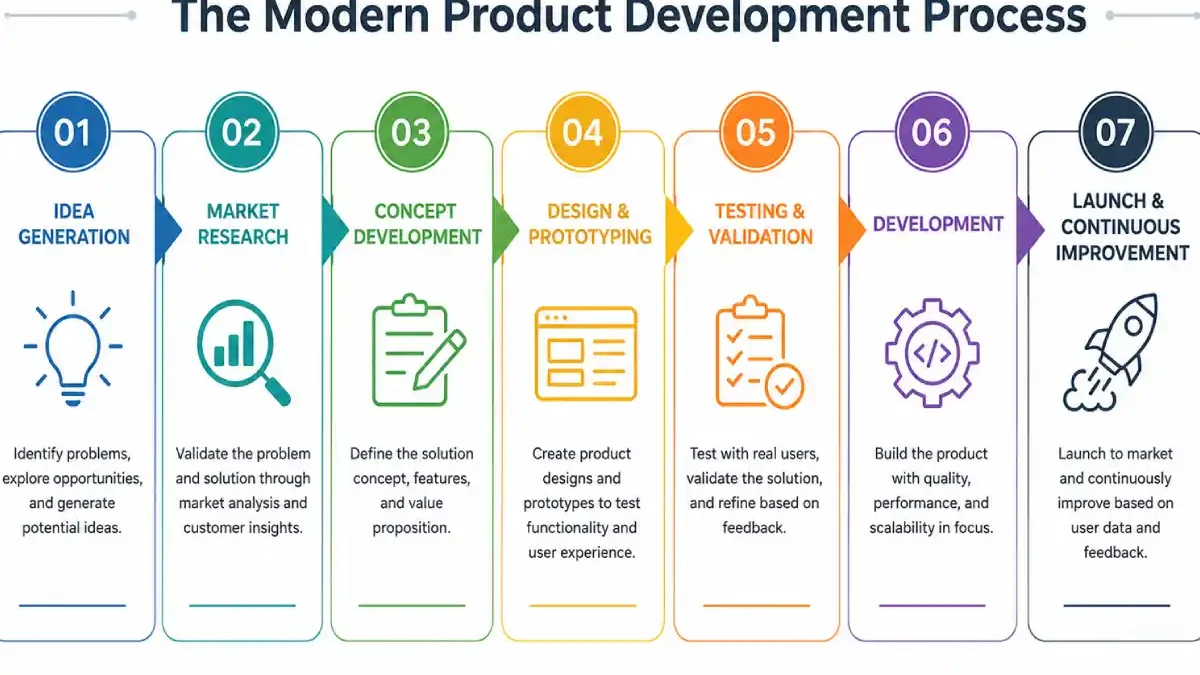
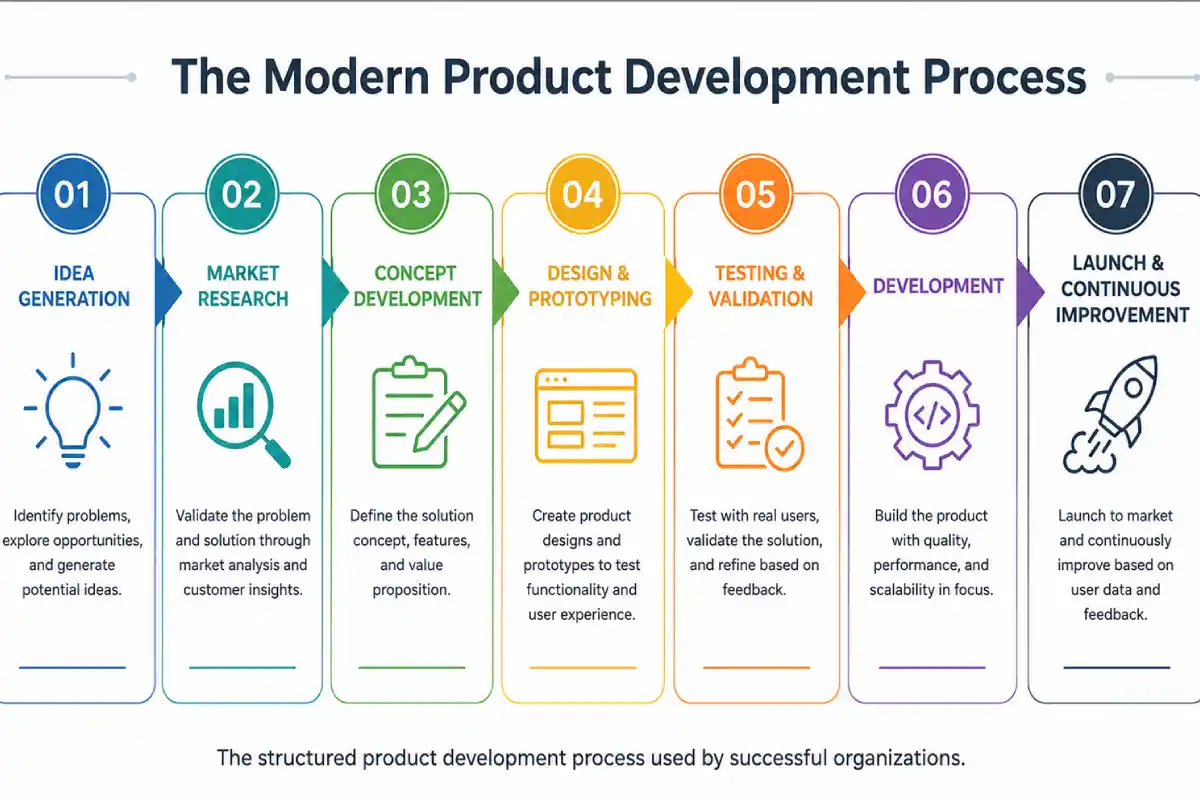
The product development process generally follows seven stages.
Stage 1: Idea Generation
Businesses collect ideas from:
- Customer feedback
- Market trends
- Competitor analysis
- Sales teams
- Social media insights
- Emerging technologies
Stage 2: Market Research
Research validates whether a product idea has real demand.
Important activities include:
- Customer surveys
- Interviews
- Focus groups
- Competitor benchmarking
- Industry analysis
Successful product planning relies heavily on customer insights and market validation. According to the Harvard Business Review, companies that consistently align product development with customer needs are more likely to achieve long-term market success and sustainable growth.
Stage 3: Product Concept Development
Teams create detailed product concepts including:
- Features
- Benefits
- Pricing
- Positioning
- Target audience
Stage 4: Business Analysis
Before investing heavily, organizations evaluate:
- Development costs
- Expected revenue
- Market size
- Profit margins
- Risk factors
Stage 5: Product Design and Development
At this stage teams:
- Create prototypes
- Develop MVPs
- Conduct usability testing
- Refine product features
Stage 6: Testing & Authentication
Testing helps to identify the issues before launch.
Common devices comprise:
- Beta testing
- User acceptance testing
- Quality assurance testing
- Pilot launches
Stage 7: Profitable Introduction
The product formally enters the marketplace done:
- Marketing campaigns
- Sales enablement
- Distribution planning
- Customer onboarding
Product Planning Strategies That Work
Sophisticated product planning is becoming the way forward for present day businesses to achieve competitive advantage.
Customer-Centric Development
Customer feedback has been the key in developing the products, instead of any executive’s assumption.
Data-Driven Planning
Organizations use:
- Analytics platforms
- Customer behavior tracking
- AI-driven forecasting
- Market intelligence tools
Agile Product Development
Agile methodologies allow teams to:
- Launch faster
- Iterate continuously
- Reduce development risks
Sustainability-Focused Innovation
Consumers increasingly prefer environmentally responsible products.
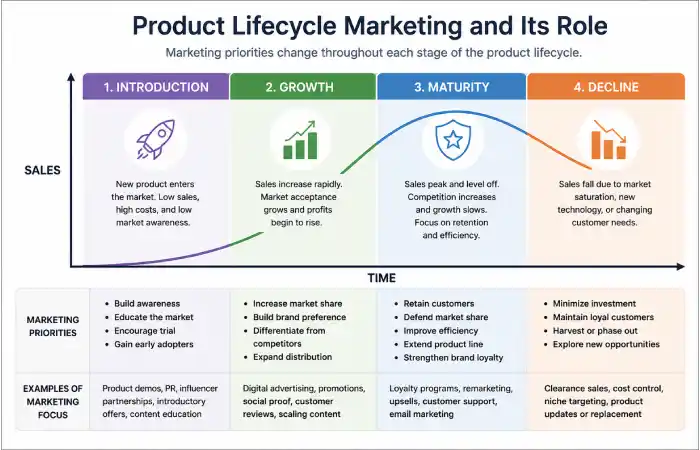
Product Lifecycle Marketing and Its Role
Every product goes through a lifecycle.
| Stage | Marketing Focus |
| Introduction | Awareness and education |
| Growth | Market expansion |
| Maturity | Differentiation |
| Decline | Optimization or replacement |
Understanding product lifecycle marketing helps businesses allocate resources effectively.
Product Planning and Development Tools Comparison
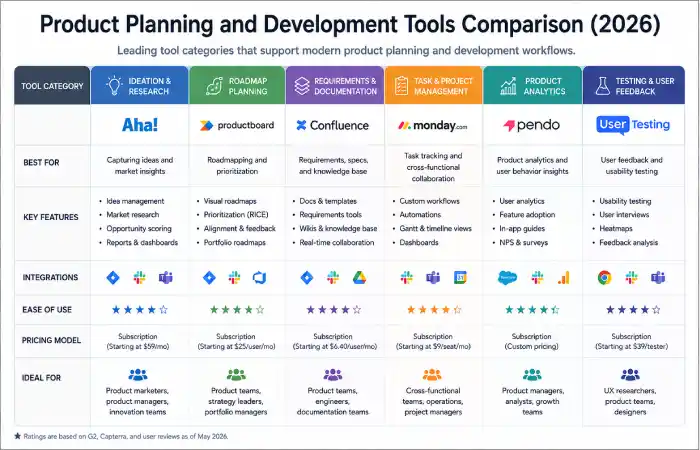
| Tool Category | Purpose | Best For |
| Product Management Software | Roadmaps and planning | Large teams |
| Customer Feedback Platforms | Voice of customer analysis | Product validation |
| Analytics Tools | Behavior tracking | Data-driven decisions |
| Project Management Platforms | Team collaboration | Cross-functional teams |
| AI Research Tools | Trend forecasting | Strategic planning |
2026 Product Development Trends
Market Trends Snapshot
| Trend | Impact Level |
| AI-Assisted Product Design | Very High |
| Predictive Analytics | High |
| Hyper-Personalization | High |
| Sustainable Products | High |
| Low-Code Development | Medium |
| Digital Twin Testing | Medium |
Organizations embracing these trends are improving launch success rates and reducing time-to-market.
Common Product Planning Challenges
1. Poor Market Research
Problem:
Teams build products based on assumptions.
Solution:
Validate demand before development begins.
2. Unclear Customer Needs
Problem:
Features don’t solve real problems.
Solution:
Conduct interviews and gather direct feedback.
3. Scope Creep
Problem:
Projects become too complex.
Solution:
Focus on MVP development.
4. Weak Cross-Team Communication
Problem:
Marketing and product teams become misaligned.
Solution:
Establish shared goals and regular review meetings.
Real-World Example
Imagine a fitness technology company noticing increased demand for personalized health tracking.
Product Planning Activities
- Analyze customer feedback
- Study competitors
- Identify unmet needs
- Forecast demand
Product Development Activities
- Build prototype
- Test with users
- Refine features
- Launch product
Planning and development are complementary; this means the company lowers the risk of failure, increases adoption.
Best Practices for Successful Product Preparation
Focus on Customer Outcomes
Always ask:
“What customer problem does this solve?”
Use Continuous Feedback Loops
Gather feedback throughout development.
Align Marketing and Product Teams
Cross-functional collaboration improves launch performance.
Measure Success Metrics
Track:
- Customer acquisition
- Retention
- Revenue growth
- Product adoption
- Customer satisfaction
FAQ’s
What is product planning and development?
Product planning and development is the study, design, testing, and introduction of products to fulfill customer requirements and business goals.
Why is the product planning being important?
It will help the businesses to reduce the risks, comprehend customer request, improve product-market fit, and increase profitability.
What are the stages of product development?
Common phases are idea generation, market analysis, concept, business analysis, design, test and launch
How does the product lifespan marketing relate to creation development?
The Product life cycle advertising enables businesses to fine-tune the method depending on the stage the produce is in; introduction, growth, adulthood or decline.
What skills are required for product planning?
Crucial competencies involve market analysis, strategic development, customer analysis, project management, communication skills and data analysis.
Conclusion
The Product planning & development is the core promotion activity that will unmoving be among the most significant in 2026. Organizations that integrate customer data, data-driven executive, iterative development, and lifecycle marketing are poised to introduce more effective products to progressively packed market landscapes. Taking a methodical approach to product development and constantly adapting to the developing market can only lead to a more groundbreaking company, faster expansion, and stronger client bonds.