


Last Updated: June 19, 2026
Marketing is much more than advertising products or posting on social media. At the back every successful campaign is a designed process that helps businesses identify customer needs, create value and reach business goals. This method is known as marketing management.
Understanding the functions of marketing management is important for business owners, marketing professionals and learners who require to learn how organizations interest and maintain customers in today’s useful market.
Table of Contents
This Article Is Part of the Marketing Resource Hub
Explore more guides, tutorials, strategies, and marketing resources inside our
Marketing Resource Hub .
Functions of Marketing Management
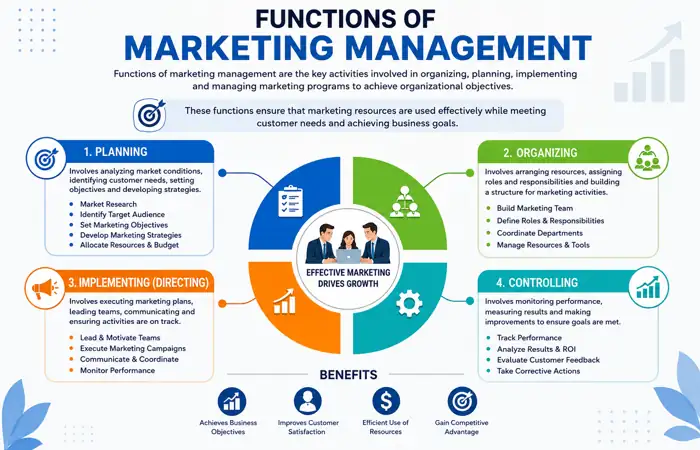
The functions of marketing management are the tricks involved in organizing, planning, implementing and managing marketing programs to complete organizational objectives. These functions make sure that marketing sources are used successfully while meeting customer challenges and business goals.
Effective marketing management involves planning, organizing, and controlling various marketing activities to achieve business objectives. Understanding the functions of marketing helps managers coordinate product development, pricing, promotion, and distribution strategies more effectively.
Why Marketing Management Matters
Marketing management helps organisations:
- Understand customer behaviour
- Identify market opportunities
- Develop effective marketing strategies
- Improve customer satisfaction
- Increase brand awareness
- Drive revenue growth
- Gain a competitive advantage
Businesses have a time when they do not have good marketing management. They often have problems with messages that do not make sense they waste a lot of money. They do not connect well with their customers. Marketing management is important for businesses to get their messages across spend their money and build strong relationships, with their customers, the businesses.
The Role of Marketing Management in Modern Business
The role of marketing management spreads across many business functions. It acts as a crossing between customers and the organization by guaranteeing products and services associate with market needs.
Key responsibilities include:
| Purpose | Marketing Management Role |
| Increase awareness | Promotion Management |
| Understand customer needs | Market Research |
| Ensure product availability | Distribution Planning |
| Improve retention | Customer Relationship Management |
| Maintain competitiveness | Pricing Strategy |
| Develop relevant products | Product Planning |
Marketing management facilitates both immediate sales and business expansion.
Core Marketing Management Functions
To build successful marketing campaigns, businesses must focus on the core functions of marketing, including market research, product planning, promotion, selling, and customer relationship management. These functions provide the foundation for effective marketing management decisions.
The major marketing management functions can be divided into four primary areas:
1. Planning in Marketing Management
Planning in marketing management is the foundation of all marketing activities.
During this stage, organizations:
- Analyze market conditions
- Study competitors
- Define target audiences
- Set marketing objectives
- Allocated budgets
- Develop marketing strategies
Marketing Planning Workflow
- Conduct market research
- Identify customer needs
- Define marketing goals
- Creating marketing strategies
- Allocate resources
- Implement campaigns
- Measure results
For instance, if a skincare company is introducing a new skincare product. It will review the likes and dislikes of customers. From there, the company will determine the product price. Also the company will consider promotion and place decisions.
The launch of a new skincare product involves consideration of the likes/dislikes of customers with regards to pricing, promotion and place decisions. The skincare company launch will analyze customer likes/dislikes.
Benefits of Marketing Planning
- Reduces uncertainty
- Improves resource allocation
- Supports better decision-making
- Aligns marketing with business goals
2. Organising Marketing Activities
Once plans are created, businesses must focus on organizing marketing activities.
This function is about putting things in order, like resources and giving people jobs and making systems that help get marketing work done. The main goal of this function is to support marketing execution. It is all about making sure marketing execution goes smoothly. The function involves creating systems that help with marketing execution and making sure everything works together to support marketing execution.
Key activities include:
- Building marketing teams
- Defining roles and responsibilities
- Coordinating departments
- Managing marketing budgets
- Selecting technology and tools
Example
An e-commerce company may assign separate teams for:
- Content marketing
- Search engine optimisation (SEO)
- Social media marketing
- Email marketing
- Paid advertising
Good organization ensures efficiency and less operational ambiguity.
3. Directing and Implementing Marketing Strategies
Following the plan and organize stage, the marketing manager will have to control the execution.
This includes:
- Leading marketing teams
- Motivating employees
- Coordinating campaigns
- Monitoring performance
- Communicating objectives
Key Leadership Responsibilities
| Activity | Purpose |
| Team Guidance | Ensure alignment |
| Communication | Improve collaboration |
| Campaign Monitoring | Maintain quality |
| Decision Making | Address challenges quickly |
A robust leadership style allows firms to adjust to evolving market dynamics and customer tastes.
4. Marketing Control Functions
This is the control function part of marketing; this is about controlling the performance and identifying areas to improve on. Marketing control ensures that actual results match planned objectives.
Monitoring marketing performance is essential for continuous improvement. The HubSpot Marketing Statistics Library regularly publishes industry benchmarks that help businesses evaluate campaign effectiveness and customer engagement trends.
Common Control Activities
- Tracking campaign performance
- Monitoring return on investment (ROI)
- Analysing customer feedback
- Reviewing sales performance
- Measuring market share
Marketing Control Metrics
| Metric | What It Measures |
| Customer Acquisition Cost | Marketing efficiency |
| Customer Retention Rate | Customer loyalty |
| Conversion Rate | Campaign effectiveness |
| Return on Investment | Profitability |
| Website Traffic | Audience engagement |
Businesses can also benefit from consistent monitoring of performance, as this allows them to refine the strategy further and learn for subsequent campaigns.
Additional Functions of Marketing Management
In addition to the four basic functions, marketing managers also usually take responsibility for:
Market Research
Understanding customer behavior and industry trends.
Product Development
Working with product teams to create giving that satisfy customer needs.
Pricing Management
Determining aggressive and profitable pricing strategies.
Promotion Management
Managing advertising, public interactions and digital marketing works.
Distribution Management
Ensuring products reach customers efficiently through suitable channels.
Comparison Table: Marketing Management Functions vs Business Outcomes
| Function | Main Objective | Expected Business Outcome |
| Planning | Set direction | Strategic growth |
| Organising | Allocate resources | Improved efficiency |
| Directing | Execute plans | Better campaign performance |
| Controlling | Measure results | Continuous improvement |
| Research | Understand customers | Better decision-making |
| Promotion | Increase awareness | Higher sales opportunities |
Expectations: What Marketing Management Can and Cannot Do
Many businesses think marketing management brings instant results. However, efficient marketing needs time, testing and constant optimization.
What Marketing Management Can Achieve
- Improve brand visibility
- Increase customer engagement
- Support sales growth
- Build customer loyalty
- Enhance market positioning
Its Limitations
- Cannot guarantee immediate sales
- Requires consistent investment
- Depending on market conditions
- Success varies by industry and competition
For businesses, marketing management should be seen as a strategic process and not a short-term panacea.
Common Challenges in Marketing Management
Modern organisations often face challenges such as:
- Rapidly changing consumer behaviour
- Increased competition
- Budget constraints
- Data privacy regulations
- Digital marketing complexity
The marketing managers who are succeeding are always monitoring their results and changing strategies.
Best Practices for Effective Marketing Management
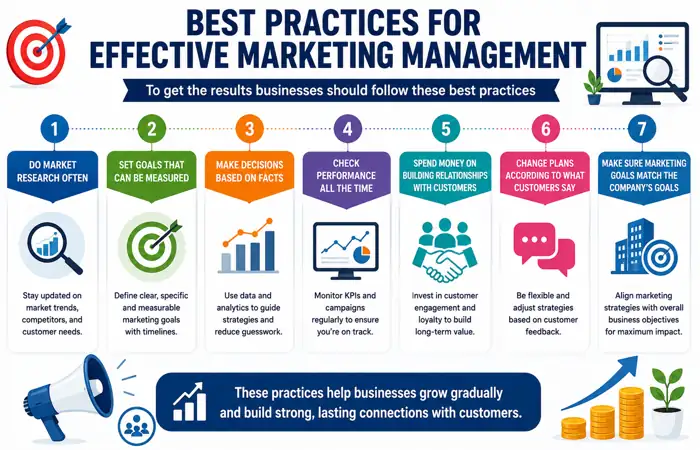
To get the results businesses should:
1. Do market research often.
2. Set goals that can be measured.
3. Make decisions based on facts.
4. Check performance all the time.
5. Spend money on building relationships with customers.
6. Change plans according to what customers say.
7. Make sure marketing goals match the company’s goals.
These practices help businesses grow gradually and have connections with customers.
Frequently Asked Questions (FAQs)
What do marketing management people do?
The marketing management people carry out number of activities such as planning, organizing, directing and controlling the marketing function. This is being done to achieve the goals of the organization in marketing and to ensure that the customers are satisfied.
Why do we need to plan things in marketing management?
Planning is important because it helps companies find opportunities to use their money and people wisely and come up with good plans that help the company do well.
What is the main job of marketing management people?
The main job of marketing management people is to make sure all the marketing work is done well understand what the customers want and make sure the products and services are what people want to buy.
What are these marketing control things?
Marketing control things are, like checking and measuring how well the marketing team is doing to make sure they are doing a job and getting the results the company wants.
How does putting marketing activities in order make things better?
When we put all the marketing activities in order it means that everyone and everything works together smoothly which makes the marketing campaigns work better and gives us results.
Conclusion
Marketing management is really important for businesses to grow. It helps them make a plan get things done tell people what to do and check if everything is working well. When businesses do these things they can understand what people want use their money wisely and do a job of selling things.
Marketing management does not mean businesses will be successful away.. It gives them a way to make good choices deal with changes in the market and become friends with their customers over time. Businesses that always do these things are usually better, at competing with companies and growing in a world where things are always changing.