

Jun 12, 2026
Sep 16, 2026
Pricing function of marketing is arguably one of the most significant activities performed in any business. Pricing has to do with what amount of money customers have to pay for the product or services and it has direct impact on sales, profitability, aligning of the market and perception of customers.
Table of Contents
This Article Is Part of the Marketing Resource Hub
Explore more guides, tutorials, strategies, and marketing resources inside our
Marketing Resource Hub .
The rivalry in the digital marketplace today is very high so companies need to use the best marketing pricing strategies that not only make the company achieve its sales volume, it should also make enough profits and satisfy the market perception and position. Students studying the basics of marketing and business owners wanting to know how to take pricing decisions will need to appreciate pricing function.
What Is Pricing Function of Marketing?
The valuing function of marketing refers to the founding of the amount of money a customer must pay to own a creation or service.
Rating is the part of the four old-style aspects of the advertising mix (Product, Price, Place and Promotion). In difference with the other marketing doings that cost, price itself has a revenue function.
An elegant pricing strategy supports businesses:
- Recover production costs
- Generate profits
- Position products in the market
- Attract target customers
- Compete effectively
- Increase long-term business growth
Why Pricing Matters in Marketing
Customers use price as a variable when buying products. The wrong pricing can lead to the loss of business, while wrong price could also lead to a reduction in profit and damage to brand name. Today’s customers compare prices on several websites before they make their purchase, hence the price should be set in line with the expectations of the customer and in line with the business goals.
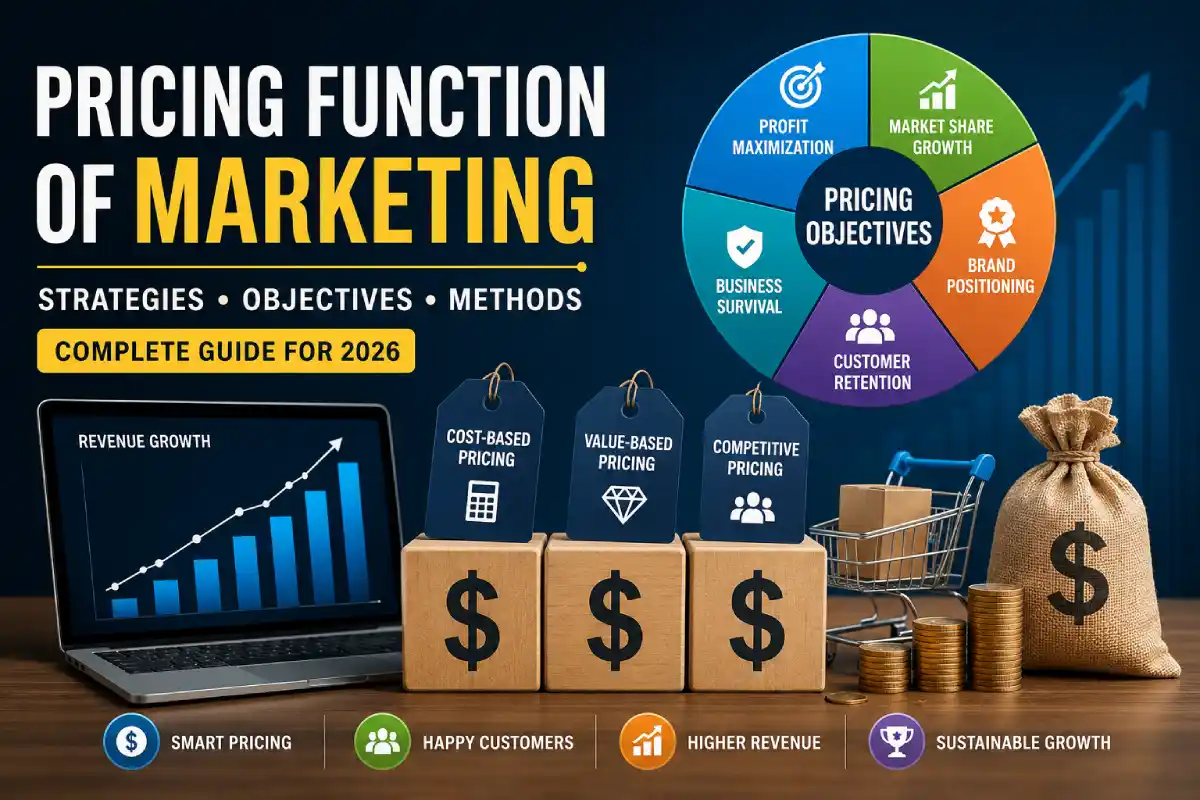
Key Pricing Objectives in Marketing
Before setting prices, organizations establish specific pricing objectives.
1. Profit Maximization
Many of the businesses aim is to generate the maximum possible income from apiece sale.
Suitable for:
- Premium brands
- Luxury products
- Specialized services
2. Market Share Development
Companies may set the lower prices to attract the more customers & gain the market share.
Suitable for:
- New businesses
- Startups
- Competitive industries
3. Survival
During financial downturns or competitive pressure, businesses may reduce values to maintain processes.
4. Brand Positioning
Pricing can communicate quality and exclusivity.
Examples:
- Apple products
- Luxury fashion brands
- Premium automobiles
5. Customer Retention
Modest pricing helps maintain customer faithfulness and reduce purchaser churn.
Common Pricing Methods in Marketing
Businesses use various pricing methods depending on their goals and industry.
Cost-Based Pricing
Cost based pricing is one of the simplest and most widely used pricing methods.
Formula:
Price = Total Cost + Desired Profit Margin
Example
| Item | Amount |
| Manufacturing Cost | $50 |
| Marketing Cost | $10 |
| Distribution Cost | $5 |
| Total Cost | $65 |
| Desired Profit | $15 |
| Final Price | $80 |
Advantages:
- Easy to calculate
- Ensures profit margin
- Suitable for stable industries
Disadvantages:
- Ignores competitor pricing
- Doesn’t consider customer demand
Value-Based Pricing
Prices are determined by perceived customer value rather than production costs.
Value-based pricing focuses on the perceived value a product delivers to customers rather than solely on production costs. According to Harvard Business Review, companies that align pricing strategies with customer value perception often achieve stronger profitability and long-term competitive advantages.
Examples:
- Software subscriptions
- Consulting services
- Extra goods
Competition-Based Rating
Businesses set prices according to competitor pricing levels.
Examples:
- E-commerce stores
- Retail chains
- Telecommunications companies
Dynamic Pricing
Prices change the based on the demand, seasonality, or market circumstances.
Examples:
- Airline tickets
- Hotel bookings
- Ride-sharing services
Pricing Strategies
The Modern businesses syndicate traditional pricing approaches with data-driven strategies.
Assessment of Popular Pricing Strategies
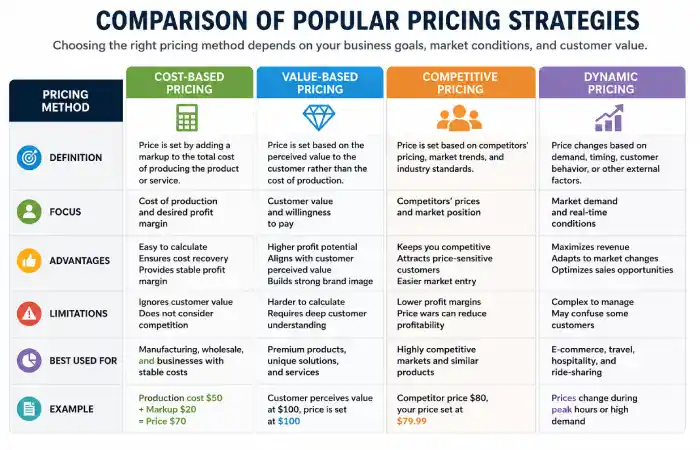
| Pricing Strategy | Best For | Main Goal |
| Cost-Based Pricing | Manufacturing | Guaranteed profit |
| Penetration Pricing | New products | Rapid adoption |
| Premium Pricing | Luxury brands | High margins |
| Competitive Pricing | Retail businesses | Market competitiveness |
| Dynamic Pricing | Travel & eCommerce | Revenue optimization |
| Bundle Pricing | SaaS & subscriptions | Increase average order value |
Product Pricing Examples
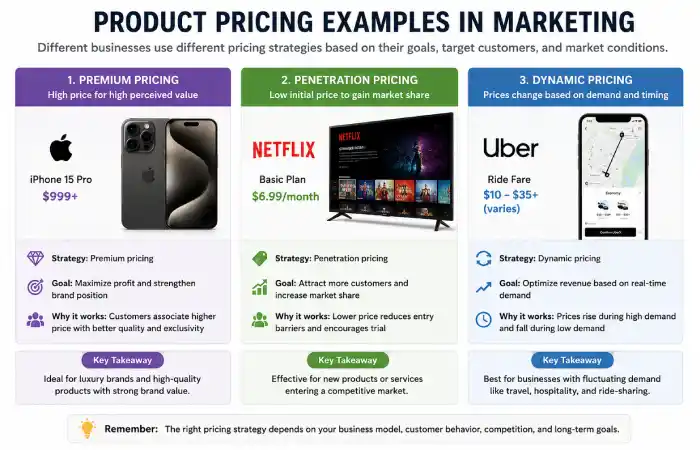
Real-world instances help illustrate how pricing the whole thing in repetition.
Example 1: Smartphone Product
A company releases a new premium smartphone at an inflated price in the first instance in order to tap the initial users.
Strategy:
- Premium pricing
- Brand positioning
- High-margin focus
Example 2: Cyclosis Service
A cyclosis platform offers a low introductory payment rate.
Strategy:
- Penetration pricing
- Customer acquisition
- Market expansion
Example 3: Online Retailer
An online retailer adjusts prices during holiday seasons.
Strategy:
- Dynamic pricing
- Demand-based pricing
- Revenue maximization
How Pricing Affects the Marketing Mix
Pricing interacts with every other marketing function.
| Marketing Function |
Pricing Impact |
| Product | Determines perceived value |
| Promotion | Influences promotional offers |
| Place | Affects distribution margins |
| Branding | Shapes market positioning |
A premium product requires premium pricing, while budget products require affordable pricing strategies.
Common Pricing Mistakes Businesses Make
Even successful companies can make pricing errors.
Setting Prices Too Low
Consequences:
- Reduced profits
- Perceived lower quality
- Difficulty scaling operations
Ignoring Participant Prices
Businesses that fail to monitor the competitors may lose the market share.
Focusing Only on Costs
The Customers buy based on apparent value, not just production costs.
Lack of Pricing Reviews
Market conditions change constantly, making regular pricing analysis essential.
Troubleshooting Pricing Challenges
Problem: Low Sales Despite Quality Products
Possible Causes:
- Price too high
- Weak value proposition
- Poor market positioning
Solution:
- Conduct competitor analysis
- Test alternative pricing models
- Improve product messaging
Problem: High Sales but Low Profit
Possible Causes:
- Underpricing
- Rising operational costs
Solution:
- Review pricing objectives
- Implement value-based pricing
- Increase average order value through bundles
Problem: Customers Compare Prices Excessively
Solution:
- Differentiate through quality
- Offer better service
- Highlight unique benefits
Future Trends in Marketing Pricing (2026)
Several trends are transforming pricing decisions:
- AI-powered pricing optimization
- Real-time competitor monitoring
- Personalized pricing offers
- Subscription-based business models
- Prognostic demand prediction
Companies which have adopted dynamic pricing are well-placed to achieve substantial gains over the coming years.
FAQ’s
Why pricing is important in marketing?
Pricing has an impact on revenue, profits, perceived value, the competition and customer purchasing behaviour.
Which are the most important marketing pricing strategies?
The most shared marketing pricing strategies are cost-based pricing, value-based pricing, competition-based pricing and dynamic pricing.
What is cost-based pricing?
The final selling price is set by summing the costs of creating the product/service and the intended profit to the amount.
Which one is the best strategy?
The best marketing strategy depends on business objectives, market situation, customer expectations and competitive situation.
Conclusion
The role of the marketing pricing function in business is vital. Efficient pricing not only covers the costs incurred in providing the product or service but it also impacts on how the customer views the product, its brand, its aligning in the market and eventually its profitability. A sound understanding of marketing objectives, methods of pricing in marketing and contemporary pricing approaches will help to make brainy pricing decisions which ease on-going business accomplishment. As 2026 unfolds, businesses are making use of data analytics, AI pricing tools and customer insights more than ever to enable informed pricing decisions. Organizations that keep review and adjust their pricing strategies, will find themselves competitive in the market.