


Last Updated: June 19, 2026
Table of Contents
Introduction
Every profitable business trust uses marketing effectively to attract clients, earn trust, and make money. Whether the business operates in a huge or tiny industry, or is located anywhere around the world, marketing is used by companies to present their unique selling points and be a factor in constantly changing marketplaces.
This Article Is Part of the Marketing Resource Hub
Explore more guides, tutorials, strategies, and marketing resources inside our
Marketing Resource Hub .
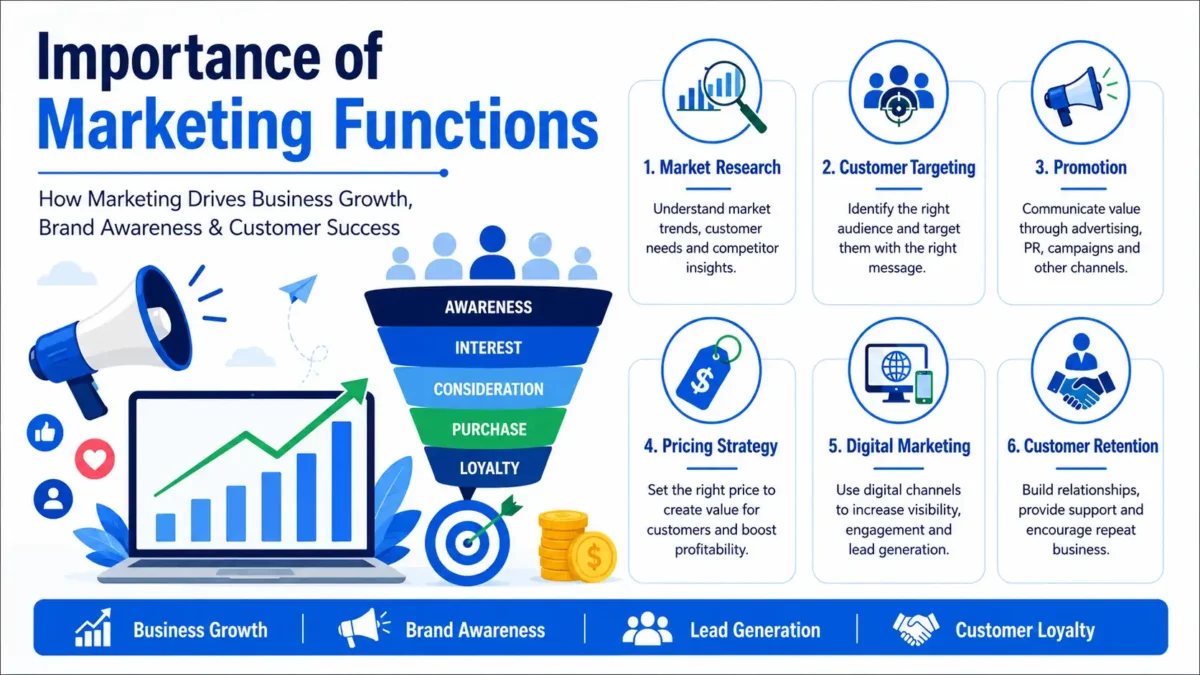
Understanding the importance of marketing functions, concepts and activities are important for business owners, managers, industrialists and marketers. The combined result of these activities helps to ascertain customers’ requirements, help in sales process, develop demands and positioning of brand. Marketing has become an important success factor for any business.
Why Marketing Is Important for Modern Businesses

Marketing is not simply advertising; it plays an integral role in allowing businesses to determine who their target market is and cater to new consumer habits. According to the American Marketing Association (AMA), marketing involves creating, communicating, delivering and exchanging offerings that provide value to customers and society.
Some key reasons why marketing is important include:
- Creates awareness about products and services
- Builds customer trust and credibility
- Generates qualified leads
- Supports sales growth
- Improve customer retention
- Strengthens brand recognition
- Help businesses compete effectively
If there’s no marketing, there will be no customers even if there’s a high-quality product.
Core Marketing Functions and Their Purpose
| Marketing Function | Primary Purpose | Business Benefit |
| Market Research | Understand customer needs | Better decision-making |
| Product Development | Align offerings with demand | Improved customer satisfaction |
| Pricing Strategy | Determine market value | Increased profitability |
| Promotion | Communicate value | Higher brand awareness |
| Distribution | Deliver products efficiently | Improved accessibility |
| Customer Service | Maintain relationships | Better retention rates |
| Digital Marketing | Online visibility and engagement | Wider audience reach |
These activities represent the core functions of marketing, helping businesses connect products with customer needs while supporting long-term growth. The significance of this comparison is evident in the illustration of how different marketing functions work together for the success of business.
Benefits of Marketing Functions
Better Understanding of Customers
Marketing has a great many functions. Market research is perhaps the most useful. To understand how different activities contribute to business success, explore the functions of marketing and their role in creating customer value. Companies can gather responses, analyse behaviour, and identify emerging trends.
This information helps companies:
- Develop relevant products
- Improve customer experience
- Address market gaps
- Reduce business risks
Increased Brand Awareness
Customers buy what they know and trust, which is where marketing plays a huge part. It keeps the brand in their sight on different sites such as their website, through email campaigns, social networks and search engines.
Consistent marketing creates understanding and strengthens brand differentiation over time.
Improved Revenue Opportunities
Marketing enables you to find potential buyers throughout the buyer journey.
Effective campaigns can:
- Generate leads
- Increase conversions
- Encourage repeat purchases
- Improve customer lifetime value
Marketing Role in Business Growth
If there’s no customer, there’s no growth. Customer acquisition and retention are the two fundamentals to business growth. Different ways to suit each business goal. Marketing will also enable you to lead the customer through a specified, smooth process, from initial awareness to the sale.
Growth Areas Influenced by Marketing
Customer Acquisition
Marketing is based on finding new audiences and then approaching and relating to them using various techniques.
Examples include:
- Search engine optimization (SEO)
- Content marketing
- Paid advertising
- Social media campaigns
Customer Retention
In general, the cost of acquiring a new customer is greater than retaining the customer. Ongoing marketing efforts will maintain the customers’ interests:
- Email newsletters
- Loyalty programmes
- Educational content
- Customer support communication
Market Expansion
When a business enters a new country or market it can reduce the risks of failure by using market research and positioning strategy.
Business Marketing Strategies That Support Marketing Functions
All the different marketing tools implemented help underline and reaffirm specific dimensions of the business strategy.
Common Business Marketing Strategies
| Main Objective | Strategy |
| Organic website visibility | SEO |
| Customer retention | Email Marketing |
| Lead generation | Paid Advertising |
| Education and trust building | Content Marketing |
| Audience engagement | Social Media Marketing |
| Brand awareness | Influencer Marketing |
| Customer acquisition | Referral Marketing |
The ideal way would involve using various methods instead of one channel.
Importance of Promotion in Marketing
Promotion is one of the most visible marketing functions. It ensures customers know about products, services, offers, and brand value.
Promotional activities may include:
- Advertising
- Public relations
- Email campaigns
- Social media marketing
- Events and sponsorships
- Search engine marketing
Advantages of Effective Promotion
- Increases visibility
- Builds credibility
- Encourages purchasing decisions
- Supports product launches
- Improves competitive positioning
Limitations to Consider
Promotion alone cannot guarantee business success.
Businesses still need:
- Quality products
- Competitive pricing
- Strong customer service
- Effective distribution channels
The best and most effective marketing is when all functions work together.
Marketing Workflow: How Marketing Functions Work Together
The following workflow shows how marketing functions support the customer journey.
Marketing Function Workflow
- Conduct market research
- Identify customer needs
- Develop products or services
- Set pricing strategy
- Choose distribution channels
- Launch promotional campaigns
- Measure performance
- Gather customer feedback
- Optimise future marketing activities
This cycle enables companies to achieve continual gains and to respond effectively to shifts in the marketplace.Successful execution of these activities often depends on effective marketing management, which helps businesses plan, organise, implement and evaluate marketing strategies.
Expectations Management: What Marketing Can and Cannot Do

The most important thing about growth is not to have over-expectations. Marketing is a major factor for growth.
What Marketing Can Achieve
- Improve visibility
- Generate awareness
- Increase website traffic
- Supporting lead generation
- Strengthening customer relationships
What Marketing Cannot Guarantee
- Instant sales growth
- Viral success
- Market leadership overnight
- Long-term loyalty without product quality
Usually there needs to be continuous work and well-planned actions before real gains will be apparent.
Common Challenges in Marketing Functions
Companies face a variety of problems when it comes to applying marketing activities.
Limited Budget
Smaller businesses may have fewer resources available for campaigns and technology.
Rapid Market Changes
Consumer demands can change rapidly and they require ongoing adaptation.
Increasing Competition
Market entry for rivals is facilitated by digital environments.
Data Privacy Regulations
New rules and regulations regarding data privacy and security will have to be adopted by organizations. Understanding these challenges will allow us to develop more effective marketing plans.
Frequently Asked Questions.
Why are marketing functions significant?
The significance of marketing functions would consist of understanding customer needs, developing brand recognition, proper positioning of product features, creating value and enabling the organization’s sustained existence via communication and strategic development.
Why are marketing functions vital for business growth?
Marketing helps an organization to obtain and maintain customers and build an identity of the brand as well as generate revenue.
What are the core marketing functions?
The core marketing functions are market research, product development, promotion, pricing, distribution, customer service and digital marketing.
How is promotion integral for marketing functions?
Promotion contributes to business success by communication the benefits and value of a product, in turn enabling better awareness.
Can marketing determine business success?
No. Marketing helps businesses grow and being recognized in their industry. However, an organization’s success also depends on certain other significant aspects such as product quality, effective pricing, customer satisfaction, efficiency etc.
Conclusion
The significance of marketing functions goes beyond mere advertisement and promotion. Marketing allows companies to know their customers, develop their brand image, back the efforts of the sales department and create opportunities for enduring success. Every aspect of marketing, from research and pricing to promotion and customer care, helps a business to expand. A business with effective marketing will find it easier to react and adapt to customer demand and relationships. These also help the business to meet its goals in the future.
“`html
Functions of Marketing Topic Cluster
“`