
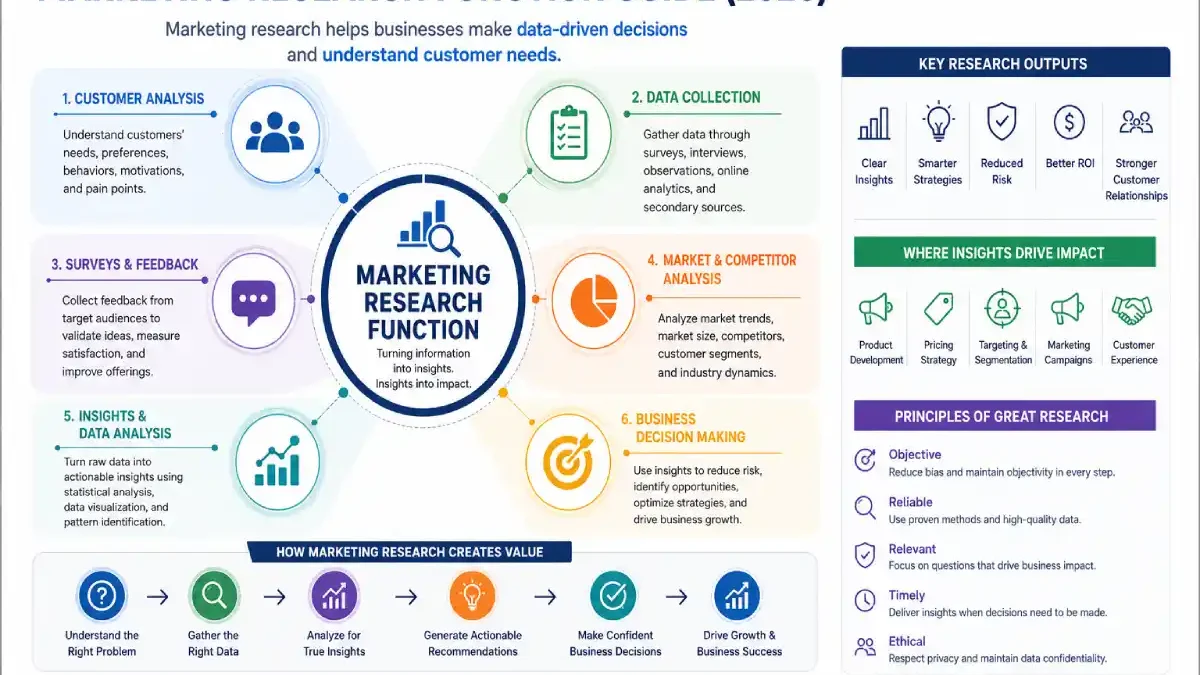

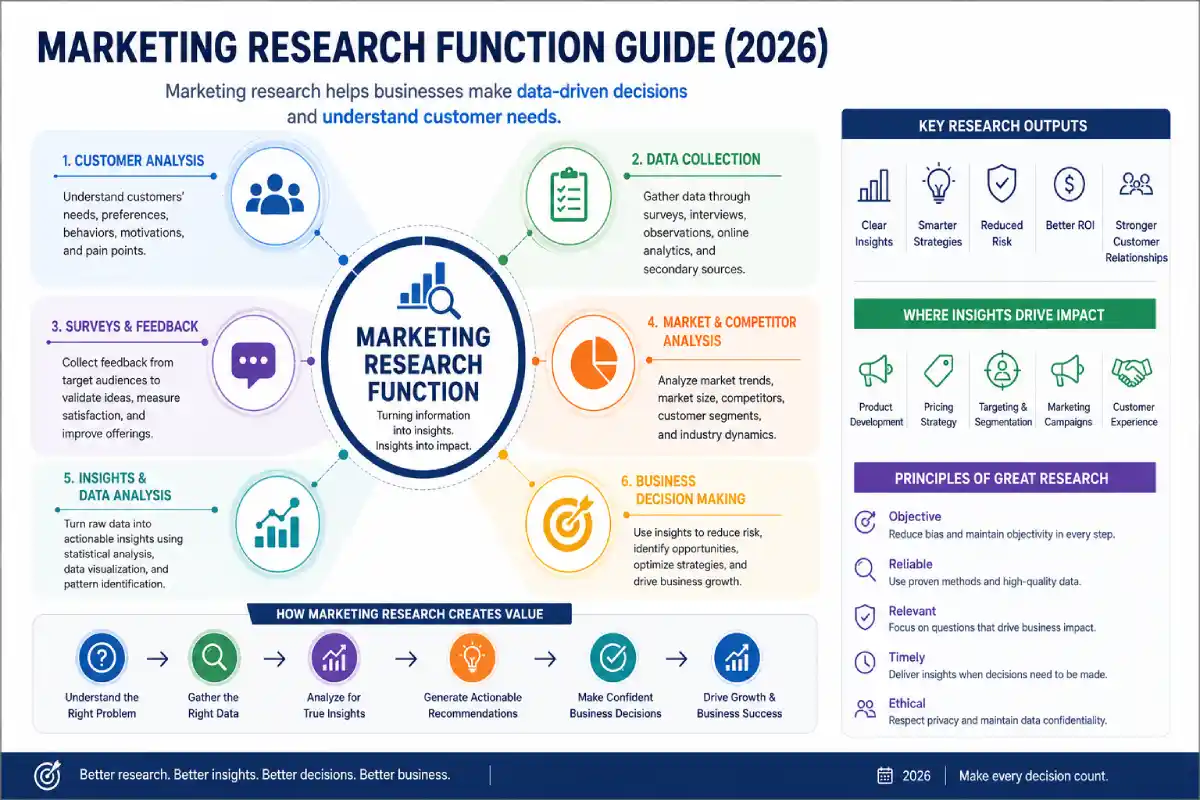


The publicity research role assists corporations in sympathetic their customers, identifying market opportunities and directing decision making. If this is a commercial gaining a new product, improving an existing service, or entering a new market, marketing research delivers data that a commercial can use to minimize risk and boost their chances of success.
Table of Contents
This Article Is Part of the Marketing Resource Hub
Explore more guides, tutorials, strategies, and marketing resources inside our
Marketing Resource Hub .
In the in the competitive business environment of today, firms that are more able to understand the consumer ‘s attitude and respond to the changes in the market trends by being ahead of the competition are those who spend in effective market research. This guide addresses the marketing research function, its importance, techniques, procedures, pitfalls and optimum schemes of the year 2026.
What Is the Marketing Research Function?
The marketing research function: has been defined as a systematic design, collection, analysis, and reporting of data and answers relevant to a specific marketing state facing a company.
The biggest function of accounts is delivering reliable information in support of selling decisions rather than estimates.
Marketing research helps organizations answer questions such as:
-
- Who are our customers?
- What do customers need?
- Why are sales increasing or declining?
- How do competitors attract buyers?
- Which advertising strategies work best?
Answering these will also help businesses identify areas for intervention and these questions can inform targeted efforts by the company.
Why Marketing Research Is Important
Marketing investigate serves as the foundation of successful advertising strategies.
Key Benefits
Better Customer Understanding
Research supports the businesses to understand the customer partialities, motivations, and buying behaviour.
Compact Business Risk
Companies can test the ideas before investing the significant possessions.
Improved Product Development
Research reveals the customer pain points & openings for novelty.
Stronger Inexpensive Benefit
Businesses can screen competitors and classify market gaps.
More Effective Marketing Campaigns
Data-driven campaigns generally achieve better engagement and conversion rates.
Core Functions of Marketing Research
Marketing research performs several essential functions within an organization.
1. Consumer Behaviour Research
Understanding customer behaviour is one of the most important research functions.
This includes:
- Purchasing habits
- Customer preferences
- Brand perception
- Decision-making factors
Consumer behaviour investigate helps industries tailor crops and marketing letters to their target spectators.
2. Market Chance Identification
Research helps identify:
- Emerging trends
- New customer segments
- Untapped markets
- Growing occasions
Companies can use these insights to develop the inexpensive policies.
3. Product Development Support
Before launching a product, businesses conduct research to determine:
- Customer demand
- Desired features
- Pricing expectations
- Product positioning
This reduces the likelihood of product failure.
4. Competitive Analysis
Marketing research monitors competitors by evaluating:
- Product offerings
- Pricing strategies
- Marketing campaigns
- Customer reviews
Competitive insights help businesses improve their own market position.
5. Sales Forecasting
Research data helps estimate future demand and revenue potential.
This assists with:
- Inventory planning
- Budget allocation
- Resource management
6. Marketing Performance Evaluation
Businesses use research to measure:
- Campaign effectiveness
- Customer satisfaction
- Brand awareness
- Return on investment (ROI)
Marketing Research Process
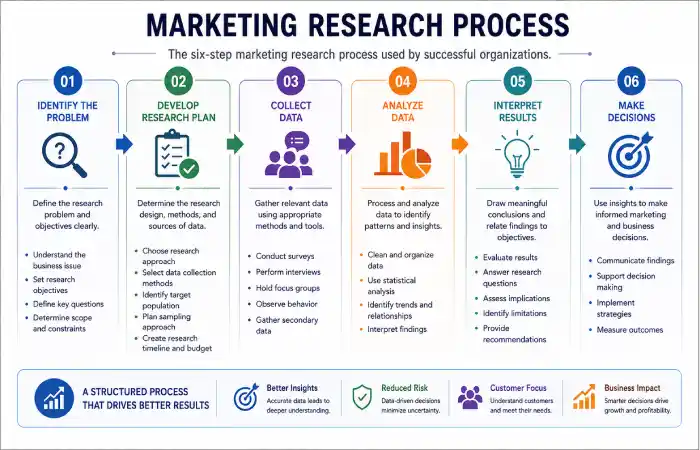
Successful research typically follows a structured process.
| Stage | Purpose |
| Problem Identification | Define research objectives |
| Research Design | Select methodology |
| Data Collection | Gather information |
| Data Analysis | Identify patterns and insights |
| Reporting | Present findings |
| Decision Making | Implement actions |
Following this process ensures accuracy and consistency.Businesses increasingly rely on data-driven research to understand customer behavior and market trends. According to Qualtrics Research Resources, effective market research helps organizations make informed decisions, improve customer experiences, and reduce business risk.
Market Research Methods
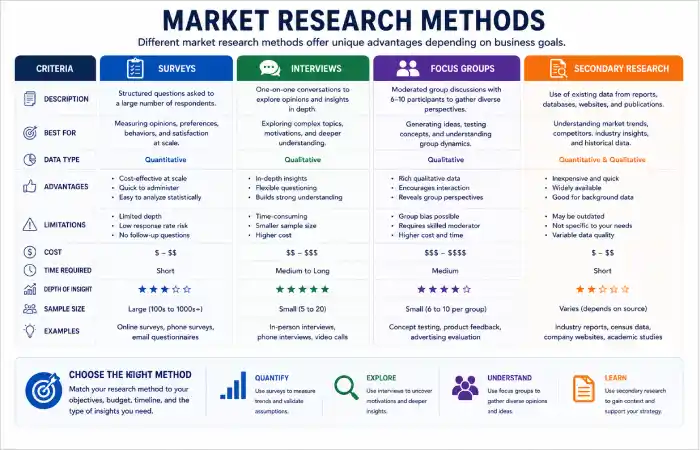
Different methods are used depending on research goals.
Primary Research
Primary research collects original data directly from participants.
Examples include:
- Surveys
- Interviews
- Focus groups
- Observations
- Product testing
Secondary Research
Secondary research uses existing information.
Sources include:
- Industry reports
- Government statistics
- Academic studies
- Company reports
Comparison of Research Methods
| Method | Cost | Speed | Accuracy |
| Surveys | Low | Fast | High |
| Interviews | Medium | Moderate | Very High |
| Focus Groups | Medium | Moderate | High |
| Observations | Medium | Slow | High |
| Secondary Research | Low | Very Fast | Moderate |
Consumer Behavior Research in 2026
Consumer behaviour research has evolved significantly due to digital technologies and artificial intelligence.
Businesses now analyze:
- Website behavior
- Search trends
- Social media interactions
- Purchase history
- Customer feedback
2026 Consumer Insight Trends
| Trend | Impact |
| AI-Powered Analytics | Very High |
| Predictive Consumer Modeling | High |
| Real-Time Customer Insights | High |
| Voice Search Analysis | Medium |
| Personalization Research | High |
Organizations using advanced analytics gain deeper customer insights and faster decision-making capabilities.
Market Analysis Techniques
Marketing professionals use several techniques to evaluate markets.
SWOT Analysis
Examines:
- Strengths
- Weaknesses
- Opportunities
- Threats
Competitor Benchmarking
Compares business performance against competitors.
Customer Segmentation
Groups customers based on:
- Demographics
- Interests
- Behavior
- Location
Trend Analysis
Identifies future market opportunities and threats.
Marketing Research Tools Comparison
| Tool Category | Main Purpose | Best For |
| Survey Platforms | Collect customer feedback | Small businesses |
| Analytics Software | Track user behavior | E-commerce |
| CRM Systems | Customer insights | Sales teams |
| Social Listening Tools | Brand monitoring | Marketing teams |
| AI Research Platforms | Predictive analysis | Enterprise organizations |
These tools help industries gather accurate data and recover executive.
Common Marketing Research Challenges
Poor Sample Selection
Problem:
Research participants do not represent the target audience.
Solution:
Use diverse and representative samples.
Low Survey Response Rates
Problem:
Insufficient responses reduce reliability.
Solution:
Offer incentives and simplify surveys.
Data Overload
Problem:
Too much information creates confusion.
Solution:
Focus on actionable metrics and key objectives.
Biased Questions
Problem:
Leading questions distort results.
Solution:
Use neutral and objective wording.
Best Practices for Effective Marketing Research
Define Clear Objectives
Know exactly what information is needed.
Combine Multiple Research Methods
Use both primary and secondary research.
Leverage Technology
Modern analytics tools improve speed and correctness.
Monitor Market Changes Regularly
Customer preferences can change quickly.
Turn Insights into Action
Research only creates value when results influence choices.
FAQ’s
What is the marketing research function?
Marketing research function is a combination of activities to collect, interpret, analyze, and report the information about the market, in order to aid business and marketing decisions.
Why is marketing research important?
It helps businesses understand customers, reduce risks, identify opportunities, and improve marketing effectiveness.
What are the main types of marketing research?
The two primary types are primary research and secondary research.
How does marketing research help product development?
Uncovers customer problems, validates product ideas and optimizes product-market fit.
What tools are commonly used for marketing research?
Survey tools, analytics tools, CRM tools, social listening tools, and AI-enabled investigate stages.
Conclusion
Marketing research is still the most beneficial element of 2026 marketing. Collecting reliable information about the customer, competition, and the overall industry enables a company to make better decisions that will result in higher profits and future growth. As 2026 progresses with the aid of real-time consumer feedback and AI-driven analysis, marketing research will have improved value for organization ‘s looking for to achieve sustainable achievement.