


Last Updated: June 19, 2026
Table of Contents
Introduction
Understanding the Selling Function in Marketing is important for students, business owners, marketers, and sales specialists. While advertising involves researching customer requirements, developing goods, setting prices, and encouraging contributions, selling plays a direct role in changing interested predictions into paid clients.
This Article Is Part of the Marketing Resource Hub
Explore more guides, tutorials, strategies, and marketing resources inside our
Marketing Resource Hub .
In today’s competitive business situations, organisations use several selling tactics to connects value, build belief, address buyer concerns, and generating revenue. Whether through face-to-face conferences, online discussions, retail interactions, or digital frequencies, selling remains one of the most significant functions within the advertising process.
Definition Snippet
The Selling Function in Marketing mentions to the process of recognizing potential customers, presenting products or services, overcoming objections, negotiating terms, and closing sales. It acts as the joining between advertising efforts and actual business incomes.
What Is the Selling Function in Marketing?
The selling function is the fragment of marketing responsible for inspiring customers to purchase products or facilities. It includes direct interaction among sellers and purchasers with the objective of satisfying customer requirements while realizing organisational goals.
Selling is not limited to pushing goods. Modern selling aims on understanding purchasing problems and offering appropriate answers.
Important objectives include:
- Identifying potential customers
- Understanding customer requirements
- Demonstrating product value
- Building customer relationships
- Generating revenue
- Encouraging repeat purchases
Why the Sales Function of Marketing Matters
The sales function of marketing transforms marketing strategies into measurable business outcomes. Without effective selling, even excellent products may struggle to achieve market success.
Benefits of Effective Selling
| Benefit | Impact on Business |
| Revenue Generation | Creates direct income |
| Customer Associations | Builds loyalty and faith |
| Market Response | Provides purchaser insights |
| Product Awareness | Growths visibility |
| Good Advantage | Discriminates offerings |
| Customer Holding | Encourages repeat consumptions |
An effective sales function helps businesses appreciate changing customer preferences and familiarize their strategies therefore.
Individual Selling in Marketing: Understanding the Human Connection
What Is Individual Selling?
Personal selling in marketing denotes to direct communication between a salesperson and a prospective customer. It is one of the most personalised forms of statements in the marketing mixer.
Examples include:
- Retail sales representatives
- Financial advisors
- Insurance agents
- Business-to-business sales executives
- Real estate consultants
- Advantages of Personal Selling
| Advantage | Explanation |
| Personalised Communication | Messages can be tailored to individual needs |
| Immediate Feedback | Questions can be answered instantly |
| Strong Relationships | Builds long-term customer trust |
| Better Conversion Rates | Often more effective for complex products |
| Flexibility | Sales approach can be adjusted in real time |
Limitations of Personal Selling
| Limitation | Explanation |
| Higher Cost | Requires trained personnel |
| Limited Reach | Fewer customers reached at once |
| Time Intensive | Sales cycles may be lengthy |
Core Selling Activities in Marketing
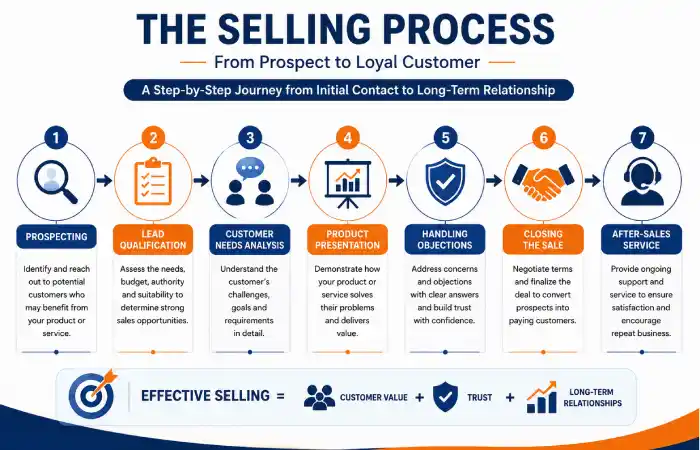
The most imperative selling activities in advertising follow a organized process designed to leader clients from awareness to acquisition.
Prospecting
Sales teams identify possible customers who may advantage from a product or provision.
Lead Qualification
Not every prospect becomes a customer. Qualification helps determine purchase intent, budget, and suitability.
Customer Needs Analysis
Sales professionals gather information about customer challenges and expectations.
Product Presentation
The product’s features and benefits are demonstrated to show how it solves customer problems.
Handling Objections
Customers often have concerns about price, excellence, reliability, or implementation. Speaking these concerns is a critical vending activity.
Final the Sale
The salesperson helps the client make a final purchasing decision.
After-Sales Facilities
Support continues after the business to encourage satisfaction and loyalty.
Direct Selling Policies Used by Businesses
Understanding Direct Selling Strategies
Direct selling policies include selling crops directly to customers without relying seriously on outdated retail intermediaries.
Popular methods include:
- Face-to-face selling
- Home demonstrations
- Social selling
- Online consultations
- Network marketing
- E-commerce assisted selling
- Common Direct Selling Approaches
| Strategy | Description | Suitable For |
| Consultative Selling | Focuses on solving customer problems | B2B services |
| Relationship Selling | Builds long-term trust | Financial services |
| Solution Selling | Provides customised solutions | Technology products |
| Value-Based Selling | Emphasises benefits and ROI | Premium products |
| Social Selling | Uses social media engagement | Online businesses |
Businesses increasingly combine traditional and digital direct marketing methods to improve customer appointment.
Workflow: How the Selling Function Works in Promotion
Step 1: Market Investigation
Businesses recognize customer needs, favourites, and market occasions.
Step 2: Principal Generation
Possible customers are recognized through marketing, referrals, websites, and social television.
Step 3: Prospect Assessment
Sales teams assess client suitability and acquiring potential.
Step 4: Buyer Engagement
Original communication begins over calls, meetings, emails, or digital networks.
Step 5: Product Demonstration
The value scheme is explained and verified.
Step 6: Negotiation
Valuing, features, timelines, and service conditions are deliberated.
Step 7: Sale Completion
The customer completes the purchase.
Step 8: Relationship Organization
Ongoing funding strengthens purchasers’ loyalty and replication of business.
Traditional Selling vs Modern Relationship Selling
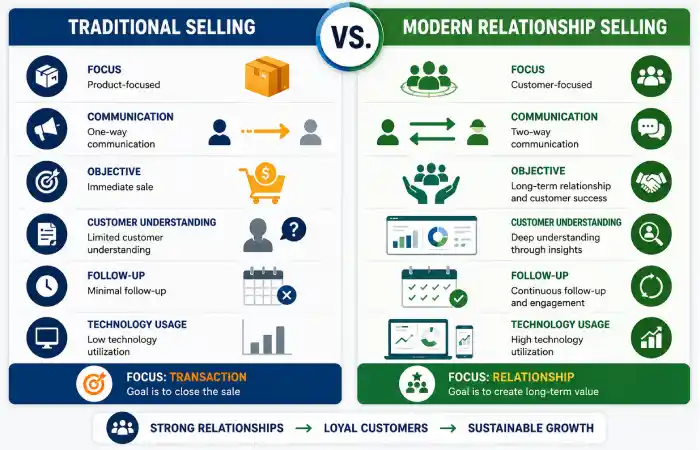
| Factor | Traditional Selling | Modern Relationship Selling |
| Focus | Product | Customer Needs |
| Communication | One-Way | Two-Way |
| Objective | Immediate Sale | Long-Term Relationship |
| Customer Understanding | Limited | Extensive |
| Follow-Up | Minimal | Continuous |
| Technology Usage | Low | High |
Modern marketing progressively favours relationship-based selling because clients expect personalised experiences and ongoing provision. According to the HubSpot Sales Resources, relationship-based selling helps businesses improve customer trust, increase retention, and create long-term revenue opportunities through personalized interactions.
Prospects: What Selling Can and Can’t Realize
Many businesses expect selling efforts to deliver immediate results. However, realistic expectations are important.
- What Selling Can Achieve
- Improve customer awareness
- Increase conversions
- Build relationships
- Generate feedback
- Strengthen brand trust
- What Selling Cannot Guarantee
- Instant customer loyalty
- Immediate market dominance
- Universal customer acceptance
- Success without quality products
- Growth without marketing support
Successful selling works best when combined with effective product development, pricing, promotion, and customer service.
Common Challenges in the Selling Function
Businesses frequently encounter obstacles such as:
Increasing Competition
Customers often compare multiple options before purchasing.
Changing Consumer Behaviour
Digital platforms have transformed buying habits.
Price Sensitivity
Customers seek maximum value for their spending.
Information Overload
Buyers often research extensively before engaging with sales teams.
Maintaining Customer Trust
Trust involves consistent announcement and reliable service.
Addressing these tasks requires ongoing training, knowledge adoption, and customer-focused policies.
Best Practices for Actual Selling
Businesses can recover selling consequences by:
- Understanding customer needs thoroughly
- Listening actively during conversations
- Providing honest product information
- Using data-driven sales insights
- Following up consistently
- Concentrating on long-term relations
- Offering brilliant after-sales provision
These practices contribute to buyer gratification and supportable business growth.
Frequently Asked Queries
What is the selling function in marketing?
The selling purpose involves actions that persuade clients to purchase products or facilities. It includes prospecting, communication, negotiation, closing sales, and purchaser support.
Why is personal selling in marketing significant?
Personal selling allows industries to provide customised data, address concerns directly, and figure out stronger buyer relationships.
What is the key selling activities in marketing?
Major activities include prospecting, lead criteria’s, customer relations, product performance, objection treatment, closing sales, and after-sales facility.
What are direct selling policies?
Direct selling strategies involve selling products directly to customers through personal communication, digital channels, debates, demonstrations, or social selling methods.
How does the sales function of marketing support commercial growth?
The sales function generates revenue, recovers customer relationships, gathers market response, and helps organisations achieve their advertising objectives.
Conclusion
This guide on the Selling Function in Marketing establishes how selling attends as a crucial link between advertising efforts and customer procurements. Through effective individual selling in marketing, strategic selling happenings in marketing, and client-focused direct selling policies, organisations can improve buyer satisfaction while supporting long-term growth. The most effective business view selling not only as closing transactions but as construction of meaningful relationships that create lasting value for both customers and organisations.