


Last Updated: June 19, 2026
You know when you click the send button. Then you think something is not quiet, right? Maybe you sent the message to the person, or you forgot to add a file. Maybe you saw a big mistake in the message after it had already gone from your outbox. If this has happened to you do not worry about it. You are not the one this has happened to. Lots of people have done the thing with their messages.
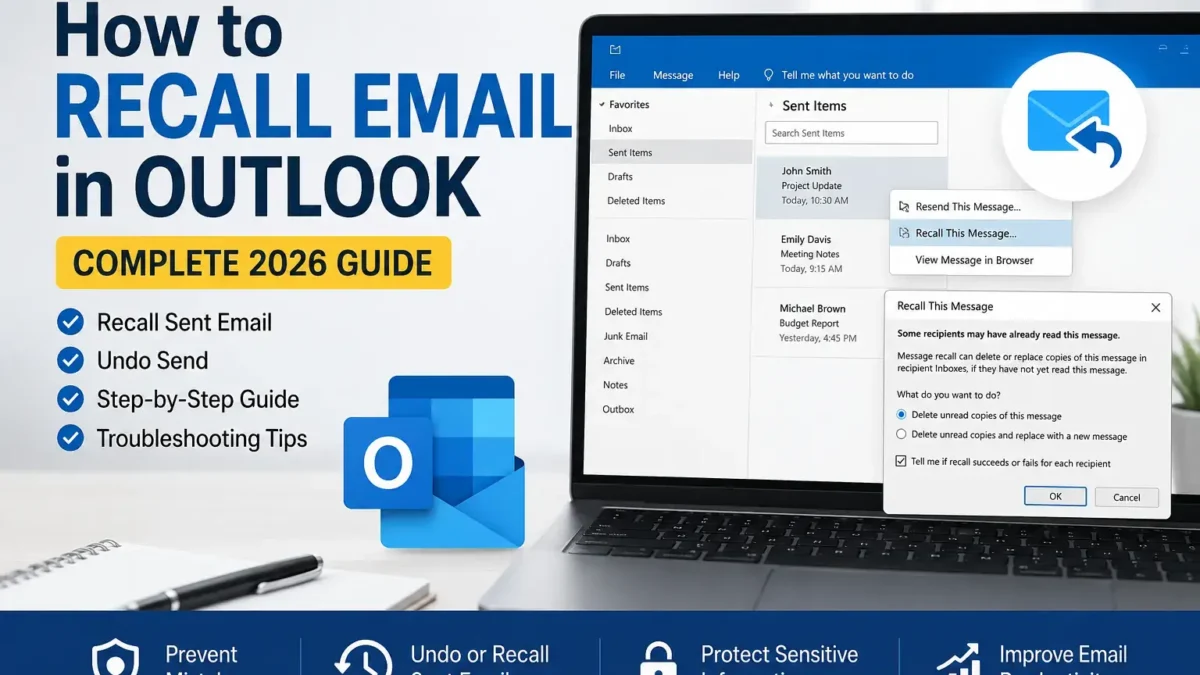
Being How to recall an email in Outlook will keep you from a potentially awkward blunder, prevent the transmission of confidential information to the wrong recipient and retain on-the-job knowledge. Microsoft Outlook includes a built in message recall feature that lets users try to recall or change sent email under given conditions.
However, many users are shocked to learn that email recall doesn’t always run. What is displayed about the recall is determined by several factors, the recipient’s mail system, if the message has been read or not and if they use a particular type of Outlook account.
Ultimate 2026 guide, we are going to dive in to understand exactly how Outlook’s recall functionality works, when it occurs, when it fails and, ultimately, the best alternatives to recall that prevent email blunders from occurring in the first place.
Table of Contents
What Does Recall Email in Outlook Mean?
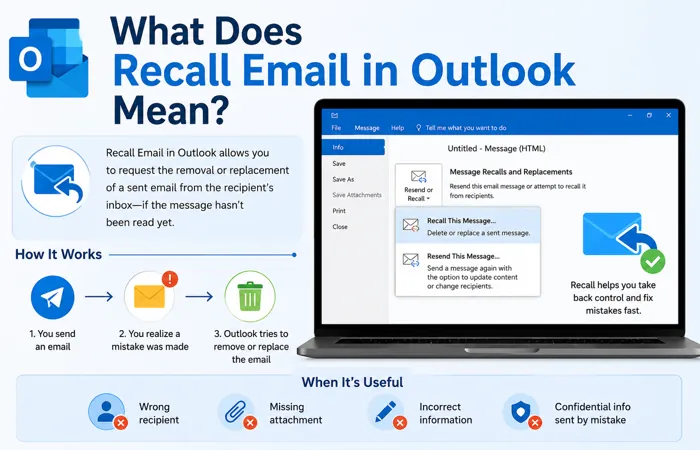
The Outlook recall feature lets you as the sender ask Outlook to try and delete an email you’ve already sent from the recipient’s inbox. Outlook can also replace the message with a new one, in some cases.
This works when both you and the recipient use Microsoft 365 email accounts or Microsoft Exchange server within the organization. The recall function does not work if the recipient has already opened the email.
The recall function also does not work if the email was sent to a folder. The recall function does not work either if the recipient uses an email service to check their emails. This is something to keep in mind when you try to recall an email using the recall function.
Think of recalling an email like hitting a button for emails you’ve already sent. Recalling an email in Outlook is not as simple as that. It only works in situations. The email recall feature in Outlook is like a chance to take back what you’ve sent.
It does not always work. You need to have conditions in place for it to work. The conditions for recalling an email in Outlook must be met. Outlooks email recall is not a foolproof undo button.
How Outlook Message Recall Works
Upon initiating a recall, Outlook will issue a request to the recipients’ mailbox and will ask the mail server to remove the original message.
If all required conditions are met, Outlook can:
- Delete the original message.
- Replace it with a corrected version.
- Notify the sender of the recall status.
Common Reasons People Recall Emails
Many professionals use Outlook recall when they:
- Send an email to the wrong recipient.
- Forget to attach a document.
- Include incorrect information.
- Share outdated pricing or data.
- Accidentally expose confidential information.
- Send an unfinished draft.
Even experienced professionals make these mistakes occasionally. That’s why understanding Outlook recall is an important productivity skill.
Requirements for Outlook Email Recall
Before attempting to recall a message, it’s important to understand that Outlook recall is not guaranteed to work.
Microsoft has several requirements that must be met for a successful recall.
Outlook Recall Requirements
| Requirement | Required? |
| Microsoft Exchange Account | Yes |
| Microsoft 365 Work or School Account | Yes |
| Recipient Uses Outlook | Yes |
| Recipient Is Within Same Organization | Usually |
| Email Is Unread | Yes |
| Outlook Desktop Application | Recommended |
When Outlook Recall Will Not Work
Outlook recall generally fails when:
- The recipient has already opened the email.
- The recipient uses Gmail.
- The recipient uses Yahoo Mail.
- The recipient uses Apple Mail.
- The email was forwarded.
- The email was moved by inbox rules.
- The recipient is outside your organization.
This is why many IT administrators suggest using preventative measures instead of depending on only recall.
How to Recall Email in Outlook (Step-by-Step)
If you meet the requests above, follow these steps to try an Outlook message recall.
Step 1: Open Outlook
Launch the Outlook desktop application and move it to the Sent Items folder.
Step 2: Locate the Email
Find the email you need to recall and double click it, so it begins in a split window.
Step 3: Open Recall Options
In the message window:
- Click File.
- Select Info.
- Click Resend or Recall.
- Choose Recall This Message.
Step 4: Choose a Recall Option
You’ll see two options:
Delete Unread Copies of This Message
This option attempts to remove the original email completely.
Delete Unread Copies and Replace With a New Message
This option removes the original email and lets you send a corrected version.
Step 5: Enable Recall Notifications
Check:
“Tell me if recall succeeds or fails for each recipient.”
This allows Outlook to send status updates regarding the recall attempt.
Step 6: Confirm the Recall
Click OK.
Outlook will immediately send recall requests to recipients who meet the eligibility requirements.
How to Check If Outlook Recall Was Successful
Many users assume a recall worked simply because Outlook accepted the request.
Unfortunately, that’s not always the case.
Successful Recall
A recall succeeds when:
- The recipient hasn’t opened the email.
- The recipient uses a compatible Outlook environment.
- The email remains in the Inbox.
Failed Recall
A recall typically fails when:
- The message was already opened.
- The recipient uses another email platform.
- Rules moved the email to another folder.
Understanding Recall Reports
| Recall Status | Meaning |
| Successful | Email removed from inbox |
| Failed | Recipient may have read email |
| Partial Success | Some recipients received recall, others did not |
Always review recall notifications rather than assuming success.
Outlook Recall vs Undo Send: What’s the Difference?
As many of the Outlook users are unaware of the difference between the ‘Undo send’ and ‘Recall message’, here is a solution to save the already sent email. All these three ways enable to recover from an error, at a higher probability than others.
| Feature | Message Recall | Undo Send |
| Happens After Sending | Yes | No |
| Requires Exchange Account | Yes | No |
| Works With External Recipients | Usually No | Yes |
| Success Guaranteed | No | Yes |
| Recommended Option | Sometimes | Yes |
Why Undo Send Is Better
Unlike recall, Undo Send delays the email before it’s delivered.
This indicates you can stop the message before anybody receives it.
For many people it’s enabled via Undo Send which offers the safe route.
How to Enable Undo Send in Outlook

Microsoft has improved the Undo Send feature considerably in recent years.
Configure Send Delay
- Open Outlook Settings.
- Select Mail.
- Click Compose and Reply.
- Locate Undo Send.
- Choose a delay period.
Recommended Delay Settings
| Delay Time | Recommended Use |
| 5 Seconds | Personal emails |
| 10 Seconds | Everyday business use |
| 20 Seconds | Teams and managers |
| 30 Seconds | High-risk communications |
For most professionals a delay between 10-20 seconds is optimal as this allows sufficient time to pick up on error without there being a delay between each message that is perceptible to a human.
Why Outlook Recall Fails
The main error of Outlook Recall is that it’s like an “undo” feature. Well, it’s not. The truth is that the Outlook recall feature is a ‘request’ and not a guarantee. Microsoft itself says that Recall rely on various conditions, many of which are external the sender’s device.
Knowing why Outlook recall is unreliable helps prevent users from depending on it for undoing errors.
The Recipient Already Opened the Email
The most common reason a recall fails is that the recipient has already opened the message.
Once an email is opened, Outlook can no longer delete it from the recipient’s inbox. Even if the recall request succeeds later, the original content has previously been seen.
For example:
- You send an email at 9:00 AM.
- The recipient opens it at 9:02 AM.
- You attempt a recall at 9:05 AM.
The recall request will likely fail because the email has previously been seen.
The Recipient Uses Gmail or Another Email Service
Outlook recall mainly works within Microsoft Discussion and Microsoft 365 situations.
If the recipient uses:
- Gmail
- Yahoo Mail
- Apple Mail
- Proton Mail
- Zoho Mail
The recall request is generally ignored because those platforms do not support Outlook’s recall mechanism.
This is why message recall is mostly effective within corporate organizations where everyone uses Outlook.
The Email Was Moved by Inbox Rules
Many professionals use automated inbox rules to manage emails.
If a rule moves your email from the Inbox to another folder before the recall request comes, Outlook may be unable to find and remove the previous message.
Common rule examples include:
- Moving emails into project folders
- Sorting emails by department
- Automatically archiving messages
Shared Mailboxes and Delegated Access
Organizations frequently use shared mailboxes for easy customer support, HR department, finance team, and sales teams.
In these environments:
- Multiple people may access the same mailbox.
- The email may already be visible to another user.
- Recall requests may not function as expected.
Cached Exchange Mode Issues
Sometimes Outlook clients operate in Cached Exchange Mode.
Synchronization delays can cause:
- Delayed recall notifications
- Inconsistent recall results
- Partial recall success
This can create confusion because some recipients may lose access to the email while others retain it.
Mobile Devices
Many recipients now read emails first on smartphones.
If a user opens the message through:
- Outlook Mobile
- iPhone Mail
- Android Email Apps
Before the recall request is processed, the recall may fail entirely.
The Email Was Forwarded
If a receiver forwards your email before the recall request comes, the forwarded copy remains available.
Even if the original message is deleted, forwarded versions cannot be taken back.
Multiple Recipients Create Mixed Results
Large email distributions often produce inconsistent outcomes.
Example:
| Recipient | Status |
| User A | Recall Successful |
| User B | Recall Failed |
| User C | Already Read |
| User D | External Email |
This is why Outlook often reports “partial success.”
Outlook Recall Should Never Be Your Safety Net
The biggest lesson is simple:
Message recall should be considered a backup option—not your primary protection against mistakes.
The most reliable strategy is preventing mistakes before sending emails.
Outlook Recall in New Outlook vs Classic Outlook
Microsoft continues transitioning users toward the New Outlook experience.
However, there are important differences between the New Outlook and Classic Outlook when it comes to message recall.
Classic Outlook
Classic Outlook offers the most complete recall functionality.
Features include:
- Message Recall
- Replace Message
- Recall Notifications
- Advanced Tracking
This remains the preferred version for organizations that frequently use recall.
New Outlook
Microsoft has improved Outlook with a new interface and cloud first design.
Benefits include:
- Better performance
- Simplified interface
- Improved Microsoft 365 integration
- Enhanced security
However, some recall-related features may differ depending on account configuration.
Comparison Table
| Feature | Classic Outlook | New Outlook |
| Message Recall | Yes | Limited Support |
| Replace Message | Yes | Varies |
| Recall Tracking | Yes | Limited |
| Undo Send | Yes | Yes |
| Microsoft 365 Support | Yes | Yes |
| Exchange Support | Yes | Yes |
Which Version Should You Use?
For organizations that frequently rely on recall functionality:
Classic Outlook remains the better option.
For everyday users:
New Outlook combined with Undo Send provides a better overall experience.
Troubleshooting Outlook Recall Problems
Problem #1: Recall Option Missing
Possible Causes
- Using Outlook Web
- Using Personal Outlook Account
- Unsupported Outlook Version
Solutions
- Update Outlook.
- Use the Desktop Application.
- Verify Microsoft Exchange account access.
- Switch to Classic Outlook if necessary.
Problem #2: Recall Always Fails
Causes
- External recipients
- Read emails
- Gmail recipients
Solutions
- Verify recipient environment.
- Use Undo Send instead.
- Enable delivery delays.
Problem #3: No Recall Notification Received
Solutions
- Check Junk Folder.
- Verify Outlook tracking settings.
- Confirm Exchange synchronization.
Problem #4: Partial Recall Success
Cause
Different recipients interact with emails differently.
Solution
Review individual recall reports instead of assuming organization-wide success.
2026 Email Statistics and Research
Email continues one of the best important communication networks in business.
Global Email Usage (2026)
| Metric | Estimated Value |
| Daily Emails Sent | 390+ Billion |
| Business Emails Sent Daily | 140+ Billion |
| Average Office Worker Emails Per Day | 120+ |
| Mobile Email Opens | 60%+ |
| Email Users Worldwide | 4.8+ Billion |
Common Email Mistakes
| Mistake | Frequency |
| Wrong Recipient | High |
| Missing Attachment | Very High |
| Incorrect Subject Line | Medium |
| Broken Link | High |
| Outdated Information | High |
Why Email Recall Matters
As email volume continues growing, even small mistakes can create:
- Compliance issues
- Reputation damage
- Customer dissatisfaction
- Productivity losses
Security and Compliance Risks
Sending incorrect emails can have serious concerns.
Sensitive Information Exposure
Examples include:
- Customer records
- Employee information
- Financial reports
- Contracts
Compliance Violations
Industries structured by privacy laws face extra risks.
Affected sectors:
- Healthcare
- Finance
- Government
- Education
Reputation Damage
Even a simple email mistake can reduce trust among:
- Customers
- Partners
- Investors
- Employees
Financial Impact
Data breaches caused by email mistakes can result in:
- Legal costs
- Regulatory fines
- Lost contracts
- Reduced productivity
Best Alternatives to Outlook Recall
1. Enable Undo Send
The safest solution.
Benefits:
- Works before delivery.
- Nearly 100% reliable.
- No recipient requirements.
2. Use Delay Delivery Rules
Delay outgoing emails by:
- 1 minute
- 5 minutes
- 10 minutes
This provides additional review time.
3. Use Microsoft Copilot
AI-powered review can detect:
- Missing attachments
- Tone issues
- Grammar errors
- Missing information
4. Grammarly
Excellent for:
- Proofreading
- Clarity improvements
- Professional communication
5. Two-Minute Review Rule
Before sending:
- Verify recipients.
- Check attachments.
- Confirm links.
- Review subject line.
This simple habit prevents most email mistakes.
Frequently Asked Questions
1. Can I recall an email in Outlook after it has been read?
No. Once the recipient reads the email, recall usually fails.
2. Does Outlook recall work with Gmail?
Generally, no. Gmail does not support Outlook message recall.
3. Can I recall an email sent outside my organization?
In most cases, no.
4. Why can’t I find the recall option?
You may be using an unverified Outlook version or account type.
5. How long do I have to recall an email?
There is no fixed time limit, but the faster you act, the better.
6. Does Outlook Mobile support recall?
Recall support is limited and depends on the account environment.
7. Is Undo Send better than Recall?
Yes. Undo Send is more reliable.
8. Does Microsoft 365 support email recall?
Yes, under supported organizational environments.
9. Can Outlook recall attachments only?
No. Outlook recalls the entire message.
10. What is the best way to avoid email mistakes?
Enable Undo Send and review messages before sending.
Final Verdict
Outlook’s message recall feature can be very helpful when you send an email by mistake, but it is not a sure solution. Recall only works under limited conditions, including friendly Outlook environments, unread messages, and administrative email systems.
For many users in 2026, the smarter method is avoidance rather than recovery. Features like Undo Send, Delay Delivery, and AI based writing assistants give far more consistent protection against costly email mistakes.
If you are wondering how to remember the email in Outlook, the response is, use the recall feature whenever appropriate, however, it should not be relied on; it should be used with protection mechanisms as well as security best practices in order to ensure that every email that you send is true, professional and secure.