



This animated artistic style has gained the attention of digital artists, content creators, educators and marketers. In modern times with AI tools readily available, advanced animation skills and cutting paper physically is no longer required to create this style of artwork.
Table of Contents
This Article Is Part of the SEO Hub
Explore more SEO guides, tutorials, strategies, and optimization resources inside our
SEO Resource Hub .
By generating the right prompts for paper animation style, creative professionals and other enthusiasts are able to create scenes in the form of unique hand cut paper art, layered paper cut, origami orstop-motion storytelling. In this guide, we dive into how prompts for paper animation are created, how they are developed and the outcomes that creators can expect.
Definition:
An AI prompt for paper animation is text-based instruction for an AI image or video generation tool. This prompt specifies the desired visual style, undertaking, and feel of the animatronics with the constraint that it appears to be constructed out of paper.
The goal is typically to replicate visual characteristics such as:
- Layered paper cut-outs
- Handmade paper textures
- Origami-inspired designs
- Stop-motion movement styles
- Cardboard or papercraft effects
- Shadow depth between paper layers
When written correctly, prompts help AI systems generate visually cohesive animations with a handcrafted appearance.
What Is Paper Animation?

The paper animation system uses cut-out animated statistics, objects and environments that look like they are made out of newspaper.
Traditional paper animation often involves:
- Hand-cut paper shapes
- Stop-motion photography
- Layered backgrounds
- Physical movement between frames
AI-generated paper animation digitally recreates these artistic qualities without requiring manual production.
Common Paper Animation Styles
| Style | Characteristics | Best Use Cases |
| Paper Cut-Out | Layered paper shapes and shadows | Storytelling videos |
| Origami Style | Folded paper objects and characters | Educational content |
| Stop-Motion Paper | Frame-by-frame movement simulation | Short films |
| Papercraft 3D | Multi-layered depth effects | Marketing videos |
| Collage Animation | Mixed textures and materials | Creative projects |
Why AI Prompts Matter in Paper Animation
The quality of the final animation often depends on prompt quality.
A vague prompt such as:
“Create a paper animation of a forest.”
may generate inconsistent results.
A detailed prompt provides much stronger guidance:
” Handmade paper-cut layered forest scene with subtle shadow casting between layers. Stop-motion movement, cinematic light, colourful forest animals and detailed papercraft.
The second prompt gives the AI clearer instructions regarding:
- Style
- Materials
- Movement
- Lighting
- Detail level
AI Prompts for Paper Animation Examples
Nature-Themed Paper Animation
Prompt Example
” Gorgeous layered paper-cut forest scene, handmade textured paper, moving leaves, soft sun-light on the trees, stop motion animation, cinematic depth, detailed paper craft scene, fluid camera.
Children’s Story Animation
Prompt Example
” Bright paper-cut fairy tale village, handmade paper houses, cheerful characters, animated clouds, story book illustration style, shadow layered, magical atmosphere.”
Educational Animation
Prompt Example
” The Paper-made solar systems, are realistic paper textures, revolving planets, educational infographic style, covered depth, slow transitions, flat design.”
Wildlife Animation
Prompt Example
“The Paper-cut jungle act with animated animals, detailed paper feels, layered foliage, stop-motion movement, realistic darks, vibrant colours.”
Workflow: Creating Paper Animation with AI

The process typically follows a structured workflow.
| Step | Action |
| 1 | Define the animation concept |
| 2 | Choose an AI image or video tool |
| 3 | Write detailed paper-style prompts |
| 4 | Generate initial scenes |
| 5 | Refine prompts for consistency |
| 6 | Export animation sequences |
| 7 | Edit and assemble final video |
Typical Workflow
- Plan the story or scene.
- Decide on paper animation style.
- Write detailed prompts.
- Generate assets.
- Review output quality.
- Adjust prompts as needed.
- Create final animation.
Essential Elements of Effective AI Prompts for Paper Animation
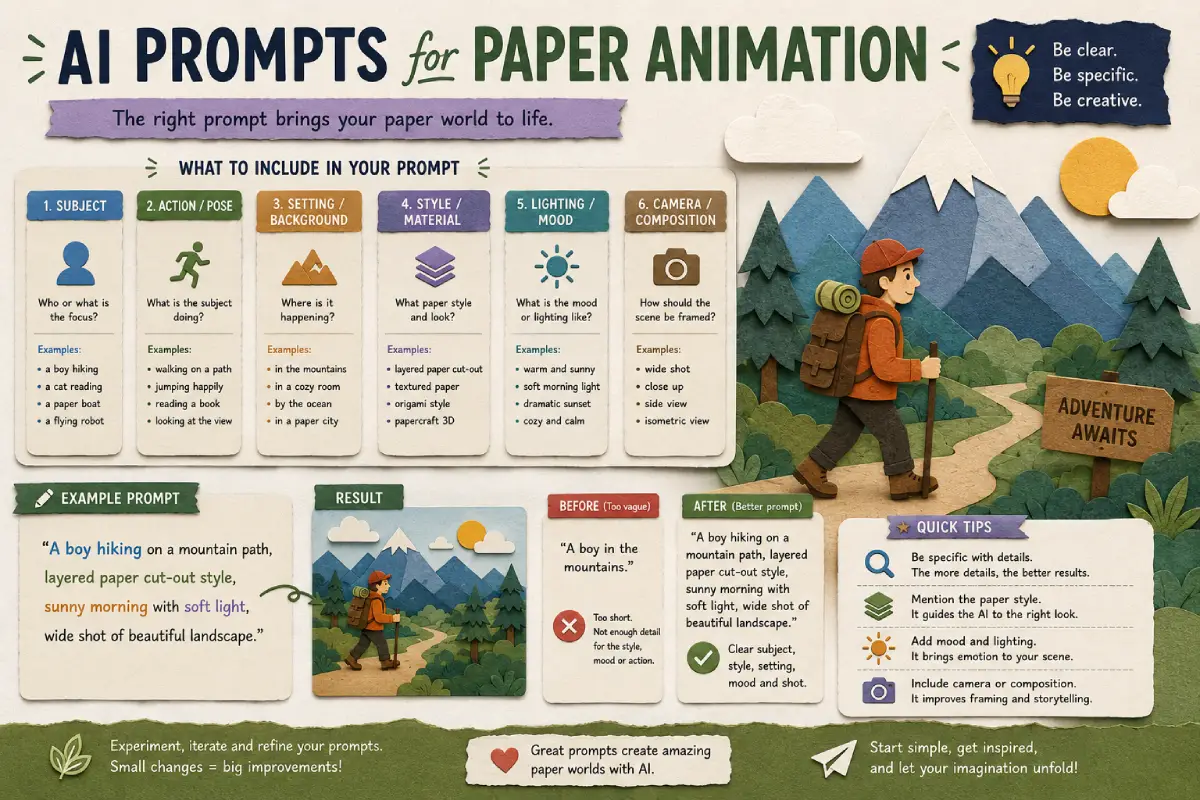
Strong prompts often include several key components.
1. Material Description
Specify paper-related characteristics:
- Hand-cut paper
- Cardstock
- Origami paper
- Recycled paper texture
- Craft paper
2. Layering Instructions
Layering creates realism.
Examples:
- Multi-layered background
- Paper-cut depth effect
- Overlapping paper elements
3. Movement Style
Define how animation should move.
Examples:
- Stop-motion effect
- Smooth paper transitions
- Handmade movement style
4. Lighting and Shadows
Paper animations benefit from realistic lighting.
Examples:
- Soft directional lighting
- Natural shadows
- Studio lighting
Comparison: Basic vs Detailed Prompts
| Feature | Basic Prompt | Detailed Prompt |
| Style Clarity | Low | High |
| Texture Quality | Generic | Realistic |
| Layer Depth | Limited | Strong |
| Animation Consistency | Variable | Better |
| Visual Storytelling | Weak | Strong |
| Editing Requirements | Higher | Lower |
Detailed prompts generally produce more predictable and visually appealing results.
Expectations When Using AI Paper Animation Prompts
It is imperative to maintain realistic prospects.
AI tools can create the impressive paper-style graphics, but results may vary contingent on:
- Prompt quality
- Tool capabilities
- Scene complexity
- Character consistency
- Motion requirements
What AI Does Well
- Paper textures
- Layered environments
- Artistic backgrounds
- Creative concepts
- Visual experimentation
Current Limitations
- Character consistency across long videos
- Complex motion sequences
- Detailed facial animations
- Precise storytelling control
Many of the creators still combine the AI-generated properties with traditional editing software for professional projects However, many creators are still integrating AI generated media with their current post-production software for specialized purposes.
Mutual Errors to Avoid
Using Overly Short Prompts
Minimal descriptions often produce generic results.
Ignoring Texture Details
Paper texture is essential for authenticity.
Forgetting Layer Information
Layering creates depth and realism.
Mixing Too Many Styles
Combining numerous artistic styles can confuse the AI model.
Skipping Refinement
Most successful animations require multiple prompt revisions.
Who Should Use AI Prompts for Paper Animation?
These prompts can be valuable for:
- YouTube creators
- Digital artists
- Marketing teams
- Educators
- Children’s content creators
- Animation beginners
- Social media storytellers
They can also speed up the production while still producing visually appealing results.
Best Practices for Better Results
- Use descriptive language.
- Mention paper textures clearly.
- Include lighting instructions.
- Define movement style.
- Test multiple prompt variations.
- Keep visual themes consistent.
- Use reference frames when supported.
Small prompt adjustments often lead to noticeable improvements.
FAQ’s
What are AI prompts for paper animation?
The paper animation AI prompts are descriptive textual inputs designed for an AI generator to produce animations that have a paper cut-out, origami, papercraft, or stop-motion look.
Which AI tools support paper animation prompts?
Many modern AI image and video generation platforms support paper-style prompts, particularly those designed for creative visual content generation.
How detailed should paper animation prompts be?
Generally, more detailed prompts produce better results. Including texture, lighting, layering, and movement instructions often improves output quality.
Can AI create the realistic stop-motion paper effects?
Yes, most AI tools will offer stop-motion effects, but it’s likely that the output still needs to be edited if you want it to be professional.
Are AI prompts for paper animation suitable for beginners?
Yes. Beginners can use pre-built prompt templates and gradually learn how to refine prompts for more consistent outcomes.
Conclusion
AI paper animation prompts allow for easier production of stunning paper cut and stop motion style animated content. Working with detailed descriptions of scenes, paper textures, layering effects, and animation styles allows for a more uniform and engaging style.
Despite the amazing advancements in AI animation, it is vital to maintain a degree of realistic expectation when generating content, as the highest quality productions require excellent AI prompts to be combined with creativity and careful editing. Regardless of if you are looking to generate educational videos, promotional material or works of artistic narrative, effective prompts for paper animation could provide you with great starting point.