




The boom in AI-powered creative tools has been revolutionizing how art and content creation is approached. Paper cut 2D animation AI software is now available to produce paper-cut animation style visuals, animation scenes, and storytelling materials without being well-versed in any animation software.
Table of Contents
This Article Is Part of the SEO Hub
Explore more SEO guides, tutorials, strategies, and optimization resources inside our
SEO Resource Hub .
Irrespective of if you are making informative videos, social media material, announcements or a small film.
Definition:
2D paper animation AI software refers to artificial intelligence (AI) which aids the design of a paper-cut animation, papercraft, or origami-like image or animation.
These tools characteristically mechanize errands such as:
- Scene generation
- Character creation
- Motion generation
- Background design
- Visual consistency
- Animation sequencing
The goal is to reduce production time while helping creators achieve a distinctive paper-crafted aesthetic.
What Is 2D Paper Animation AI Software?
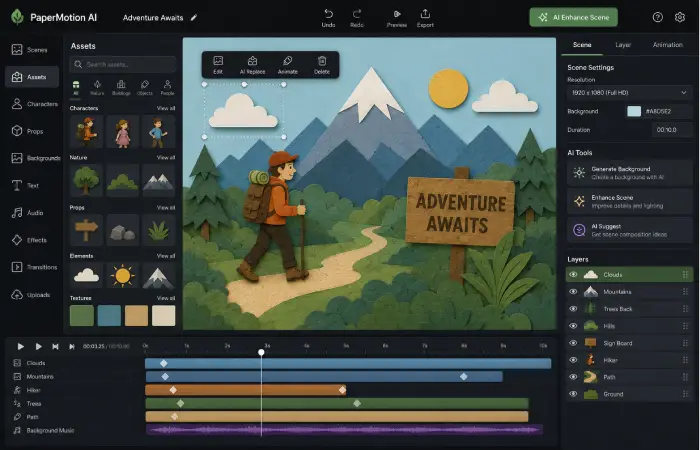
For standard paper animation, artists will have to painstakingly handcraft the various layers of paper artwork and animate them manually frame by edge. For the above types of visual possessions, the AI will be able to generate them for you.
Modern platforms can assist with:
- Paper-cut illustrations
- Layered scene composition
- Character animation
- Motion effects
- Storyboard generation
- Video rendering
Some tools focus primarily on image generation, while others offer complete animation workflows.
Key Features of Modern AI Paper Animation Software
Most platforms share several common capabilities.
AI-Assisted Asset Generation
Users can generate characters, props, and environments from simple text prompts.
Paper Texture Simulation
Many tools create realistic paper textures that mimic handcrafted materials.
Layer-Based Scene Design
Paper animations rely heavily on layered visual depth.
Motion Generation
AI can automate camera movements, transitions, and character actions.
Style Consistency
Advanced systems help maintain visual consistency across multiple scenes.
Export Flexibility
Most software supports exports for:
- YouTube
- Social media
- Educational presentations
- Marketing campaigns
Specifications Comparison Table
| Feature | Basic AI Tool | Advanced AI Animation Tool |
| Text-to-Image Generation | Yes | Yes |
| Text-to-Animation | Limited | Advanced |
| Paper Texture Effects | Basic | Detailed |
| Layer Management | Limited | Full Control |
| Character Consistency | Moderate | Better |
| Video Export Quality | HD | HD / 4K |
| Collaboration Features | Rare | Common |
| Learning Curve | Low | Moderate |
Workflow: Creating a Paper Animation Using AI

The designed workflow regularly produces the best results.
Step 1: About the Project
Identify:
- Story concept
- Audience
- Animation length
- Visual style
Step 2: Produce Paper-Style Properties
Use prompts as:
“Covered paper-cut forest scene with handmade textures and soft glooms.”
Step 3: Generate Character Designs
Generate consistent characters for use throughout the animation.
Step 4: Assemble Scenes
Arrange backgrounds, characters, and visual layers.
Step 5: Apply Motion
Add movement, transitions, and camera effects.
Step 6: Edit and Export
Review the animation and export it in the required format.
Performance Expectations
AI animation tools can significantly reduce production time, but realistic expectations are important.
What AI Does Well
- Rapid asset creation
- Creative experimentation
- Background generation
- Paper texture simulation
- Concept visualisation
Current Limitations
- Long-form storytelling consistency
- Complex character interactions
- Advanced facial expressions
- Detailed motion control
Most professional creators still combine AI output with traditional editing software for final production.
Pros and Cons
Pros
- Faster content creation
- Reduced manual illustration work
- Suitable for beginners
- Supports creative experimentation
- Helps generate visual concepts quickly
Cons
- Results may require editing
- Character consistency can vary
- Advanced features often require paid plans
- Complex animations still need manual adjustments
A balanced approach generally produces the best outcomes.
Comparison: AI Paper Animation vs Traditional Paper Animation
| Factor | AI Paper Animation | Traditional Paper Animation |
| Production Speed | Fast | Slow |
| Cost of Materials | Low | Higher |
| Learning Curve | Moderate | High |
| Artistic Control | Moderate | High |
| Physical Craftsmanship | None | Extensive |
| Scalability | High | Limited |
| Editing Flexibility | High | Moderate |
Both approaches have strengths depending on project goals and creative preferences.
Who Should Use 2D Paper Animation AI Software?
These tools are suitable for:
Content Creators
Makers producing YouTube videos, short films, and social content.
Educators
Teachers making attractive learning resources.
Marketing Teams
Businesses producing animated promotional content.
Animation Beginners
Users seeking an easier introduction to animation.
Freelancers
Designers handling client projects with limited production time.
Who Should Avoid It?
AI paper animation software may not be ideal for:
- Artists requiring complete frame-by-frame control
- High-end film productions needing custom animation
- Projects requiring highly detailed character acting
- Traditional paper-craft purists
Manual work flow may continue preferable in these circumstances.
Is 2D Paper Animation AI Software Legitimate?
Yes. AI animation software is indeed an area of creative technology..
However, users should:
- Review licensing terms
- Understand commercial usage rights
- Verify export limitations
- Check privacy policies
Legitimacy depends largely on the specific platform and its usage policies.
Popular Alternatives
Creators often combine multiple tools rather than relying on a single platform.
Common alternatives include:
- Adobe After Effects
- Toon Boom Harmony
- Moho Animation Software
- Blender Grease Pencil
- Traditional stop-motion workflows
Each option offers different levels of automation and creative control.
Buying Tips
Before choosing software, consider:
Your Skill Level
Beginners may benefit from simpler AI-first platforms.
Project Type
Short-form social content and educational videos often work well with AI-assisted workflows.
Export Requirements
Check supported resolutions and formats.
Budget
Many stages offer free tiers, but advanced features are regularly subscription-based.
Commercial Rights
Always verify whether generated content can be used commercially.
FAQ’s
What is 2D paper animation AI software?
2D paper animation AI software uses artificial intelligence to create paper-cut style animations, helping users generate visual assets, scenes, and motion effects more efficiently.
Can beginners use AI paper animation tools?
Yes. Many platforms are designed for beginners and include prompt-based generation systems.
Does AI replace traditional animation?
Not entirely. AI often assists production rather than replacing professional animation workflows.
Is 2D paper animation AI software suitable for YouTube videos?
Yes. Many of the creators use these tools for educational content, storytelling videos, and short-form social media projects.
Are AI-generated paper animations professional quality?
They can be visually impressive, but many projects still benefit from physical excision and modification.
Conclusion
2D paper animation AI software provides an easy-to-use tool for content creators to make paper cut and paper craft style animation with less manual effort. 2D paper animation AI software helps creator to speed up the process of asset creation, scenes creation and animation, however it should not be a silver bullet.
To gain the best result from 2D paper animation AI software, one should blend AI technology with direction and prompt adjustment, and post-production editing is necessary as well. For educator, marketer, content creator and novice, using AI to create animation offers a less obstacle-resistant entrance to the world of paper animation.