



AI marketing analytics tools enable businesses to turn advertising, websites, CRM and sales data into actionable insights. Marcom teams can utilize platforms to automate report generation, spot patterns, and predict consumer behavior instead of having to look at numerous dashboards manually.
Of course, only the quality of data the recommendation is based on dictates reliability. Poor tracking or incomplete CRM records or inconsistent campaign naming would inevitably mislead any inference made. So, the most advantageous is not necessarily the one with most AI features, but rather one whose data, team and decision-making mechanism fits best
Table of Contents
What Is AI Marketing Analytics Software?
AI marketing analytics tools leverage data such as that found on sheets to automatically monitor and interpret the results of your marketing efforts. It can uncover correlations that humans can look using sheets alone.
Common applications include:
- Predicting customer conversion or churn probability
- Identifying campaigns with unusual performance changes
- Automating marketing data analysis and reporting
- Forecasting revenue or advertising demand
- Grouping customers according to behavior
- Summarizing performance in natural language
- Recommending possible budget or audience adjustments
This differs from basic analytics software, which primarily reports what has already happened. AI-enabled platforms may also explain why performance changes and estimate what could happen next.
Related terms and their meaning
| Search term | Practical meaning |
| AI marketing analytics software | Software that applies AI to marketing measurement and reporting |
| Artificial intelligence marketing tools | A wider category cover analytics, automation, content and personalization |
| Predictive marketing analytics tools | Platforms that forecast conversions, mix, revenue or customer behavior |
| AI-powered marketing platforms | Broader systems combining analytics with CRM, campaigns or customer journeys |
| Automated marketing data analysis | Collecting, cleaning and evaluating marketing information with reduced manual work |
Best AI Marketing Analytics Tools Compared
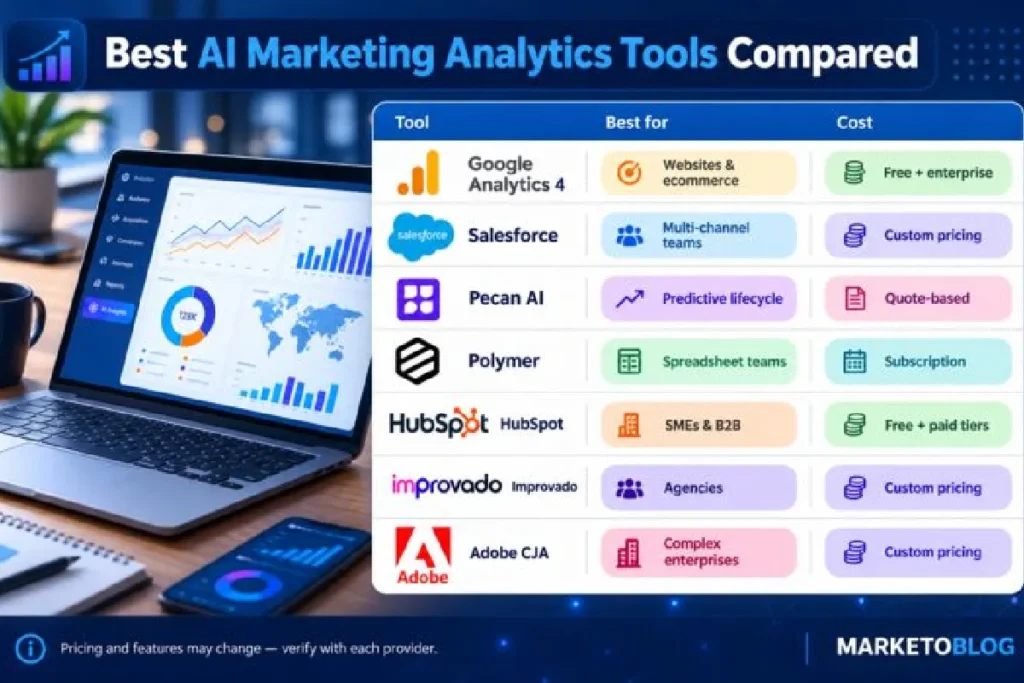
| Tool | Best suited to | Cost approach | Main limitation | Important analytics capabilities |
| Google Analytics 4 | Websites and ecommerce businesses | Free standard version; enterprise option available | Predictions require sufficient eligible data | Predictive metrics, automated insights and audience creation |
| Salesforce Marketing Intelligence | Larger multi-channel teams | Custom enterprise pricing | Implementation can require specialist support | Data harmonisation, automated reporting and AI insights |
| Pecan AI | Performance and lifecycle teams | Plan or quotation-based | Value depends on clean historical data | Predictive models for conversion, churn and customer value |
| Polymer | Smaller teams working with spreadsheets | Subscription plans | Less comprehensive than an enterprise analytics suite | AI-assisted data exploration and dashboard creation |
| HubSpot Marketing Hub | SMEs and B2B teams | Free tools and paid tiers | Advanced reporting generally requires higher plans | CRM-linked campaign reporting, attribution and AI-assisted segmentation |
| Improvado | Agencies and multi-channel marketing teams | Custom pricing | May be excessive for a small operation | Automated data integration, normalisation and reporting |
| Adobe Customer Journey Analytics | Enterprises with complex customer journeys | Custom enterprise pricing | Higher cost and technical complexity | Cross-channel analysis, attribution, segmentation and predictive insights |
Features and pricing can change. Businesses should confirm integrations, usage limits and contract terms directly with each provider before purchasing.
Which Tool Fits Each Audience?
Small businesses and start-ups
Google Analytics 4 is a sensible starting point for website and ecommerce analysis. Its standard version is free, while predictive metrics can estimate purchase probability, churn probability and predicted revenue when a property meets the required data conditions. Google’s documentation confirms that these predictions depend on structured event data and eligibility thresholds.
HubSpot may be more suitable when a business wants marketing analytics connected directly to contacts, leads and sales activity.
Marketing agencies
Agencies managing numerous advertising accounts may benefit from Improvado or Salesforce Marketing Intelligence. These tools focus on bringing information from different advertising, CRM and analytics systems into a more consistent reporting environment.
Ecommerce businesses
GA4 can support ecommerce measurement and predictive audiences. A larger retailer may consider Adobe Customer Journey Analytics when it needs to connect online, offline and customer-service interactions across a longer journey.
Enterprise marketing departments
Adobe and Salesforce are strong candidates for organisations with several brands, data sources and reporting teams. Salesforce describes its platform to unify performance data, automate reporting and identify optimisation opportunities using AI insights. Salesforce Marketing Intelligence also supports data mapping and harmonisation across multiple sources.
AI Marketing Analytics Workflow
A practical implementation should follow a controlled process:
- Define the commercial question: Decide whether the objective is improving lead quality, reducing acquisition cost, predicting churn or measuring revenue.
- Audit tracking: Check conversion events, consent settings, advertising tags and CRM fields.
- Connect data sources: Import relevant websites, advertising, email, ecommerce and sales data.
- Standardise the data: Use consistent channel names, campaign labels, currencies and conversion definitions.
- Establish a baseline: Compare AI findings against recent historical performance.
- Review recommendations: Ask a marketer or analyst to investigate the context behind each important insight.
- Test changes: Apply recommendations through controlled campaign experiments.
- Measure business outcomes: Evaluate qualified leads, revenue and profit not only clicks or engagement.
AI should assist this workflow rather than make unsupervised budget decisions.
Daily and Periodic Reporting Suitability
Daily campaign monitoring
Automated alerts and anomaly detection are useful for detecting sudden changes in traffic, spending or conversion volume. Daily reports should concentrate on operational problems rather than encourage constant campaign editing.
Weekly optimisation
Weekly reviews are suitable for examining audience, creative, channel and landing-page patterns. This provides more data than a daily snapshot while still allowing timely adjustments.
Monthly planning
Predictive marketing analytics tools are most useful during monthly or quarterly planning. Teams can examine customer value, channel contribution, budget allocation and longer-term conversion trends.
Key Benefits and Limitations
| Benefits | Limitations |
| Reduces repetitive reporting work | Cannot correct inaccurate source data automatically |
| Identifies patterns across large datasets | Predictions may fail with limited historical data |
| Supports faster campaign investigation | Attribution remains an estimate |
| Can forecast conversions, churn or revenue | Enterprise tools can be costly and complex |
| Creates more consistent multi-channel reporting | Recommendations still require human review |
Performance Expectations
AI-powered marketing platforms can reduce the time spent preparing reports and investigating performance changes. They do not guarantee higher revenue, cheaper leads or more accurate attribution.
Results normally depend on:
- The volume and quality of historical data
- Correct conversion and revenue tracking
- Integration coverage
- Customer journey complexity
- Staff ability to interpret findings
- The quality of campaign execution
A small company with limited traffic may gain more from accurate basic reporting than from an advanced predictive model. Predictions should also be checked against actual results before they influence substantial advertising budgets.
Cost Comparison and Buying Tips
Free or lower-cost platforms are generally enough for businesses that need website reporting, basic dashboards and straightforward campaign measurement. Enterprise platforms become more relevant when data must be combined across numerous brands, regions and customer systems.
Before selecting a tool:
- List every required advertising, CRM and ecommerce integration.
- Request a demonstration using a realistic reporting scenario.
- Confirm whether setup, training and support carry additional charges.
- Ask how the platform handles Indian rupees, tax and regional data requirements.
- Check data-export options to avoid becoming dependent on one vendor.
- Run a short pilot before signing a long contract.
- Calculate the total cost, including implementation and analyst time.
Final Recommendations by Use Case
- Best starting option: Google Analytics 4
- Best for CRM-connected SME marketing: HubSpot Marketing Hub
- Best for multi-channel enterprise reporting: Salesforce Marketing Intelligence
- Best for complex customer journeys: Adobe Customer Journey Analytics
- Best for dedicated predictive modelling: Pecan AI
- Best for agency data integration: Improvado
- Best for spreadsheet-based analysis: Polymer
None of them truly wins. Choose the platform depending on the decisions your team must take, not on the number of AI functions depicted in a demo.
Frequently Asked Questions
What are the best AI marketing analytics tools for small businesses?
Google Analytics 4 and HubSpot are practical starting options. GA4 supports website and ecommerce measurement, while HubSpot is useful when campaign data needs to be connected with CRM contacts and sales activity.
Can AI predict marketing campaign performance accurately?
We use past and historic patterns to estimate the future, but this is only a probability and can’t be assured. Accuracy can decline when customer behavior changes or the available data set is small, incomplete or incorrectly tracked.
Are AI analytics tools suitable for Indian businesses?
Absolutely yes. In India, businesses will benefit from them in aspects like e-commerce, lead generation, advertising, and analysis of data pertaining to the customer. Before they buy in India, they will need to make sure of the INR support, tax concerns, availability of relevant local connections and systems, permission needed for any data to be collected and from where in India data can be stored.
Will automated marketing data analysis replace an analyst?
It can automate data preparation, summaries and pattern detection, but human judgement remains necessary. An analyst must assess commercial context, tracking quality and whether a recommended action is sensible.
Conclusion
Leading AI tools for marketing analytics help you digest messy data, but they’re no substitute for diligent measurement and sensible marketing. If you have a small marketing team, GA4 and HubSpot are obvious places to start. If you’re a larger enterprise, think about Adobe, Salesforce and dedicated data and analytics providers. Start with a specific business problem to answer, then let the platform demonstrate its worth on your data, before scaling.
Marketing Analytics Resource Hub
Explore essential marketing analytics guides, tools and resources for measuring and improving marketing performance.
Marketing Analytics
A complete guide to measuring, analysing and improving marketing performance.
Social Media Analytics Tools
Measure audience growth, engagement and social media campaign results.
Free Marketing Analytics Tools
Explore free tools for tracking and analysing marketing performance.
AI Marketing Analytics Tools
Discover AI-powered tools for insights, forecasting and optimisation.
Content Marketing Analytics Tools
Evaluate content traffic, engagement, leads and conversions.
Email Marketing Analytics Tools
Track email delivery, clicks, conversions and subscriber behaviour.
Marketing Attribution Tools
Understand customer journeys and assign credit across marketing channels.