



The ‘social listening’ platforms assist organizations to hear not just direct comments, but also other messages that have not been tagged. Using these tools organizations would be able to search for mentions that are not tagged, evolving market sentiments of the existing and potential customers, monitoring competitive moves, and identifying future market trends. Indian businesses would consider opting such platforms to cater to regional talks, spelling errors, and if feasible – to multiple languages.
Table of Contents
What Are Social Listening Tools?
The software listens for defined keywords across social networks, news sites, blogs and forums and categorises those public online conversations in terms of mention volume, sentiment, themes, share of voice and influencers.
This differs from basic social monitoring. Monitoring helps a team find and respond to individual mentions, while listening examines broader patterns that can guide marketing, customer experience and product decisions.
Best Social Media Listening Software Compared
| Platform | Best suited to | Notable capabilities | Main limitation |
| Brandwatch | Large brands and research teams | Extensive data coverage, sentiment analysis, AI alerts and consumer research | Can require training and a substantial budget |
| Lumen by Talkwalker | Enterprise reputation and media monitoring | Social, web and media coverage, image recognition and trend detection | Custom pricing may not suit small businesses |
| Sprout Social | Marketing teams wanting listening and social management | Sentiment trends, competitor comparison, demographics and publishing | Listening may require a higher-level package |
| Meltwater | PR and communications teams | Social listening, news monitoring and reporting | Setup and query refinement take time |
| Hootsuite | Teams managing several social accounts | Listening combined with publishing and engagement workflows | Advanced intelligence features vary by plan |
| Google Alerts | Small organisations testing brand monitoring | Free alerts for indexed web mentions | Limited social coverage, sentiment and analytics |
Features and access to data on platforms may vary – please check current usage/coverage and price on individual provider website. Brandwatch notes the following for its platform: sentiment analysis, monitoring and AI alerts while Sprout Social provides brand-health, audience and competitor insights. Lumen from Talkwalker includes social listening and beyond.
(Brandwatch, Sprout Social, Lumen by Talkwalker)
Features That Matter Most
Useful brand monitoring tools should provide:
- Boolean keyword queries and exclusion filters
- Coverage of relevant social and web sources
- Alerts for unusual increases in mentions
- Competitor and share-of-voice reporting
- Historical data for trend comparisons
- Exportable dashboards and reports
- Language, location and source filtering
- Integration with customer-support or analytics systems
For an Indian brand, test whether the platform recognises Hinglish, regional-language content and local brand-name variations. A large source count is less valuable if the conversations important to the business are missing.
Social Sentiment Analysis Tools: What to Expect
Automated sentiment analysis classifies conversations as positive, negative or neutral. It can reveal directional changes, but it should not be treated as a perfect measure of customer opinion.
Sarcasm, mixed-language sentences, slang and cultural context can produce incorrect classifications. Teams should manually inspect a sample of posts before presenting sentiment percentages as firm conclusions. Sentiment works best as an early signal supported by qualitative review.
Social Listening Workflow
A practical listening process involves:
Define the decision:
Choose whether the research will support reputation, campaign, competitor or product analysis.
Build the query:
Add the brand name, common misspellings, product names and relevant exclusions.
Select sources:
Prioritise the channels where the intended audience is active.
Create a baseline:
Measure normal volume and sentiment before judging changes.
Review conversations:
Examine representative posts instead of relying only on dashboard totals.
Assign action:
Send service issues, product feedback and reputation risks to the appropriate teams.
Refine regularly:
Remove irrelevant results and add newly discovered phrases.
For example, an Indian food-delivery company might track its brand name alongside terms such as “late delivery”, “refund” and city names. This makes the results more actionable than tracking the brand name alone.
Benefits and Limitations of Online Conversation Tracking Tools
| Benefits | Limitations |
| Finds mentions that do not tag the brand | Cannot access every private conversation |
| Identifies recurring complaints and questions | Keyword ambiguity can create irrelevant results |
| Supports competitor and campaign research | Sentiment classifications require validation |
| Provides early warning of reputation issues | Advanced platforms can be expensive |
| Reveals topics for content and product teams | Results depend on query quality |
Who Should Use Social Media Intelligence Platforms?
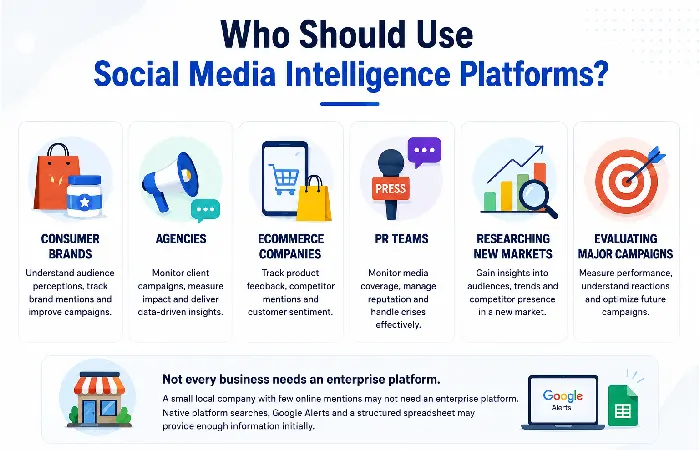
These platforms are most useful for consumer brands, agencies, ecommerce companies, PR teams and businesses receiving a meaningful volume of online discussion. They can also help organisations researching a new market or evaluating a major campaign.
A small local company with few online mentions may not need an enterprise platform. Native platform searches, Google Alerts and a structured spreadsheet may provide enough information initially.
How to Choose the Right Tool
Start with a defined use case and request a trial or guided demonstration using the company’s real keywords. Check source coverage, multilingual accuracy, reporting controls, historical-data limits, user allowances and export options.
Inquire about the full Indian rupees price. This should include on board, other queries & any other data usage. Do not choose the software because it makes pretty dashboards. Underlying data should be able to respond to a legitimate question.
Frequently Asked Questions
What are social listening tools used for?
Social listening tools are used to analyse brand mentions, customer sentiment, competitor conversations, campaign reactions and industry trends across public online sources.
Can social listening identify a reputation crisis?
It can detect unusual increases in negative mentions and send alerts. However, a person should verify the context and severity before initiating a public response.
Are free social listening options sufficient?
Free options can support basic web and keyword monitoring. Businesses usually need a paid platform for deeper social coverage, historical analysis, sentiment and competitor benchmarking.
Can these tools analyse Indian languages?
Some platforms support multiple languages, but accuracy varies. Test the required language and Hinglish examples before purchasing a subscription.
Conclusion
Best social listening tools will encompass and convert useful discussions that are relevant to the organization into useable proof of that. A larger organization may need Brandwatch, Lumen by Talkwalker or Meltwater to ensure it gets its results, an integrated team could be happy using either Sprout Social or Hootsuite. Whatever tool an organization selects all can deliver reliable results if it use a correct query, human validation, and a clear response process.
Market Intelligence Tools Resource Hub
Explore essential market intelligence tools for researching markets, monitoring competitors and understanding consumers.
Market Intelligence Tools
A complete guide to tools for collecting, analysing and using market intelligence.
Competitive Intelligence Tools
Track competitors, compare strategies and identify changes in your market.
AI Market Intelligence Tools
Use AI-powered platforms to analyse market data, patterns and emerging trends.
Market Research Tools
Collect reliable data about markets, audiences, demand and opportunities.
Consumer Intelligence Tools
Understand customer needs, preferences, behaviour and purchasing decisions.
Social Listening Tools
Monitor brand mentions, audience conversations, sentiment and market trends.
Market Intelligence Tools for Small Business
Find practical tools that help small businesses research markets and competitors.