




Business can leverage consumer intelligence tools that transform disorganized customer data into actionable evidence to drive marketing strategy. In addition to educated guesses, the tools allow marketing teams to assess audience interests, purchase behaviour, brand sentiments, and new industry trends.
Data alone may not produce conclusive findings; results are dependent on data accuracy, representative samples and cautious interpretations of findings.
Table of Contents
What Are Consumer Intelligence Tools?
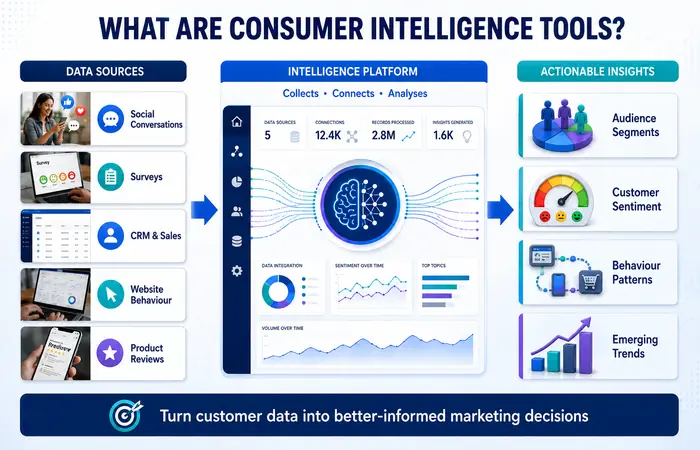
Consumer intelligence software collects data on sources including social media, customer surveys, website analytics, product reviews, CRM, and transaction history
And analyze it to spot patterns and trends in your customers’ needs, opinions and behavior. These insights could be used by marketers to segment customer audiences, shape campaigns, or adapt products and plans for future demand.
Where market research can come out and on an ad hoc project, intelligence can give the continuous view on an updated dashboard.
Key Features of Customer Intelligence Software
Capabilities vary between platforms, but useful features commonly include:
- Audience segmentation based on interests or behaviour
- Social listening and sentiment classification
- Customer journey and purchase analysis
- Survey and feedback management
- Competitor and category monitoring
- Trend detection and forecasting
- Dashboard creation and automated reports
- CRM, analytics and data warehouse integrations
- Privacy controls and user-access management
An organisation does not necessarily need every feature. A smaller ecommerce business may benefit more from reliable customer behaviour analytics tools than from an expensive global research database.
Comparing Consumer Insight Tools
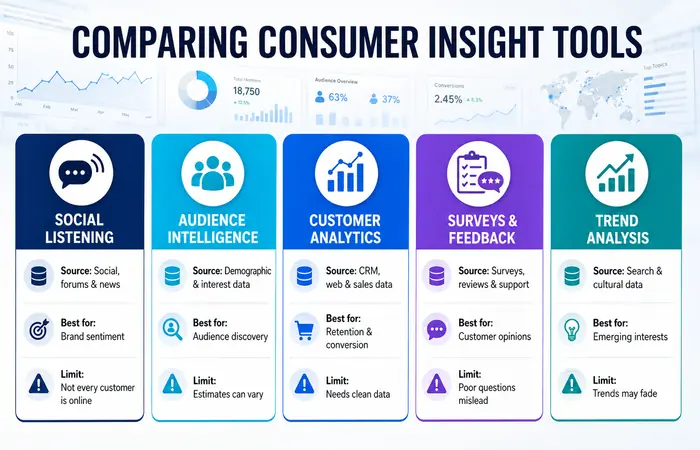
| Tool category | Primary data source | Best suited to | Main limitation |
| Social listening platforms | Social posts, forums and news | Brand sentiment and campaign monitoring | Online conversations may not represent all customers |
| Audience intelligence platforms | Social, demographic and interest data | Audience discovery and media planning | Audience estimates can differ between platforms |
| Customer analytics software | CRM, website and transaction data | Retention, conversion and lifecycle analysis | Requires clean first-party data |
| Survey and feedback tools | Surveys, reviews and support feedback | Understanding customer opinions | Poor questions can create misleading results |
| Consumer trend analysis tools | Search, cultural and category data | Identifying emerging interests | Trends do not always become sustained demand |
The best option depends on the business question. Comparing platforms only by the number of features can lead to unnecessary spending.
How Consumer Intelligence Tools Work
A practical consumer intelligence workflow usually follows five stages:
Define the question:
Decide whether the goal is to understand customer churn, brand sentiment, product demand or another specific issue.
Select relevant sources:
Combine suitable first-party data with surveys, reviews or public market information.
Clean and organise the data:
Remove duplicates, spam, irrelevant mentions and inconsistent labels.
Analyse patterns:
Use segments, sentiment, behavioural trends and comparisons to locate meaningful differences.
Validate and act:
Compare findings with sales results, interviews or campaign tests before making a major decision.
For example, growing online discussions around a product feature may indicate interest. It should still be checked against website searches, enquiries or purchases before additional budget is committed.
Benefits and Limitations
Advantages
- Provides a clearer view of customer preferences
- Supports more relevant audience segmentation
- Helps detect changes in sentiment or demand
- Brings multiple data sources into one reporting environment
- Can reduce dependence on unsupported assumptions
Limitations
- Automated sentiment analysis can misunderstand humour and regional language
- Social data may overrepresent highly active users
- Weak or incomplete input data produces unreliable findings
- Advanced platforms can require specialist training
- Dashboards can show correlation without explaining the actual cause
Indian audiences use several languages and frequently mix languages within the same conversation. Businesses should test whether a platform can accurately analyse the languages and contexts relevant to their customers.
Realistic Performance Expectations
Consumer intelligence is most useful for identifying patterns and generating questions for further investigation. It should not be treated as a perfect prediction system.
Initial setup may involve connecting data sources, establishing consistent labels and filtering irrelevant information. Smaller teams can begin with one use case and a limited dashboard rather than attempting to monitor every available metric.
Allow enough time to create a reliable baseline. Sudden changes should be investigated before they are classified as genuine consumer trends.
How to Choose Audience Intelligence Platforms
Before purchasing a platform, assess:
- The business questions it must answer
- The geographic and language coverage provided
- Compatibility with existing CRM and analytics systems
- Data sources and collection methods
- Export, reporting and dashboard options
- Privacy, consent and data-retention controls
- Training and implementation requirements
- Total cost, including additional users and data allowances
Request a trial using realistic queries. A demonstration based on the organisation’s own category will reveal more than a generic sales presentation.
Data Privacy and Legitimacy
Legitimate providers should explain where their data comes from, how it is processed and which privacy controls are available. Indian organisations processing personal data should also review their responsibilities under applicable data-protection requirements.Indian organisations using consumer intelligence tools should ensure their collection, storage and processing practices comply with the Digital Personal Data Protection Act, 2023.
Avoid platforms that promise unrestricted personal profiles or cannot explain their collection methods. Access controls, documented retention periods and clear vendor agreements are important when customer information is involved.
Alternatives to Paid Intelligence Platforms
A paid suite is not always necessary. Smaller businesses can combine web analytics, CRM reports, customer interviews, search data, feedback forms and manual review analysis.
This approach requires more coordination, but it can answer focused questions at a lower cost. A specialist platform becomes more valuable when monitoring volume, reporting frequency or data complexity grows.
Frequently Asked Questions
What are the best consumer intelligence tools for small businesses?
To choose the right consumer intelligence software, you must ensure that it perfectly fits a given need and an existing capability data and if you are looking for consumer intelligence solutions for a small business, look for products that offer smooth integration, clear pricing, functional reporting, and accurate insights of your customer group.
Are consumer intelligence and market research the same?
No. Market research is typically project-based whereas consumer intelligence uses a blend of ongoing behavioral, transactional and audience data; they can complement each other well.
Can these tools predict customer behaviour?
However, they can only detect patterns and guess at possible outcomes for these markets and can therefore make no promises, as of course in a changing market place and with partial data, they may get it wrong and customer behavior, as ever, can be entirely unpredictable.
Conclusion
Consumer intelligence solutions enable Indian companies to get insights into customer segments, gain visibility into shifting demand, and ensure that your marketing decisions are data-supported. But simply measuring everything under the sun is not the secret to getting good data. Instead, you need to pull the relevant data points, confirm your findings, and execute with good sense.
Market Intelligence Tools Resource Hub
Explore essential market intelligence tools for researching markets, monitoring competitors and understanding consumers.
Market Intelligence Tools
A complete guide to tools for collecting, analysing and using market intelligence.
Competitive Intelligence Tools
Track competitors, compare strategies and identify changes in your market.
AI Market Intelligence Tools
Use AI-powered platforms to analyse market data, patterns and emerging trends.
Market Research Tools
Collect reliable data about markets, audiences, demand and opportunities.
Consumer Intelligence Tools
Understand customer needs, preferences, behaviour and purchasing decisions.
Social Listening Tools
Monitor brand mentions, audience conversations, sentiment and market trends.
Market Intelligence Tools for Small Business
Find practical tools that help small businesses research markets and competitors.