



The right market intelligence tools for small business means putting useful information in place of guessing work. With these, Indian owners can gauge customer interests, competitive moves, and shifting demand. Since there is rarely a one-stop platform, buying two or three specialized tools is typically better than a one-off expense.
Table of Contents
What Are Market Intelligence Tools?
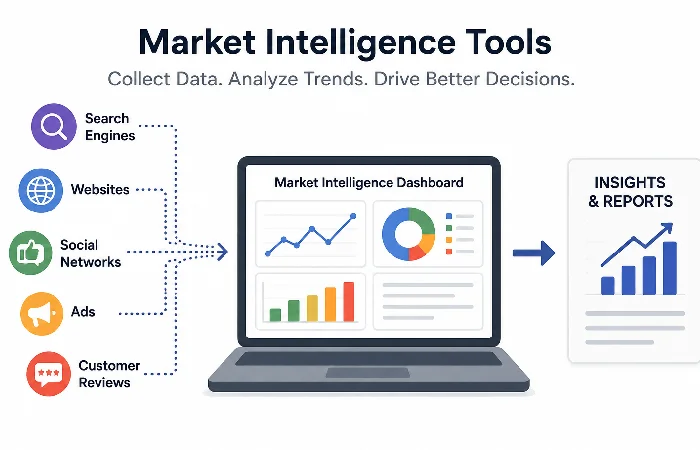
Data is gathered by market intelligence tools from things such as search engines, websites, social networks, ads, and customer reviews, and is transformed into report or dashboards that can be used by companies when planning campaign products and costs.
Unlike internal business intelligence tools for startups, which mainly analyse company data such as sales and inventory, market intelligence platforms examine external market conditions.
Best Market Intelligence Tools for Small Business
| Tool | Best use | Cost level | Main limitation |
| Google Trends | Measuring search interest by location and time | Free | Shows relative interest rather than exact search volume |
| Meta Ad Library | Reviewing active Facebook and Instagram advertisements | Free | Does not reveal a competitor’s conversions or full budget |
| Google Alerts | Monitoring new web mentions and competitor updates | Free | Results can contain irrelevant pages |
| Zoho Social | Tracking social mentions, keywords and engagement | Free trial and paid plans | Advanced monitoring may require a higher plan |
| Similarweb | Comparing website traffic and digital channels | Limited free access; paid plans from about US$125 monthly | Estimates may be less dependable for smaller websites |
Google Trends has a feature that allows you to compare your topic based on time or geography, andMeta claims that the Ad Library has searchable ads run on any of their services. Zoho Social features monitoring columns, including reviews, mentions and keyword. Similarweb has broader competitive benchmarking and could be cost-prohibitive for microbusinesses.
Key Features
Useful affordable market intelligence software should offer:
- Competitor tracking
- Geographic and time-based filters
- Keyword or brand monitoring
- Clear reports that non-specialists can understand
- Exportable data
- Alerts for important changes
- Integration with existing marketing platforms
A local shop may only need trend data, customer reviews and advertising examples. A growing ecommerce company may require traffic comparisons, social listening and automated reports.
Competitor Research for Small Businesses
Follow this monthly process rather than collecting data without a defined purpose:
- Choose three direct competitors serving a similar audience.
- Compare relevant product terms in Google Trends using the India filter.
- Review competitors’ active creative and offers in Meta Ad Library.
- Set Google Alerts for brand names, products and industry terms.
- Use Zoho Social or a similar tool to monitor conversations and reviews.
- Record findings in a spreadsheet and identify recurring patterns.
- Test one change, such as a new offer or content topic, and measure the result.
This workflow turns scattered information into a manageable decision-making routine.
Market Analysis Tools for Beginners: Realistic Expectations
Those tools identify trends; they don’t promise winning results. Search interest doesn’t translate to buying demand, and all third-party traffic reports are estimates, not verified, audited data.
Small datasets can even lead to flawed conclusions. Instead, it’s prudent to cross-reference multiple sources, then validate any significant results by interviewing customers, looking at sales results, or running an inexpensive small-scale campaign test. Don’t expect an instant surge in sales but do expect decisions to get smarter.
Benefits and Limitations
Pros
- Reduces reliance on assumptions
- Helps identify emerging customer interests
- Makes competitor activity easier to follow
- Supports better content and campaign planning
- Free tools are sufficient for many early-stage businesses
Limitations
- Data can be incomplete or delayed
- Premium subscriptions may exceed a small firm’s budget
- Dashboards still require human interpretation
- Competitor estimates are not equivalent to internal company data
- Excessive monitoring can distract from implementation
Who Should Use These Tools?
They help local service providers, ecommerce sellers, agencies and startups to go to a new market. Especially the data would help one before launching a product, changing price or going into another Indian city.
A very small business with few competitors may not need an advanced subscription. Free tools, customer feedback and a simple spreadsheet could provide sufficient insight initially.
How to Choose an Affordable Tool
Begin with a specific question: Are customers searching for the product? Which offers are competitors promoting? Where does their website traffic originate?
Opt for the cheapest tool that can answer your question. Try it with a single project and ask yourself what it can and can’t tell you about a “real-world” decision. If it can help you, try again with an annual contract. Look for restrictions on who can use it, how much you can download and whether local Indian data is rich enough.
Frequently Asked Questions
What are the best market intelligence tools for small businesses?
Google Trends, Meta Ad Library, and Google Alerts are powerful, free first steps. Zoho Social excels at social media, while it makes more sense to splash out on the extra data when conducting website and competitor analyses.
Are free market research tools reliable?
They are useful for recognizing patterns, but their data has limits. Important decisions should be checked against sales information, customer feedback and small-scale tests.
How often should small business conduct competitor research?
In many industries, monthly reviews may well suffice. Fast-moving industries ecommerce, technology, digital advertising-may require more: weekly notifications, quarterly in-depth analysis.
Conclusion
The choice of best market intelligence software for small businesses largely varies on the problem that they want to answer, budget and how good the available data is. India Inc firms can initially rely on using Google Trends, Meta Ad Library, and Google Alerts and then introduce proprietary software later. Integrating your customer insights, company performance, and market external signals is often the best strategy.