



Market intelligence tools help companies understand what is occurring beyond their own websites, advertising accounts and sales reports. They collect signals about competitors, customer query, market growth, pricing, search behavior and public discussions so that decision-makers can assess opportunities with more evidence.
For India-based brands this could be particularly effective in: A brand entering a new city A new product launch to an ecommerce category. Competing head-to-head with national brands. However, no platform offers an extremely accurate picture of an entire market. The best results come from combining digital intelligence with internal sales data, customer interviews, and professional judgement.
Table of Contents
What Is Market Intelligence?
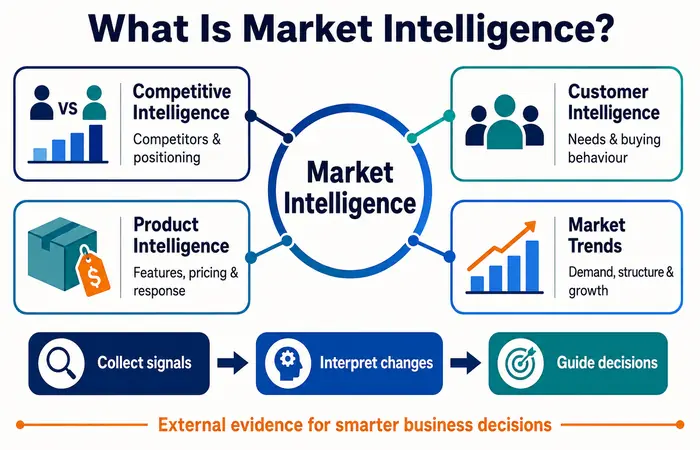
Market intelligence is the continuous collection and interpretation of information about a company’s external business environment.
It normally covers four connected areas:
| Intelligence area | What it examines | Example question |
| Competitive intelligence | Competitors, positioning and business activity | Which competitor is gaining digital visibility? |
| Customer intelligence | Needs, preferences and buying behaviour | Why are customers switching to another brand? |
| Product intelligence | Features, pricing and customer response | Which product features receive repeated complaints? |
| Market intelligence | Market structure, demand and trends | Is this category growing in Tier 2 Indian cities? |
Market intelligence differs from ordinary reporting because it looks beyond the organization’s internal performance. A sales dashboard can show that monthly orders have declined. Market intelligence may reveal that a new competitor entered the category, customer interest shifted towards a substitute product or demand declined across the entire sector.
Market intelligence versus market research
Market intelligence and market research overlap, but they are not identical.
Market research is commonly conducted to answer a defined question during a particular project. A company might conduct a survey before launching a new snack or interview customers to test a proposed service.
Market intelligence is more continuous. It monitors external signals so that businesses can recognize changes over time.
| Factor | Market intelligence | Market research |
| Primary purpose | Ongoing strategic awareness | Answering a defined research question |
| Frequency | Continuous or regularly repeated | Project-based |
| Typical sources | Competitor sites, search data, news, social conversations and industry databases | Surveys, interviews, focus groups and experiments |
| Main output | Trends, alerts, benchmarks and opportunity signals | Research findings and recommendations |
| Best use | Monitoring a changing market | Exploring a specific customer or product question |
Businesses frequently need both. Intelligence identifies a possible change, while focused research helps explain why it is occurring.
What Are Market Intelligence Tools?
Market intelligence tools are software platforms that gather, organise and analyse external market information. Depending on the platform, this may include estimated website traffic, competitor advertising, search demand, pricing, company activity, media coverage, customer reviews and social conversations.
Some tools focus on a single data type. Others combine several sources into dashboards and automated reports.
Typical capabilities include:
- Identifying major competitors
- Estimating competitor website traffic
- Comparing audience acquisition channels
- Tracking search demand and keyword visibility
- Monitoring competitor content and advertising
- Analysing reviews and public conversations
- Detecting emerging customer needs
- Following product and pricing changes
- Tracking media coverage
- Building industry benchmarks
- Sending alerts when important activity changes
- Summarising large datasets with artificial intelligence
The tool category is broad. An SEO platform, social listening application and company database can all contribute to market intelligence, even though each provides a different perspective.
Comparison of Popular Market Intelligence Tools
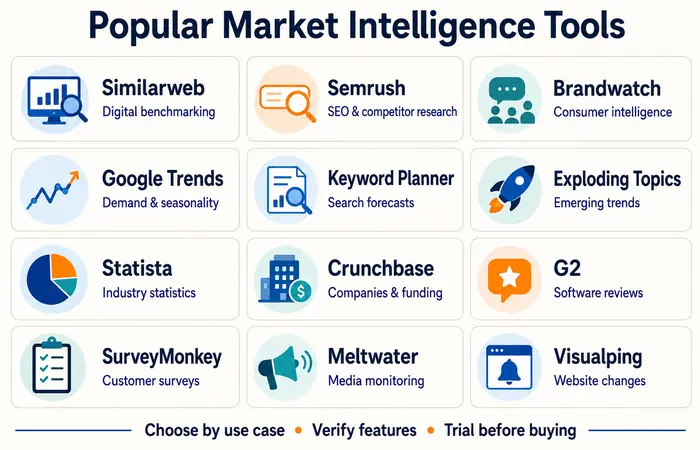
When comparing the following, it emphasizes practical use cases rather than one universally “best” product. Remember that product features and plans can differ and companies should confirm details and have a trial/demo arranged before buying.
| Tool | Main intelligence focus | Particularly useful for | Important limitation |
| Similarweb | Website traffic, audience and digital markets | Digital benchmarking and market sizing | Traffic figures are modelled estimates |
| Semrush | Search, traffic, competitors and digital visibility | SEO-led competitor and demand research | Full market features may require additional access |
| Brandwatch | Consumer conversations and social listening | Brand, consumer and reputation intelligence | Advanced platform aimed mainly at larger teams |
| Google Trends | Relative search interest | Early demand and seasonality checks | Does not provide absolute search volume |
| Google Keyword Planner | Search demand and advertising forecasts | Keyword and paid-search planning | Data is centred on Google Ads use cases |
| Exploding Topics | Emerging topics and growth signals | Early trend discovery | A trend signal does not prove commercial demand |
| Statista | Published statistics and industry reports | Desk research and presentation evidence | Coverage and methodology vary by dataset |
| Crunchbase | Companies, funding and business activity | Start-up, investor and B2B research | Private-company information may be incomplete |
| G2 | Software reviews and category comparisons | B2B software and buyer research | Review audiences may not represent every customer |
| SurveyMonkey | Primary surveys and customer feedback | Validating assumptions directly | Quality depends on survey and sample design |
| Meltwater | Media, social and brand monitoring | Communications and reputation analysis | May be more extensive than a small firm requires |
| Visualping | Website-change monitoring | Tracking competitor page and pricing updates | Detects changes but does not explain their meaning |
Similarweb
Similarweb is designed for digital market and competitor analysis. It can be used to compare websites, traffic channels, audience behaviour, geographical activity and changes in digital market share.
The company describes its market intelligence platform as covering market size, competition, demand, geography and audience behaviour. Its methodology combines multiple data sources and modelling to estimate digital activity. This makes it useful for directional comparison, but its numbers should not be confused with a competitor’s private analytics records.
Best suited to: Digital-first companies, ecommerce teams, analysts and agencies comparing online competitors.
Main limitation: Coverage can be lower for small websites, narrow regional businesses or markets where less observable data is available.
Semrush
The SEO side of Semrush is very familiar to many, however, its market analysis features bleed over into website traffic, industry trends, consumer behaviour and competitor research. Its official market analysis page describes the ability to review traffic sources, growth rates, emerging competitors and potential market gaps.
It is particularly practical when search visibility and content form an important part of the intelligence question.
Best suited to: SEO teams, content marketers, organizations and businesses researching digital gain.
Main limitation: It provides a strong digital-marketing view rather than a complete picture of offline distribution, sales or consumer behavior.
Brandwatch
Brandwatch is a consumer intelligence and social listening platform. It analyzes public discussions online and looks for themes, sentiment, audience behavior and strange changes.
Its official materials describe applications including consumer research, crisis monitoring, sentiment analysis and AI-supported alerts. These features can help large brands understand how people discuss a category, although automated sentiment must be reviewed carefully in multilingual markets.
Best suited to: Consumer brands, research teams, communications departments and organisations managing brand risk.
Main limitation: Language, sarcasm, code-switching and local context can reduce the reliability of automated interpretation.
Google Trends
Google Trends provides a free way to compare relative search interest over time, by region and across related topics. It can help identify seasonal behaviour, regional differences and rising queries.
An Indian retailer could compare relative interest in a product across Maharashtra, Karnataka and Delhi or examine whether demand normally rises before a particular festival.
Best suited to: Free preliminary research, seasonality checks and geographical comparisons.
Main limitation: A score of 100 represents peak relative interest within the chosen dataset. It does not mean 100 searches or reveal total market size.
Exploding Topics
Exploding Topics identifies subjects showing signs of sustained online growth. It can provide an early signal for content planning, product discovery or industry monitoring.
Best suited to: Innovation teams, publishers, investors and product researchers.
Main limitation: Online attention does not automatically translate into sustainable sales. Every trend should be validated using additional sources.
Statista
Statista brings together charts, statistics, forecasts and reports from numerous publishers and research sources. It is useful for desk research and developing initial market context.
Best suited to: Business plans, industry overviews, presentations and early-stage research.
Main limitation: Users need to inspect the original source, sample, date and methodology behind each figure instead of treating all charts as equally authoritative.
Crunchbase
Crunchbase tracks companies, funding events, acquisitions and organisational activity. It can help B2B teams or investors identify expanding categories and newly funded competitors.
Best suited to: Start-up research, investment analysis, partnership discovery and B2B prospecting.
Main limitation: Information about private companies may be delayed, self-reported or incomplete.
Categories of Market Intelligence Software
Selecting a platform becomes easier when the business first identifies the type of evidence it needs.
Competitive intelligence tools
Competitive intelligence tools monitor the visible activity of competing organisations. They may track website changes, search rankings, advertising, hiring, funding, product launches, media coverage and pricing.
Ethical competitive intelligence relies on legally and legitimately available information. It should not involve impersonation, unauthorised access, misrepresentation or attempts to obtain confidential information.
These tools are useful when a company needs to understand:
- How competitors position similar products
- Which channels appear to drive their visibility
- Whether competitors are expanding into new regions
- How frequently their prices or offers change
- Which customer segments they target
- Which topics they emphasise in their content
Competitor activity should be treated as evidence, not an instruction. Copying a competitor may reproduce its mistakes and weaken differentiation.
AI market intelligence tools
AI market intelligence tools use machine learning or generative AI to classify information, detect patterns, create summaries and suggest possible trends.
They can reduce manual work by:
- Grouping thousands of reviews into themes
- Summarising competitor announcements
- Detecting unusual increases in mentions
- Classifying feedback by topic or sentiment
- Generating natural-language explanations of dashboards
- Finding patterns across large datasets
- Supporting early forecasting
AI-generated conclusions require human review. The system may misunderstand local language, give excessive weight to widely repeated claims or present a correlation as a causal explanation.
The reliability of the result still depends on data coverage, methodology and the quality of the question being asked.
Market research tools
Market research tools support surveys, interviews, panels, concept testing and statistical analysis. They help businesses collect primary evidence directly from a target audience.
These tools are useful when digital signals cannot answer the underlying question. Website data might indicate that a new service page has a poor conversion rate, but interviews may reveal whether the cause is price, trust, unclear language or an unsuitable offer.
A larger sample is not automatically a representative sample. Businesses should examine how respondents were recruited, whether the sample reflects the relevant population and whether the questions introduced bias.
Consumer intelligence tools
Customer intelligence tools aggregate data about your customers’ needs, behaviour, attitudes and discussions. Data can be gathered from customer reviews, survey responses, social comments, search data, customer service transactions, and purchase behavior, among others.
They’re not meant to explain a particular segment of people. Quality consumer intelligence will articulate needs, barriers, and circumstances that play roles when someone is making a purchasing decision.
A food-delivery business could learn, say, that a customer segment in a particular metropolitan city has greater purchasing concern for delivery dependability, in contrast with discount marketing. This intelligence will impact business strategies more significantly compared with any alternative campaign with less targeted marketing objectives.
Social listening tools
Social listening tools monitor public references to brands, products, competitors and topics. They are useful for reputation monitoring, campaign analysis, customer-language research and detecting emerging issues.
A social listening query needs careful construction. A common brand name can return unrelated mentions, while spelling variations and local-language terms may otherwise be missed.
In India, researchers may need to include English, Hindi, Hinglish and relevant regional-language variations. Automated sentiment analysis should then be checked against a manually reviewed sample.
Market Intelligence Tools for Small Business
Small companies rarely need a large enterprise intelligence suite at the beginning. A carefully managed combination of free and affordable tools can provide enough evidence for many routine decisions.
A practical starting stack might include:
| Business need | Accessible option | What to monitor |
| Search demand | Google Trends and Keyword Planner | Seasonality, regional interest and related searches |
| Competitor content | Search results and website-change alerts | New pages, offers and positioning |
| Customer opinion | Reviews, surveys and support messages | Recurring needs and complaints |
| Social conversation | Native platform search and basic listening | Mentions, questions and emerging language |
| Industry activity | Trade publications and company alerts | Entrants, regulations and product launches |
| Internal validation | CRM, ecommerce or sales records | Actual enquiries, purchases and retention |
Market intelligence tools for small business should save time or improve a defined decision. If the owner cannot explain what action a dashboard will support, the subscription may be unnecessary.
A local Bengaluru training company, for example, may not need a global digital intelligence platform. It could combine regional search trends, competitor course pages, student interviews, reviews and internal enquiry data to decide which programme to introduce.
A Practical Market Intelligence Workflow
The value of intelligence comes from the decision process around the data, not from collecting more charts.
1. Define the decision
Start with a precise business question.
Weak question: “What is happening in our market?”
Stronger question: “Should we launch our accounting software for small retailers in Pune during the next financial year?”
The stronger question establishes the audience, location, product and decision period.
2. Identify the evidence needed
Break the main question into smaller research questions:
- Is relevant demand growing?
- Which businesses already serve the segment?
- What prices and features are common?
- What complaints do users have?
- Which acquisition channels reach this audience?
- What regulatory or operational barriers exist?
Each question may require a different source.
3. Build a source map
Combine several types of evidence rather than relying on one platform.
A source map may include:
- Search-interest data
- Competitor websites
- Customer interviews
- Public reviews
- Industry reports
- Government statistics
- Social conversations
- Internal sales information
- Distributor or partner feedback
Record the owner, refresh frequency and known limitation of every source.
4. Establish a baseline
Before searching for change, measure the starting point. The baseline could reflect factors such as your competitors, going rate, assumed demand, customers’ feelings about you, market share, etc.
Without a baseline, a sudden increase may look meaningful even when it reflects normal seasonal variation.
5. Collect and clean up the information
Use consistent categories, dates, currencies and competitor names. Remove duplicates and mark unavailable values rather than inventing estimates.
For social and review data, manually examine a sample to confirm that automated classifications are reasonable.
6. Separate facts, estimates and interpretations
A disciplined intelligence report labels the type of claim being made.
- Fact: A competitor published a new pricing page on 10 August.
- Estimate: Its website traffic appears to have increased within a third-party platform.
- Interpretation: The company may be investing in a new customer segment.
- Unknown: Whether the activity produced profitable sales.
This distinction prevents an assumption from gradually being presented as confirmed evidence.
- Triangulate important findings
Triangulation means checking a finding against independent sources.
If a tool shows rising interest in electric scooters, compare that signal with search trends, industry registrations, retailer discussions and customer research. Agreement across sources increases confidence. Contradictory evidence indicates that further investigation is necessary.
8. Convert insight into action
Every report should identify a proposed response, an owner and a review date.
For example:
There seems to be an increased demand for cheap accounting software for small retailers in Pune. Conduct 15 customer interviews and a test on the regional landing page to assess the quality of the qualified leads for six weeks and then launch on a wider scale.
9. Review the outcome
After acting, compare the result with the original assumption. This creates an intelligence loop in which decisions continuously improve the organisation’s understanding of its market.
How to Choose the Right Tool
A long feature list is less important than fit with the decision.
Start with the use case
Clarify whether the primary need is competitor traffic, consumer opinion, trend detection, product feedback, media monitoring or primary research.
A social listening platform cannot reliably estimate total industry revenue. A website intelligence tool cannot explain the private motivations of every customer.
Check coverage in India
Ask vendors to demonstrate coverage for the specific country, language, industry and competitor set.
A platform that performs well for large US websites may provide less dependable estimates for a small Indian regional site. Similarly, language models trained mainly on English may struggle with Hindi, Hinglish or other regional-language discussions.
Examine the methodology
Request clear answers to the following questions:
- Where does the data come from?
- Is it observed, modelled, surveyed or self-reported?
- How frequently is it updated?
- Which countries and languages are covered?
- How does the provider handle low-volume data?
- Can results be exported and audited?
- What privacy and security controls apply?
- How are AI-generated conclusions produced?
A vendor that cannot explain its methodology should not be the sole basis for a high-value decision.
Test usability and integration
The platform should fit the team’s ability and existing workflow. Consider exports, APIs, alerts, dashboard sharing, CRM connections, onboarding and training.
If analysts are spending most of their time copying data between systems using the same traditional methods on a high-end platform, then the platform does not deliver much value.
Evaluate total cost
Look beyond the advertised subscription. Total cost may include additional users, historical data, exports, API access, implementation, analyst time and training.
For enterprise platforms with custom quotations, define the required features before requesting proposals. This makes comparisons more consistent.
Benefits of Using Market Intelligence Tools
The main advantages include:
- Faster access to external information
- More consistent competitor monitoring
- Earlier detection of demand changes
- Improved market-entry assessment
- Better customer-language and content research
- Stronger assumptions for planning
- More informed product and pricing decisions
- Reduced dependence on informal opinions
- Centralised reporting across teams
The tools can also create organisational memory. A company can review how a market developed instead of relying on what individual team members remember.
Limitations and Realistic Expectations
Market intelligence platforms reduce uncertainty; they do not remove it.
Third-party figures are usually estimates
A platform cannot normally access a competitor’s private analytics or sales ledger. Website traffic, audience size and market share may be inferred from panels, public sources and modelling.
Use these numbers for directional comparison unless the methodology supports a more precise conclusion.
Coverage varies by market
Large brands and high-traffic websites often have more observable data than small local firms. Regional conversations may occur in closed groups, offline networks or languages that the platform covers poorly.
Sentiment analysis is imperfect
Automated solutions still fare poorly when dealing with sarcasm, slang, code mixing and also to context. Therefore, human intervention is critical while using this information for brand, product management decisions etc.
Intelligence does not prove causation
A competitor’s traffic may rise after it launches a new campaign, but the campaign may not be the cause. Seasonal demand, media coverage or unrelated activity could also explain the change.
More data can create false confidence
A polished dashboard may look authoritative even when the underlying sample is limited. Teams should document uncertainty and avoid reporting estimates with unnecessary decimal-level precision.
Results take time
Basic competitor monitoring can produce useful findings within days. Reliable trend analysis, customer segmentation and market forecasting usually require repeated observations over weeks or months.
A sensible expectation is that the first stage will improve visibility. Stronger strategic value develops after the organisation establishes baselines, validates sources and reviews previous decisions.
Ethical and Privacy Considerations
Market and consumer intelligence should be collected responsibly. Public availability does not automatically make every use fair, appropriate or lawful.
Businesses should:
- Define a legitimate research purpose
- Avoid collecting unnecessary personal information
- Respect consent and applicable privacy requirements
- Review vendor data-handling practices
- Restrict access to sensitive datasets
- Avoid attempts to obtain confidential competitor information
- Disclose material use of synthetic or AI-generated data
- Protect research participants from harm
- Clearly distinguish genuine respondents from simulated personas
The 2025 ICC/ESOMAR International Code is a recognised benchmark for professional and ethical conduct in market, opinion and social research and data analytics. It applies principles of transparency, responsibility and public confidence to researchers, clients and related organisations. India’s Market Research Society has also adopted this updated framework.
Legal and privacy requirements depend on the organisation, dataset and intended use. Advice which is relevant to the circumstances of the business concerned should be sought for any company which processes personal information.
Common Mistakes to Avoid
Buying a tool before defining the question
This produces unused dashboards and irrelevant reports. Start with the decision, then identify the necessary evidence.
Treating estimates as audited facts
Modelled traffic and market figures should be labelled clearly. Compare trends and proportions instead of presenting uncertain estimates as exact sales.
Monitoring too many competitors
A focused set of direct, indirect and emerging competitors is usually more useful than an unmanageable watchlist.
Ignoring internal evidence
External data should be compared with enquiries, purchases, customer-service conversations and retention. A popular trend may be irrelevant to the company’s profitable customers.
Reporting without recommendations
A recurring report should explain what changed, why it matters, the confidence level and the proposed action.
Allowing AI to make the final judgement
Even though AI can categorize and collate information, the responsibility for understanding context and considering business risk and ethics remains with humanity.
Commonly Asked Questions
What are market intelligence tools?
Market intelligence software refers to business software solution to research, gather and compile the market related – information on market, market research, consumer behavior, rival competitor. This software helps an business to build good strategies with market data collected.
Which market intelligence tool is best?
There is no “best” market intelligence tool. Similarweb and SEMrush work well for competitor-based internet research, Brand watch is best for consumers’ conversations and, CrunchBase excels at tracking businesses. Use survey tools to gather explicit evidence from your customers. Your selection depends on what business decision needs support.
Do free market intelligence tools exist?
Yes. Online information, searches and many reports at firms like Google Trend or through open sources (e.g., published financial information of publicly traded corporations, consumer reviews) provide basic market intelligence. However, these can require more effort to manually manage, aggregate and often lack automated historical data.
How accurate are competitors’ website traffic reports?
They should serve as comparative estimations, as opposed to actual internal data from your rivals. Their accuracy varies significantly between competitive intelligence tool providers; even more importantly, it will vary by business size and its target industries.
Can small business leverage market intelligence platforms?
Yes. Small businesses can use readily accessible data, online reviews and searches to track their rivals. Paid platforms will eventually become the right fit when they support sufficiently significant decisions to warrant their price.
How will AI market intelligence tools be used?
AI tools assist with classifying customer inputs or creating useful data summarizations. AI models can quickly uncover anomalies and analyze patterns but should still be verified against their underlying source data, as their outputs lack the critical context necessary to be considered fully reliable.
How do consumer intelligence and competitor intelligence differ?
Competitive intelligence analyzes the behavior and activities of other organizations in your market while consumer intelligence looks at current market need patterns. The combined results of consumer intelligence, competitor intelligence and broader market studies should form an integrated strategic view for your business.
How frequently should market intelligence be updated?
Current market changes like recent activity from competitors and negative public opinion require near daily scrutiny. Long-term market conditions or broader economic trends may only be updated monthly or on a quarterly basis.
Conclusion
As you can see, market intel tools can empower businesses to closely monitor competitors, the demands of existing customers as well as prospects, and trends on the internet, and beyond. These solutions are far more valuable if they allow managers to confidently drive forward a particular decision than simply producing copious raw data. By supplementing your proprietary data, human judgment and ethical research with those multiple, disparate information sources, your firm will build defensibly confident decision-making capacity. The key first step with any new tool is to start with a single strategic decision to address.
Market Intelligence Tools Resource Hub
Explore essential market intelligence tools for researching markets, monitoring competitors and understanding consumers.
Market Intelligence Tools
A complete guide to tools for collecting, analysing and using market intelligence.
Competitive Intelligence Tools
Track competitors, compare strategies and identify changes in your market.
AI Market Intelligence Tools
Use AI-powered platforms to analyse market data, patterns and emerging trends.
Market Research Tools
Collect reliable data about markets, audiences, demand and opportunities.
Consumer Intelligence Tools
Understand customer needs, preferences, behaviour and purchasing decisions.
Social Listening Tools
Monitor brand mentions, audience conversations, sentiment and market trends.
Market Intelligence Tools for Small Business
Find practical tools that help small businesses research markets and competitors.