



The best market research tools aid companies in identifying what their customers are seeking, where their competitors stand, and what the potential for their markets are. Even then, no single solution can answer all your questions. The business from India launching a product idea on an online site probably wants customer responses. The agency wanting to understand what their competition is doing and doing well might want site visit data and SEO data more than survey results.
In this post I compared handy tools for secondary and primary research, discussed their limitations and showed how to combine them into a practical research workflow.
Table of Contents
What Are Market Research Tools?
Market research tools are platforms, that allow collecting or analyzing information on a specific products or brand’s target market. Most products fall into one of the following two categories:
- Primary research: New information collected through surveys, interviews, polls or customer feedback.
- Secondary research: Existing information drawn from search behaviour, competitor websites, industry reports and public datasets.
Effective research usually combines both. Search data can reveal growing interest in a product, but direct customer feedback is needed to understand why people want it or what they are willing to pay.
Best Market Research Tools Compared
| Tool | Best suited to | Research type | Cost approach | Main limitation |
| Google Trends | Identifying search demand and seasonality | Secondary | Free | Shows relative interest rather than exact market size |
| SurveyMonkey | Surveys, concept testing and customer research | Primary | Free and paid plans; panel research costs extra | Reliable findings depend on survey and sample quality |
| Typeform | Conversational surveys and feedback forms | Primary | Free and paid plans | Complex studies may require a higher plan |
| Similarweb | Digital market sizing and competitor traffic analysis | Secondary | Limited free access and paid plans | Traffic figures are estimates |
| Semrush | Search, audience and competitor research | Secondary | Subscription-based | Can be expensive for occasional research |
| Google Forms | Simple surveys for existing audiences | Primary | Free with a Google account | Limited specialist research features |
| Data.gov.in | Indian government and sector datasets | Secondary | Free | Dataset coverage and update frequency vary |
Pricing and feature availability can change. Check the provider’s current plan details before purchasing access.
Online Market Research Tools for Different Tasks
Google Trends: Best for Demand Direction
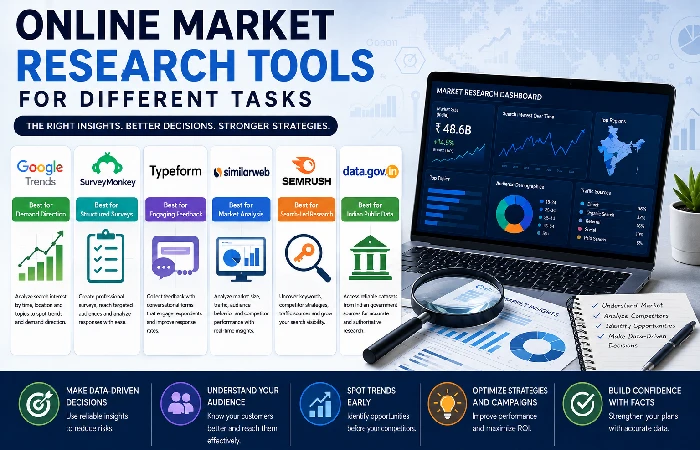
Google Trends compares search interest by time, location and popularity. Researchers can select India, compare states and examine seasonal changes in consumer interest. It is particularly useful for content planning, early product screening and regional demand comparisons.
The figures represent indexed search interest, not exact search volume or sales. A rising graph indicates growing relative attention, but it does not prove commercial demand. Google Trends should therefore be combined with customer and market data.
SurveyMonkey: Best for Structured Surveys
SurveyMonkey supports questionnaires, logic, audience targeting and response analysis. Its market research products include concept testing and price optimisation, while its audience service provides access to respondents outside a company’s existing customer base. SurveyMonkey’s official market research overview describes a global panel with demographic targeting options.
It is suitable for brand studies, customer satisfaction research and product validation. However, access to respondents does not automatically make a study reliable. Biased questions or an unrepresentative sample can still produce misleading results.
Typeform: Best for Engaging Feedback Collection
Typeform presents questions in an interactive, conversational format. It can be useful for customer discovery, purchase-behaviour surveys and post-purchase feedback.
Conditional logic can route respondents through different questions according to their previous answers. The main limitation is that long surveys may still experience respondent drop-off, regardless of their visual presentation.
Similarweb: Best Market Analysis Software
Similarweb provides estimated website traffic, audience behaviour, marketing channels and competitor comparisons. Its market research product is designed to examine market size, growth, competitive positioning and digital demand. Similarweb describes its insights as near-real-time estimates.
It is valuable for digital-first industries, but it does not provide access to a competitor’s private analytics. Smaller websites and offline-heavy sectors may also have less complete coverage.
Semrush: Best for Search-Led Competitor Research
Semrush combines keyword research, competitor visibility, traffic estimates and audience insights. Its Traffic & Market toolkit is intended for competitive benchmarking and market analysis.
The platform can help identify important search topics, competing domains and customer acquisition channels. It is most useful when organic search or paid search is central to the market. It should not be treated as a complete substitute for surveys or financial industry data.
Data.gov.in: Best for Indian Public Data
Data.gov.in provides access to datasets published by Indian ministries, departments and public organisations. Researchers may find data concerning demographics, agriculture, transport, commerce, health and regional development.
It can strengthen reports with local evidence, although researchers should check each dataset’s source, coverage period, methodology and most recent update.
Business Research Tools by Use Case
| Business question | Recommended starting tool | Additional validation |
| Is interest in this category increasing? | Google Trends | Semrush keyword data |
| What features do customers prefer? | SurveyMonkey or Typeform | Customer interviews |
| Which competitors attract online traffic? | Similarweb | Semrush |
| Which states show stronger search interest? | Google Trends | Sales or survey data |
| What official Indian data is available? | Data.gov.in | Industry associations |
| How do customers respond to a new concept? | SurveyMonkey | Small pilot launch |
Market Research Workflow
-
Define the decision
Begin with a specific business decision, such as whether to launch a subscription plan or enter a new Indian city. A broad objective like “understand the market” is difficult to measure.
-
Review existing evidence
Use industry research platforms, public datasets, Google Trends and competitor information to understand the market before conducting a survey.
-
Select the target audience
Specify location, age, buying role, income range or business type where relevant. “Online shoppers in India” may be too broad if the proposed product serves working professionals in Bengaluru and Hyderabad.
-
Collect primary data
Run a short pilot survey first. Check whether respondents understand the questions, then collect the full sample. Interviews can provide context that multiple-choice responses miss.
-
Compare the findings
Look for agreement and disagreement between sources. If search interest is increasing but survey purchase intent is weak, investigate price, trust or availability barriers.
-
Document limitations
Record the sample size, fieldwork dates, data source and assumptions. This helps decision-makers understand what the findings can and cannot establish.
Market Data Collection Tools: Pros and Limitations
| Advantages | Limitations |
| Faster data collection and reporting | Poor research design still produces weak evidence |
| Easier regional and audience comparisons | Third-party figures may be modelled estimates |
| Access to search, traffic and survey information | Premium platforms can become expensive |
| Repeatable reporting and monitoring | Online data can underrepresent offline behaviour |
| Useful charts and exports | Automated summaries may overlook context |
What Results Should You Realistically Expect?
Market research reduces uncertainty; it does not eliminate it. Survey answers may differ from actual buying behaviour, search interest does not equal revenue and competitor traffic figures are normally estimates.
Smaller businesses should initially use free tools and a focused customer survey. Paid industry research platforms become more valuable when the decision involves substantial advertising expenditure, market entry or product development.
For a niche Indian audience, 50 convenient responses can reveal useful themes but should not be presented as representative of the entire country. Larger strategic decisions require a properly selected sample and, where necessary, an experienced researcher.
How to Choose the Right Tool
Consider the following before subscribing:
- Define whether you need customer opinions, competitor data or industry statistics.
- Confirm that the platform covers India and the required audience segment.
- Review data sources, calculation methods and update frequency.
- Exports and reporting tests during a trial.
- Calculate the combined cost of software, respondents and staff time.
- Check privacy, consent and data-retention controls.
- Avoid buying a large platform when one focused study would answer the question.
Frequently Asked Questions
What are the best market research tools for small businesses?
Google Trends, Google Forms and Data.gov.in are practical free starting points. SurveyMonkey or Typeform can support more structured customer feedback, while Similarweb or Semrush may be useful when competitor and search analysis becomes important.
Can market research tools predict sales?
They can identify demand signals, preferences and market patterns, but they cannot guarantee sales. Pricing, distribution, competition, product quality and marketing execution also affect commercial performance.
Are free market research tools reliable?
Free tools can be reliable when their data is used for the right purpose. Researchers should check methodology, dates and sample coverage rather than assuming that free or paid automatically means accurate.
Which tool is suitable for Indian market research?
The choice depends on the question. Google Trends can compare regional search interest, Data.gov.in provides official datasets, and survey platforms can collect responses from a defined Indian audience.
Conclusion
The right market research tool should meet the clear question you are trying to answer. While Google Trends, Data.gov.in provide easy to access secondary data, tools such as SurveyMonkey, and Typeform are great for primary research, while Similarweb and Semrush can be used for digital competitor research.
The best approach to market research is not to limit yourself to one website or service, but complement online market research tools, customer interactions and business data in order to provide a more balanced view of the Indian market and avoid one another of overstating capabilities.
Market Intelligence Tools Resource Hub
Explore essential market intelligence tools for researching markets, monitoring competitors and understanding consumers.
Market Intelligence Tools
A complete guide to tools for collecting, analysing and using market intelligence.
Competitive Intelligence Tools
Track competitors, compare strategies and identify changes in your market.
AI Market Intelligence Tools
Use AI-powered platforms to analyse market data, patterns and emerging trends.
Market Research Tools
Collect reliable data about markets, audiences, demand and opportunities.
Consumer Intelligence Tools
Understand customer needs, preferences, behaviour and purchasing decisions.
Social Listening Tools
Monitor brand mentions, audience conversations, sentiment and market trends.
Market Intelligence Tools for Small Business
Find practical tools that help small businesses research markets and competitors.