



The best AI market intelligence tools extract actionable market insights from massive amounts of market information, monitor competitor movements, observe shifting customer demand, parse online chat and highlight developing possibilities, but they still must integrate with source material, source experts, and human goals.
Table of Contents
What Are AI Market Research Tools?
AI market research tool, which is a software platforms utilizing machine learning, NLP and automated data acquisition to assist the market research.
Depending on the platform, they may process:
- Competitor websites and product pages
- Search demand and website traffic
- Customer reviews and social conversations
- News reports and company announcements
- Sales calls and CRM records
- Survey responses and internal research
- Pricing, advertising and content changes
Traditional market research often provides a snapshot of a market at a particular time. AI-powered market intelligence can support continuous monitoring, although the accuracy and freshness of data vary between providers.
Best AI Market Intelligence Tools Compared
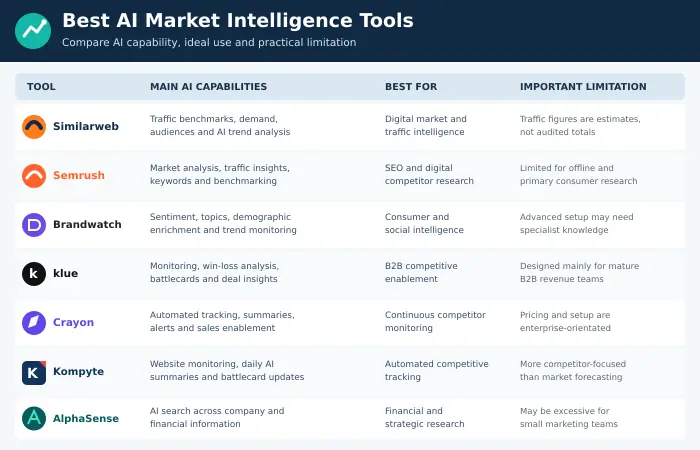
| Tool | Main AI capabilities | Best for | Important limitation |
| Similarweb | Traffic benchmarking, demand analysis, audience insights and AI trend analysis | Digital market and traffic intelligence | Traffic figures are estimates and should not be treated as audited totals |
| Semrush | Market analysis, traffic insights, keyword trends and competitive benchmarking | SEO and digital competitor research | Less suitable for offline industries and primary consumer research |
| Brandwatch | Sentiment analysis, topic detection, demographic enrichment and trend monitoring | Consumer and social intelligence | Advanced setup may require specialist knowledge |
| Klue | Competitor monitoring, win-loss analysis, battlecards and deal-specific insights | B2B competitive enablement | Primarily designed for established B2B revenue teams |
| Crayon | Automated competitor tracking, summaries, alerts and sales enablement | Continuous competitor monitoring | Pricing and implementation are generally enterprise-orientated |
| Kompyte | Website monitoring, daily AI summaries and battlecard updates | Automated competitive tracking | Focuses more on competitors than overall market forecasting |
| AlphaSense | AI-assisted search and analysis across company and financial information | Financial and strategic research | May be unnecessarily advanced for small marketing teams |
Tool features are always subject to change – consider checking data coverage, integration and latest pricing before you buy.
How Leading Tools Differ
Similarweb: Best for Digital Market Analysis
Similar web is suitable for examining digital market size, website traffic, audience behaviour and competitor performance. Its market intelligence covers demand, geography, competitive dynamics and audience insights. Its AI Trend Analyzer is designed to explain changes in online search behaviour by combining keyword data with current web signals. Similarweb
This can be highly beneficial to e-commerce businesses, publishers as well as digital-first companies. However, traffic estimates data might not match their own first-party analytics data.
Semrush: Best for Search and Marketing Intelligence
Semrush is useful when artificial intelligence market analysis is closely connected to SEO, paid search and digital marketing. Its Market Overview dashboard shows competitor positions, traffic distribution and potential market opportunities. Semrush Market Analysis
It is a practical choice for Indian agencies and small businesses that already use Semrush for keyword research. It will not replace interviews, surveys or offline market research.
Brandwatch: Best for Consumer Intelligence
Brandwatch monitors online conversations from the broadest mix of online, social and other content channels. It can help to categorize what the data reveals, using Brandwatch’s AI features by sentiment, topic, geography, emotion and demographic features. Brandwatch Consumer Intelligence
The platform suits consumer brands, research teams and organisations monitoring reputation or changing public opinion. Sentiment results should be manually checked where conversations contain sarcasm, regional language or mixed meanings.
Klue: Best for B2B Competitive Intelligence
Klue combines AI competitive intelligence software with win-loss analysis and sales enablement. It can monitor competitor changes, organise findings into battlecards and distribute intelligence through systems such as Salesforce, Slack and Microsoft Teams. Klue
It is better suited to B2B companies with product marketing and sales teams than to small organisations requiring basic market research.
Crayon: Best for Continuous Competitor Monitoring
Crayon monitors competitor activity and alerts teams when potentially relevant changes appear. It can reduce the manual work involved in reviewing competitor websites, announcements and positioning. Crayon
The platform is appropriate for structured competitive intelligence programmes. Smaller companies may find a combination of alerts, analytics and spreadsheets more economical.
Kompyte: Best for Automated Competitor Updates
Kompyte monitors websites, advertisements, reviews, social activity, content and job postings. Its AI features filter updates, create summaries and help keep sales battlecards current. Kompyte
It is useful when a team wants automated market research tools focused on named competitors. It provides less coverage of broad consumer behaviour than a dedicated consumer intelligence platform.
AI Market Intelligence Workflow
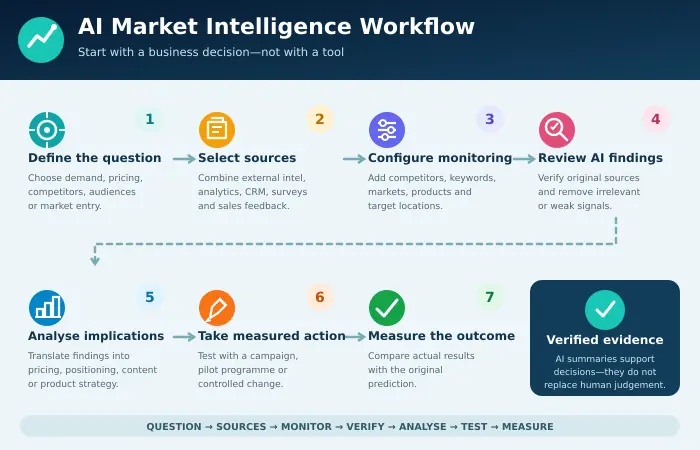
A reliable workflow should begin with a decision rather than a tool.
- Define the question: Decide whether you need to study demand, pricing, competitors, audiences or market entry.
- Select relevant sources: Combine external intelligence with website analytics, sales feedback, CRM data, or surveys.
- Configure monitoring: Add competitors, keywords, markets, products and geographic locations.
- Review AI findings: Check summaries against original sources and remove irrelevant signals.
- Analyse the implications: Determine what the information means for pricing, positioning, content or product strategy.
- Take measured action: Test the decision through a work, pilot or controlled change.
- Measure the outcome: Compare actual performance with the original prediction.
This process prevents teams from confusing automated summaries with verified commercial evidence.
Predictive Market Intelligence: What to Expect
Predictive Market intelligence provides insight into potential futures on the basis of past actions and behaviours combined with current information and trends. It may highlight increasing search demand, changing sentiment or unusual competitor activity.
However, it cannot reliably predict every market change. Results may be affected by incomplete data, sudden regulation, economic disruption, regional differences and changes in customer behaviour.
Businesses should treat predictive output as decision support, not certainty. Important decisions should also use first-party data, financial analysis and experienced human judgement.
Advantages and Limitations
| Advantages | Limitations |
| Reduces repetitive data collection | Results depend on source-data quality |
| Monitors more sources than a small team can manually | AI summaries may omit important context |
| Detect patterns and unusual changes | Sentiment analysis can misinterpret language |
| Supports faster competitor comparisons | Platform estimates may differ from internal data |
| Make recurring research easier to distribute | Enterprise tools can be expensive and complex |
Who Should Use These Tools?
AI market intelligence platforms are useful for:
- Marketing and product strategy teams
- Competitive intelligence professionals
- E-commerce businesses
- B2B sales enablement teams
- Agencies managing several markets
- Consumer research and brand teams
A small business should begin with a clearly defined use case. For example, Semrush may be enough for search-market research, while Similarweb may provide broader digital benchmarking. An enterprise monitoring consumer opinion may require Brandwatch.
How to Choose the Right Platform
Before committing to a subscription, check:
- Whether the platform covers Indian data and regional languages
- Which sources are included
- How often the information is refreshed
- Whether findings link back to original evidence
- CRM, analytics and collaboration integrations
- User limits and export restrictions
- Data privacy and retention policies
- Availability of a trial or proof of concept
- Total annual cost, including onboarding and training
Test the platform using a competitor or market that your team already understands. This makes it easier to identify inaccurate or incomplete results.
Frequently Asked Questions
What are the best AI market intelligence tools?
The right AI market intelligence tools depend on how you plan on using it. Some of the tools like:
– Similarweb is more appropriate for digital market intelligence.
– Semrush is more suited for search intelligence.
– Brandwatch for consumer conversation.
– While Klue, Crayon and Kompyte for competitive intelligence.
Can AI replace traditional market research?
No. AI can accelerate data collection and analysis, but interviews, surveys, customer observation and expert interpretation remain important.
Are automated market research tools accurate?
They can identify useful patterns, but accuracy depends on the platform’s sources, methodology and market coverage. Results should be compared with first-party data.
Are these tools suitable for Indian businesses?
Yes, but coverage varies. Businesses should test geographic depth, Indian competitor data, local search behaviour and support for regional languages before purchasing.
Conclusion
AI market intelligence tools offer a faster, more regular way to track competitor actions, understand customer behavior and identify industry trends. Tools such as Similarweb and Semrush are well-suited to digital market intelligence, while Brandwatch excels at gathering discussions online; for a systematic competitive intelligence approach, try tools such as Klue, Crayon or Kompyte.
Market Intelligence Tools Resource Hub
Explore essential market intelligence tools for researching markets, monitoring competitors and understanding consumers.
Market Intelligence Tools
A complete guide to tools for collecting, analysing and using market intelligence.
Competitive Intelligence Tools
Track competitors, compare strategies and identify changes in your market.
AI Market Intelligence Tools
Use AI-powered platforms to analyse market data, patterns and emerging trends.
Market Research Tools
Collect reliable data about markets, audiences, demand and opportunities.
Consumer Intelligence Tools
Understand customer needs, preferences, behaviour and purchasing decisions.
Social Listening Tools
Monitor brand mentions, audience conversations, sentiment and market trends.
Market Intelligence Tools for Small Business
Find practical tools that help small businesses research markets and competitors.