
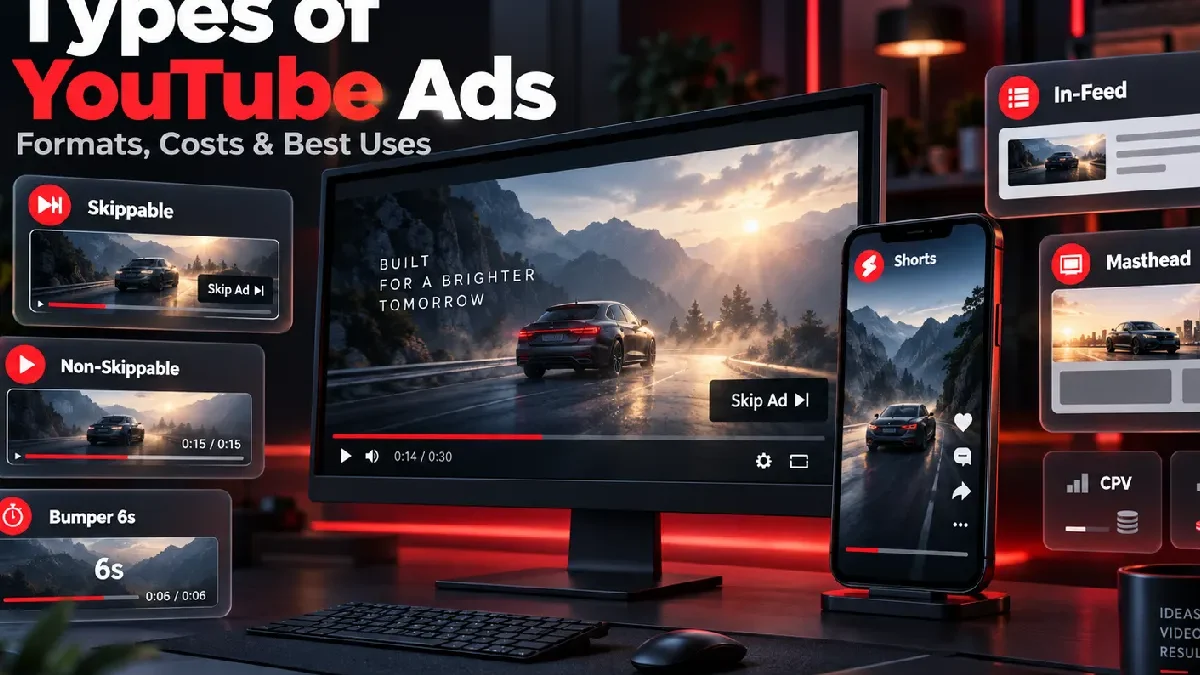

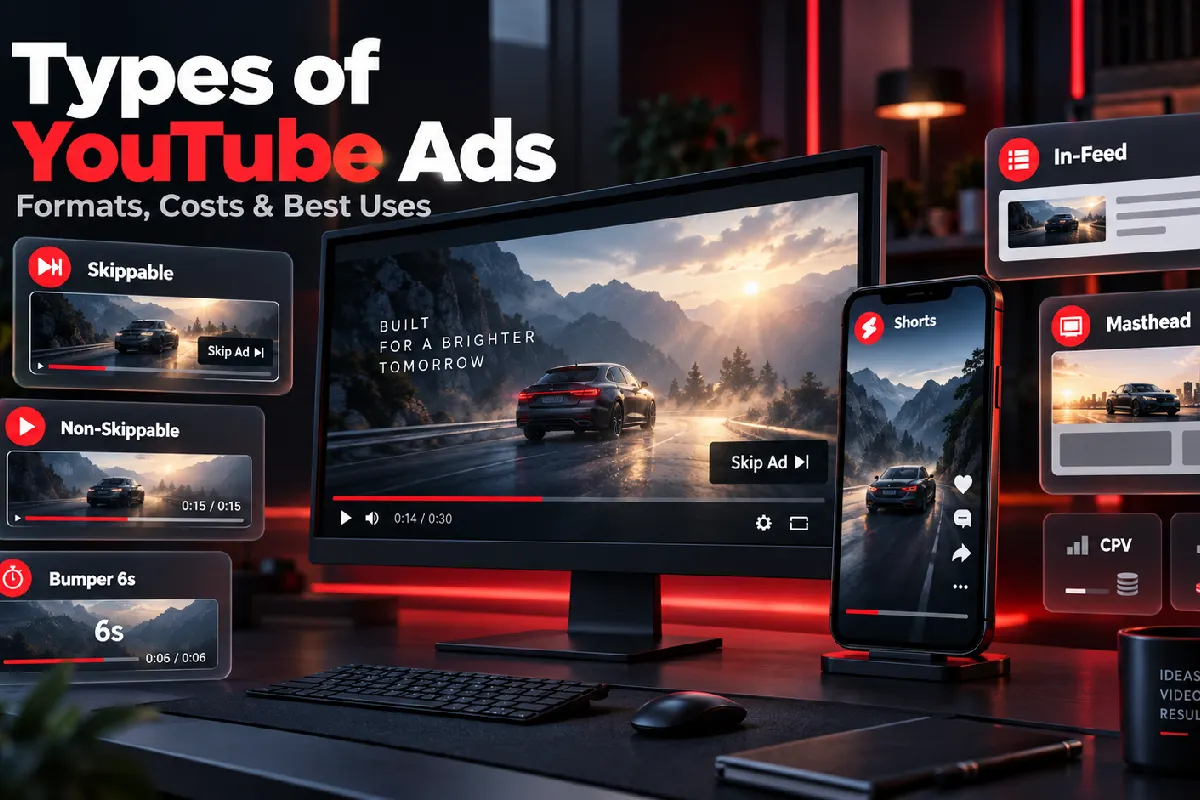


The various types of YouTube Ad are useful for marketers; allowing them to pick an ad that aligns to their objective, creative and budget. A short bumper ad may enhance brand recall whereas an in-stream skippable ad may educate consumers about a product and prompt consumers to click on an advert to visit a webpage.
Table of Contents
This Article Is Part of the Youtube Marketing Resource Hub
Explore more guides, tutorials, strategies, and marketing resources inside our Youtube Marketing Resource Hub .
Google Ads has 6 primary video ad formats to use with its system. These formats include skippable in-stream, non-skippable in-stream, in-feed, bumper, Masthead, and Shorts ads.
Types of YouTube Ads Guide
| YouTube ad format | Where it appears | Typical length | Common billing basis |
| Skippable in-stream | Before, during or after videos | No maximum; under 3 minutes recommended | CPV or impression-based |
| Non-skippable in-stream | Before, during or after videos | Up to 60 seconds, depending on campaign | Target CPM |
| Bumper | Before, during or after videos | 5–6 seconds | Target CPM |
| In-feed video | Search, Home, Watch Next and subscriptions | No fixed maximum | Click/view-based |
| YouTube Shorts | Between organic Shorts | Under 60 seconds recommended | View, engagement or impression |
| Masthead | YouTube homepage | Varies by device | CPM or cost per hour |
Availability can depend on the campaign objective, subtype, account and buying method.
1. Skippable In-Stream Ads
Skippable in-stream advertisements play before, during or after another video. Viewers can skip them after five seconds.
For CPV bid strategy, normally Google would charge if someone watched 30 seconds, or watch the entire ad if the length is less than 30 seconds or interacts with the ad-whichever occurred earlier. It is possible to have impression-based bidding, with different campaign strategies.
This may work for the demonstration as well as for customer stories, perhaps more for an ad campaign / commercials over a short duration (e.g. More than few seconds).
2. Non-Skippable In-Stream Ads
Unskippable ads, the longer ones, can’t be skipped by the user; they’ll have to view the entire message. While some campaign subtypes have up to 60-second limits according to Google, it’s best for advertisers to use no more than enough time to deliver their message clearly.
The typical purchase type for these ads is target CPM whereby the advertiser pays for each impression.
They offer wide exposure, however forced exposure does not necessarily promise the interest, sentiment nor purchase intention
3. Bumper Ads
Bumper advertisements are non-skippable videos lasting between five and six seconds. They are designed for one short, memorable message.
A bumper might introduce a product name, reinforce a sale date or repeat the main benefit from a longer campaign. Trying to include several claims usually makes the creative difficult to understand.
Bumper ads use target CPM billing.
4. In-Feed Video Ads
In-feed ads appear to users where they would find content – for instance YouTube Search, homepage, Watch Next feed and subscriptions feed
The advertisement generally contains a video thumbnail and text. Users choose to click and watch, making the format useful for tutorials, product explainers, interviews and longer educational videos.
Billing normally occurs when someone clicks to watch. In Video View campaigns, a charge may also occur when the video autoplays for at least ten seconds.
5. YouTube Shorts Ads
Shorts advertisements appear between organic videos in the Shorts feed. Users can swipe away immediately, so the opening visual and message need to earn attention quickly.
Google recommends a video shorter than 60 seconds for this mobile-oriented experience. Vertical creative is generally better suited to the placement than simply cropping a horizontal television advertisement.
Depending on bidding, advertisers may pay for impressions, eligible views or engagements.
6. YouTube Masthead Ads
Masthead ads are positioned in a prominent space at the top of the YouTube homepage on supported devices. These are generally used in connection with significant product/service launches, entertainment release promotions, or large-scale branding initiatives.
Unlike standard self-service formats, Masthead inventory is available on a reservation basis through a Google sales representative. It can be purchased using cost-per-thousand impressions or cost-per-hour pricing.
This format is normally unsuitable for small advertisers with limited test budgets.
Best Types of YouTube Ads by Objective
| Advertising objective | Suitable starting format | Reason |
| Broad awareness | Bumper or non-skippable | Delivers a complete short message |
| Video views | Skippable in-stream or in-feed | Encourages active viewing |
| Product education | Skippable in-stream | Provides time for explanation |
| YouTube search discovery | In-feed | Appears during content discovery |
| Mobile-first reach | Shorts | Fits vertical, swipe-based viewing |
| Major national launch | Masthead | Provides prominent homepage visibility |
| Leads or online sales | Skippable in-stream or Shorts | Can support calls to action and conversion bidding |
There is no single best format for every campaign. The objective and creative idea should determine the choice.
Types of YouTube Ads for Beginners
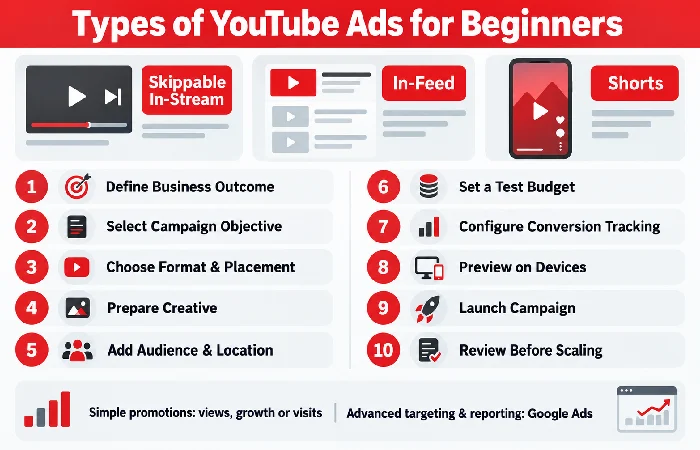
Beginners should usually start with skippable in-stream, in-feed or Shorts advertisements through Google Ads. These formats provide accessible campaign setup and support different audience actions.
Use this workflow:
- Define the required business outcome.
- Select a suitable campaign objective.
- Choose the video format and placement.
- Prepare creative for the viewing environment.
- Add audience and location targeting.
- Set a controlled test budget.
- Configure website conversion tracking where required.
- Preview the advertisement on relevant devices.
- Launch the campaign.
- Review results before increasing the budget.
YouTube Studio promotions can offer a simpler workflow for views, audience growth or website visits. Google recommends Google Ads when more advanced targeting and reporting are required.
Types of YouTube Ads Cost
YouTube does not have one fixed advertising price. Cost depends on:
- Ad format
- Bidding strategy
- Audience competition
- Location and language
- Campaign objective
- Creative performance
- Season and industry
- Placement settings
| Pricing method | What normally triggers cost |
| CPV | An eligible view or interaction |
| CPM | One thousand impressions |
| Target CPM | Delivery optimised towards an average impression cost |
| CPA-based bidding | Delivery optimised towards conversions |
| CPH | Reserved Masthead exposure for a defined time |
Indian advertisers should begin with an affordable learning budget rather than expecting a universal cost per view or conversion.
Types of YouTube Ads Examples
A software company could use a skippable advertisement to demonstrate a feature before asking viewers to book a trial.
A food-delivery brand might use a six-second bumper to reinforce a discount code. A training provider could use in-feed advertising to promote a detailed tutorial appearing in search results.
A fashion retailer may create vertical Shorts showing several outfits, while a film studio could reserve Masthead placement for a major release.
Types of YouTube Ads Tips
- Communicate the main idea early
- Design for mobile and television screens
- Add captions where speech is important
- Match the landing page to the advertisement
- Create vertical assets for Shorts
- Test several opening sequences
- Measure conversions as well as views
- Avoid changing every campaign variable simultaneously
- Check frequency and audience quality
- Follow Google Ads policies
Performance Expectations and Limitations
YouTube advertisements can provide reach, views or website activity, but none of the formats guarantees sales. Viewers may remember a message without clicking immediately, while some clicks may never become customers.
Compare campaign results with business outcomes such as qualified leads, purchases and revenue. Allow enough time and budget for meaningful testing before judging performance.
Frequently Asked Questions
What are the main types of YouTube Ads?
They include skippable in-stream, non-skippable in-stream, bumper, in-feed video, Shorts and Masthead advertisements.
Which YouTube ad format is best for beginners?
Skippable in-stream, in-feed and Shorts formats are practical starting options. The right choice depends on the campaign objective and available creative.
What is the cheapest type of YouTube advertisement?
No format is always cheapest. Auction competition, audience, bidding and creative quality affect the final cost and value.
Can a YouTube advertisement appear outside YouTube?
Some video formats can appear across websites and applications included in Google video partners when the campaign settings permit it.
Conclusion
The right choice among the types of YouTube Ads depends on where the audience should encounter the message and what action should follow. Match the format to the objective, prepare placement-specific creative and judge success using meaningful business results rather than views alone.
YouTube Ads Hub
Explore our YouTube advertising guides covering ad formats,
advertising costs in India, campaign creation, targeting options,
specifications and optimisation.
YouTube Ads Complete Guide →