
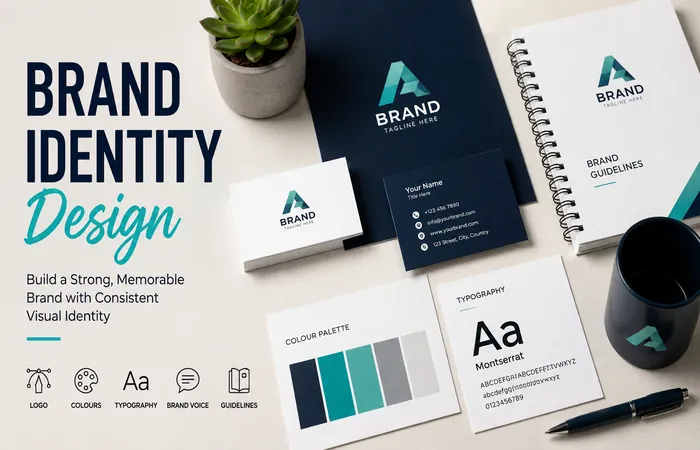



The success of a business can’t be achieved with a trendy logo only. Designing an appropriate brand identity with graphic designs, communication style, and rules will tell your brand story and show the real characteristics of your business. For start-up companies or even existing ones that are looking to refurbish the identity, uniform branding will strengthen the visibility and authority in market. In this guide we cover all about what are the elements in a brand identity design, how brand identity works, what to expect when building it and provide you with professional tips on brand design.
Table of Contents
This Article Is Part of the Marketing Resource Hub
Explore more guides, tutorials, strategies, and marketing resources inside our
Marketing Resource Hub .
What Is Brand Identity Design?
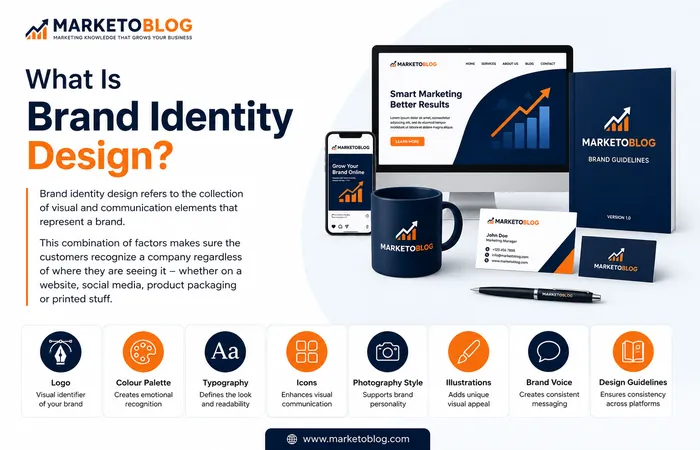
Brand identity design refers to the collection of visual and communication elements that represent a brand.
These include:
- Logo
- Colour palette
- Typography
- Icons
- Photography style
- Illustrations
- Brand voice
- Design guidelines
This combination of factors makes sure the customers recognize a company regardless of where they are seeing it whether on a website, social media, product packaging or printed stuff.
Brand Design Elements
Every successful brand identity is built upon several core components.
| Element | Purpose |
| Logo | Primary visual identifier |
| Colour Palette | Creates emotional recognition |
| Typography | Improves readability and consistency |
| Imagery | Supports brand personality |
| Icons & Graphics | Reinforces visual communication |
| Brand Voice | Creates consistent messaging |
| Style Guide | Ensure consistency across platforms |
Rather than aiming on a single design element, businesses advantage most when these mechanisms work together as one cohesive system.
Visual Brand Identity
A visual brand identity is the collection of design assets customers instantly recognise.
Examples include:
- Website design
- Social media graphics
- Business cards
- Email signatures
- Product packaging
- Presentation Templates
- Advertising creatives
A consistent visual identity reduces confusion and makes a company appear more established.
Expectations
Visual identity alone cannot guarantee increased sales. However, it can improve brand recognition, strengthen credibility, and support marketing efforts when combined with quality products or services.
Brand Identity System
A brand identity system provides documented rules for using brand assets consistently.
Typical components include:
- Logo usage rules
- Colour specifications
- Typography hierarchy
- Icon library
- Photography guidelines
- Social media templates
- Presentation templates
- Print standards
Without these guidelines, different teams may by mistake create unreliable branding across several marketing channels.
Logo and Brand Identity
Many people mistake a logo with a complete brand identity.
| Logo | Complete Brand Identity |
| Single graphic symbol | Entire visual system |
| Brand identifier | Complete customer experience |
| One design asset | Multiple coordinated assets |
| Cannot build a brand alone | Supports long-term recognition |
A workwise designed logo is an essential starting point, but it signifies only one part of the overall identity.
Professional Brand Design
“Looks don’t matter – for your target group nothing else matters.” That differentiates a business-strategic brand design from a just beautiful design. And a businessman must know if he has one.” Explore professional design principles from the American Institute of Graphic Arts (AIGA).
Experienced designers typically research:
- Target audience
- Industry competitors
- Brand values
- Customer behaviour
- Market positioning
- Communication style
This strategic method helps create an identity that associates with business objectives rather than following short term design trends.
Brand Identity Design Workflow
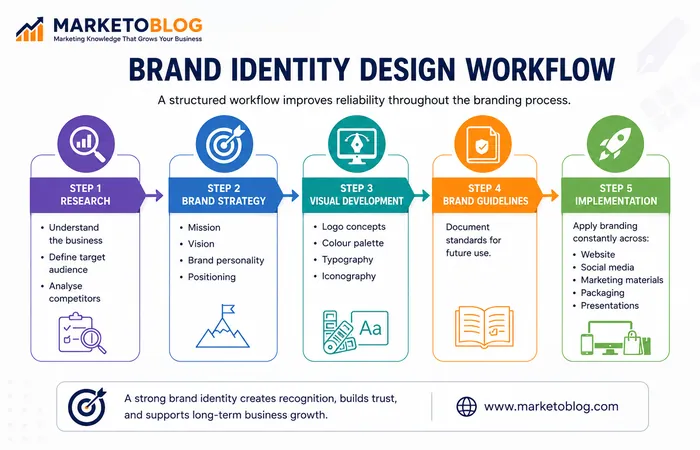
A structured workflow improves reliability throughout the branding process.
Step 1: Research
- Understand the business
- Define target audience
- Analyse competitors
↓
Step 2: Brand Strategy
- Mission
- Vision
- Brand personality
- Positioning
↓
Step 3: Visual Development
- Logo concepts
- Colour palette
- Typography
- Iconography
↓
Step 4: Brand Guidelines
Document standards for future use.
↓
Step 5: Implementation
Apply branding constantly across:
- Website
- Social media
- Marketing materials
- Packaging
- Presentations
Benefits and Limitations of Brand Identity Design
Benefits
- Improves brand recognition
- Builds customer trust
- Creates consistency
- Supports marketing campaigns
- Makes businesses appear more professional
- Helps differentiate from competitors
Limitations
- Results take time
- Does not replace quality products
- Requires consistent implementation
- May need updates as businesses evolve
Brand identity should be viewed as a long term investment rather than a quick and easy marketing solution.
Choosing the Right Brand Identity Approach
Different organizations require different levels of branding.
| Business Type | Recommended Approach |
| Small business | Basic visual identity |
| Local service | Professional logo and brand guidelines |
| E-commerce | Complete visual identity system |
| SaaS company | Comprehensive branding system |
| Enterprise | Full strategic brand identity programmer |
Common Mistakes to Avoid
Businesses often decrease the success of their branding by:
- Frequently changing logos
- Using inconsistent colors
- Mixing multiple fonts
- Ignoring brand guidelines
- Complying competitor designs
- Prioritizing trends in usability
Maintaining consistency is often more valuable than regularly redesigning visual assets.
Realistic Performance Expectations
A professional brand identity supports marketing performance, but it is only one part of business success.
Businesses can reasonably expect:
- Better brand recognition over time
- More consistent customer experiences
- Improved marketing consistency
- Stronger professional appearance
However, branding only will not warranty increased profits, higher search rankings, or customer reliability without quality products, successful marketing, and positive customer experiences.
FAQS
What is brand identity design?
It is the strategy to design visual, written and communication systems that represent the essence of a company, in a coherent way across the various communication channels (digital and offline).
Why is brand identity necessary?
The importance of brand identity relies on the ability for the potential customer to recognise your business, build trust, give coherence to communication across various channels.
Is the logo the same as branding?
No. The logo is only one of the visual elements, even though an important one. The brand identity is composed by logo, colours,typography, iconography, language and rules (brand guidelines).
When does a company need to redesign their brand identity?
Often the change of brand identity only occurs when you decide to enter into a new market, the brand has a repositioning or is now out-dated visually.
Can a small business have a good brand identity design?
Yes, the basic principles of the design process will give a structure to visual identity and can help smaller businesses gain authority on the market.
Conclusion
Design the brand identity of a company involves creating an internal and external coherent visual language for the firm to enable it to be recognizable and to build relationships and credibility.
The coherence between brand identity elements can be found on web sites, social network accounts, printed and digital advertising. Although the brand identity design cannot guarantee to bring you clients and therefore make money, the consistency of a business image has a direct impact on sales and relationships with the customer base.