

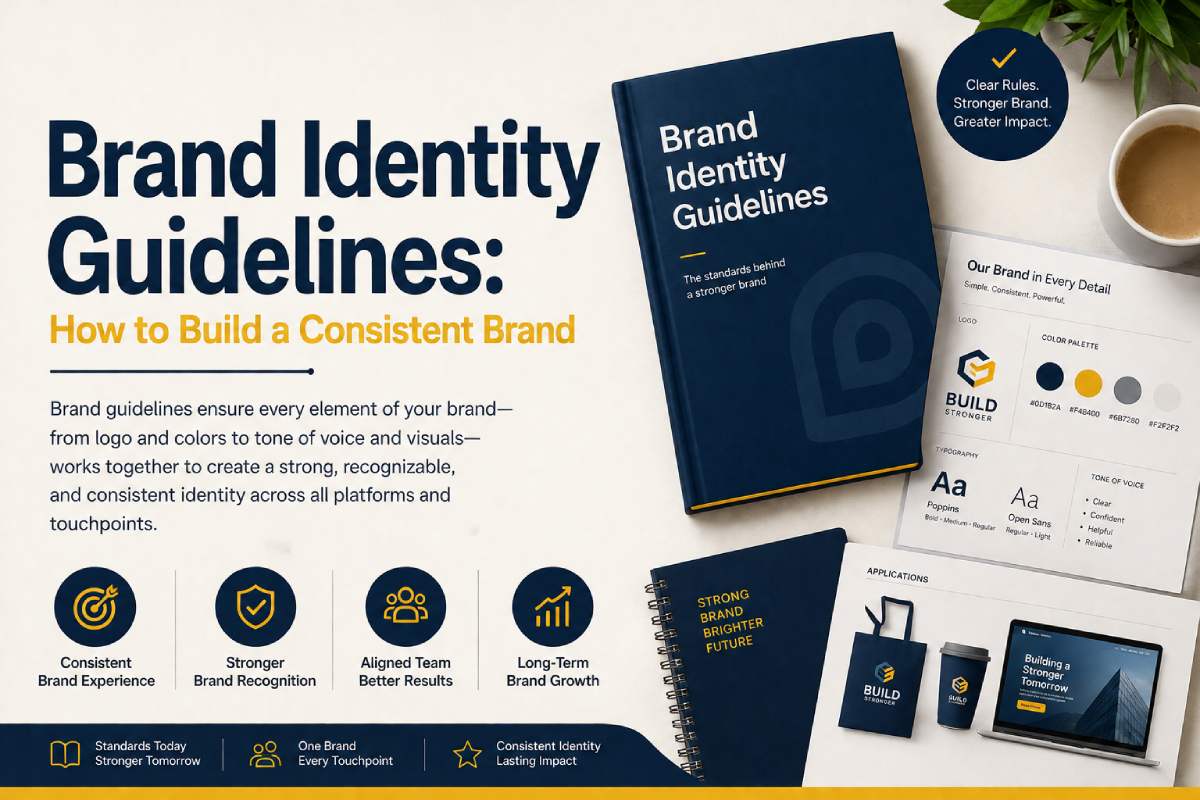


Guideline a strong visual identity ensures a company communicates a single message no matter where customers find or encounter it. This provides all members of the company and its partners with a constant touchstone for when it comes to use of its logo, colour palette, typography, imagery as well as language.
For an Indian small business, these guidelines do not need to begin as a lengthy corporate manual. A clear, practical document covering the main identity elements is often enough. It can then develop as the business enters new markets, introduces products or starts working with more contributors.
Table of Contents
What Are Brand Identity Guidelines?
Brand identity guides are guidelines to determine the way a particular organization’s brand elements – both in text and design- must be implemented. They convey your organizational identity into easily replicated practices such as being used on websites, on your social media pages, on merchandise, in presentations and ads. It guides what printed matter should look like too.
There can be many different words associated with the term ‘the brand book’- ‘brand guide’, ‘brand manual’, ‘brand bible’, ‘brand identity guide’ or ‘branding style guide’. They can all have very subtle differences, but people often use many of these terms synonymously. Essentially, whereas a minimal guide might just specify design standards, a full brand identity document would go into brand values, brand audience, brand positioning, voice etc.
The purpose is not to make every design identical. It is to establish recognizable boundaries within which teams can work creatively.
Why Brand Identity Standards Matter
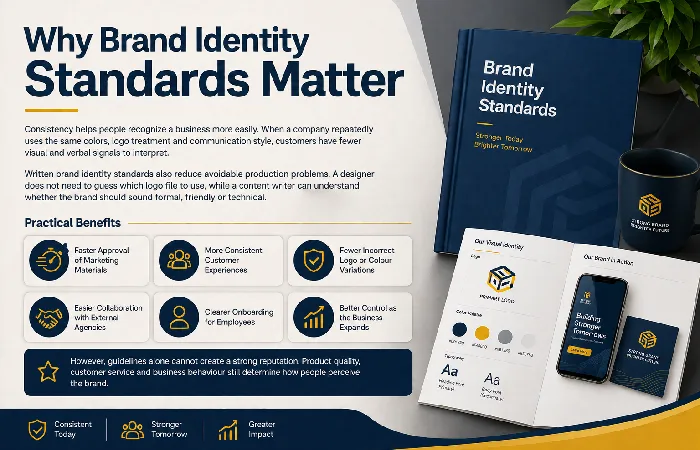
Consistency helps people recognize a business more easily. When a company repeatedly uses the same colors, logo treatment and communication style, customers have fewer visual and verbal signals to interpret.
Written brand identity standards also reduce avoidable production problems. A designer does not need to guess which logo file to use, while a content writer can understand whether the brand should sound formal, friendly or technical.
Practical benefits include:
- Faster approval of marketing materials
- More consistent customer experiences
- Fewer incorrect logo or colour variations
- Easier collaboration with external agencies
- Clearer onboarding for employees
- Better control as the business expands
However, guidelines alone cannot create a strong reputation. Product quality, customer service and business behaviour still determine how people perceive the brand.
What Should a Brand Style Guide Include?
Brand Purpose and Positioning
Begin with a short explanation of what the organisation does, who it serves and what makes it meaningfully different. Avoid broad claims such as “the best service in India” unless there is reliable evidence to support them.
A useful positioning statement should answer three questions:
- Who is the main audience?
- What problem is the business address?
- Why might customers choose it over another option?
Logo Usage Guidelines
Detailed logo usage guidelines avoid stretching, recoloring and poorly positioned logos. Include the primary logo, alternative formats, icon version and monochrome options.
Specify minimum display sizes and the clear space required around the logo. Add examples showing unacceptable treatments, such as adding shadows, changing proportions or placing the mark over a visually crowded background.
Colour and Typography Rules
The principal color and complementary tones should be stated, including hex, RGB and CMYK values and when requested Pantone specification. The hex or RGB will often be requested to your digital team whereas on occasion printers may request this to be formatted as CMYK or Pantone color specification.
For typography, identify the main heading, subheading and body fonts. Include accessible alternatives for email, documents or devices where the preferred font is unavailable.
Visual Branding Rules
They also include standards on which photograph, illustration, icon, graphics and video thumbnail style need to be utilized. As an illustration, some fiscal organizations will like plain data graphics whereas a lifestyle companies’ visual identity will normally be likely towards people today oriented photos, extra all-natural or natural.
Contrast Accessibility Text alignment should be considered in the guide. Accessibility should never take a back step due to consistency.
Brand Voice and Messaging
Describe how the organization should sound. Replace vague descriptions such as “professional yet friendly” with practical instructions and examples.
For instance:
| Brand element | Recommended approach | Avoid |
| Tone | Clear, informed and approachable | Aggressive sales language |
| Sentences | Direct and reasonably concise | Unnecessarily complex wording |
| Claims | Specific and evidence-based | “Guaranteed” or “number one” |
| Calls to action | Helpful and relevant | Excessive urgency |
| Technical terms | Explain when first used | Unexplained jargon |
How to Create Brand Identity Guidelines
-
Existing Brand Materials Audit
Collect the logo files, website pages, advertisements, packaging, social posts and presentations currently in use. Note inconsistencies and identify elements that customers already associate with the business.
-
Define the Brand Foundation
Clarify the target viewers, values, personality and positioning. Design choices should support this organization rather than follow short lived trends.
-
Establishthe Core Identity System
Select the authorized logos, color palette, typography, imagery and icon style. Test them on mobile screens, desktop versions, social media, printed documents and light or dark backgrounds.
Document Correct and Incorrect Uses
People understand standards more quickly when they can compare good and bad examples. Include realistic situations rather than only displaying isolated design assets.
-
Review, Approve and Distribute
Ask key decision-makers to approve the document. Store the latest version in a shared location with downloadable logo files, font information and reusable templates.
-
Review the Guidelines Regularly
Review the guide every 6–12 months or after a major change in positioning, audience, product range or visual identity. Small updates are generally safer than repeatedly redesigning the entire brand.
Simple Branding Guidelines Template
A practical branding guidelines template can follow this order:
| Section | Information to include |
| Brand overview | Purpose, audience, values and positioning |
| Logo system | Approved versions, spacing and minimum size |
| Colour palette | HEX, RGB, CMYK and colour combinations |
| Typography | Heading, body and fallback fonts |
| Imagery | Photography, illustration and icon direction |
| Voice | Tone, terminology and sample messages |
| Applications | Website, social, print and packaging examples |
| Asset access | Links to current files and templates |
A small business may cover these elements in 10–15 pages. A company managing several products, languages or regions may require a more extensive system.
What Guidelines Can and Cannot Do
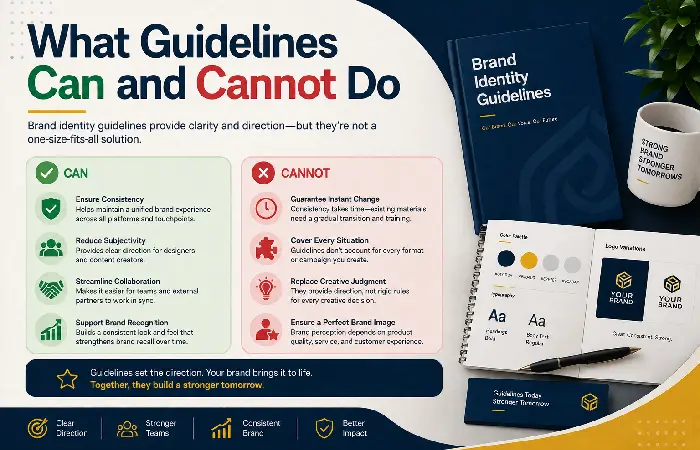
Consistency may come as soon as you’ve developed the new guide, but you won’t be completely updated overnight. Inevitably, existing elements and resources will need to be slowly transitioned; a good number will want some training.
Standards eliminate some subjectivity for designers but won’t account for every format or campaign. You can maintain a guidelines system, rather than write prescriptive text.
Not that I’m above it all… As with any guide or standards the tight controls leave you with a boring site, loose control leaves too much to imagination, I think the happy medium is strict on brand core assets and loose on execution.
Common Mistakes to Avoid
Dont implement rules for managers and only, let everyone in touch with clients, the employees as well as clients to use the most recent available set of logos and rules. Other mistakes common in this process are color palettes without numeric codes, not providing downloadable files, overlooking the aspects related to a web-accessible solution, absent example and very volatile rebranding process.
Brands, while doing so, also need to consult their legal department and ensure no name or symbols are being misused in terms of their trademarked rights before embarking on further use.
Frequently Asked Questions
What are brand identity guidelines used for?
Brand identity guidelines help employees, designers and partners use and present a company’s logo, colors, typeface, imagery and copy both on-line and in physical spaces accurately.
How long should a brand style guide be?
No fixed length. It can be as short as 10-15 clear pages for a small organization or as long as a more complex online integrated system with templates and specific channel guides for a multi-brand company.
Should small businesses create logo usage guidelines?
Yes. The simple guide covering the approved files, spacing, Midsize, colors and not allowed changes can prevent frequent diverse logo applications.
How often should branding guidelines be updated?
Go over them regularly, at least once a year. More often if the organization’s positioning, target audience, products or main channels of communication change. You don’t need to redesign every time you review.
Conclusion
Good brand guidelines convert creative choices into clear directions that your team can understand and implement. Begin by setting clear basics for logos, colours, typefaces, tone of voice and imagery, and supplement these rules with real-world examples for your key customer communications channels.
They should set a standard, without inhibiting sound judgment when it comes to creating innovative solutions, and with sufficient and up-to-date visual aids in support, they shouldn’t be “just a document.”