
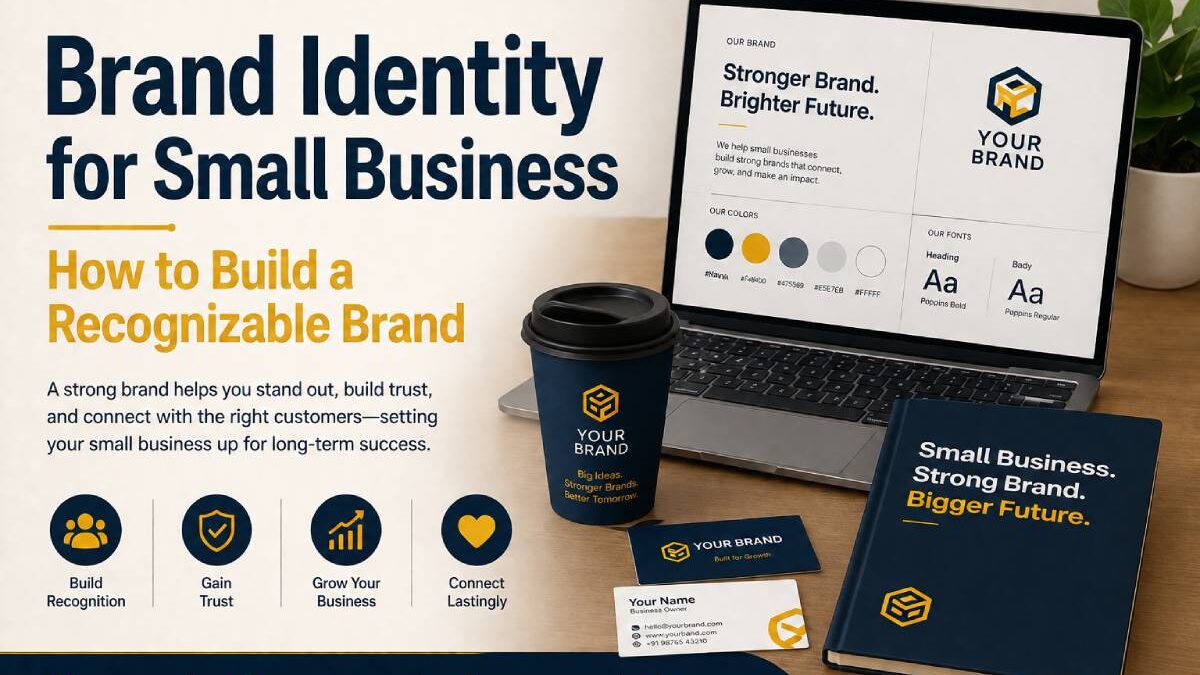

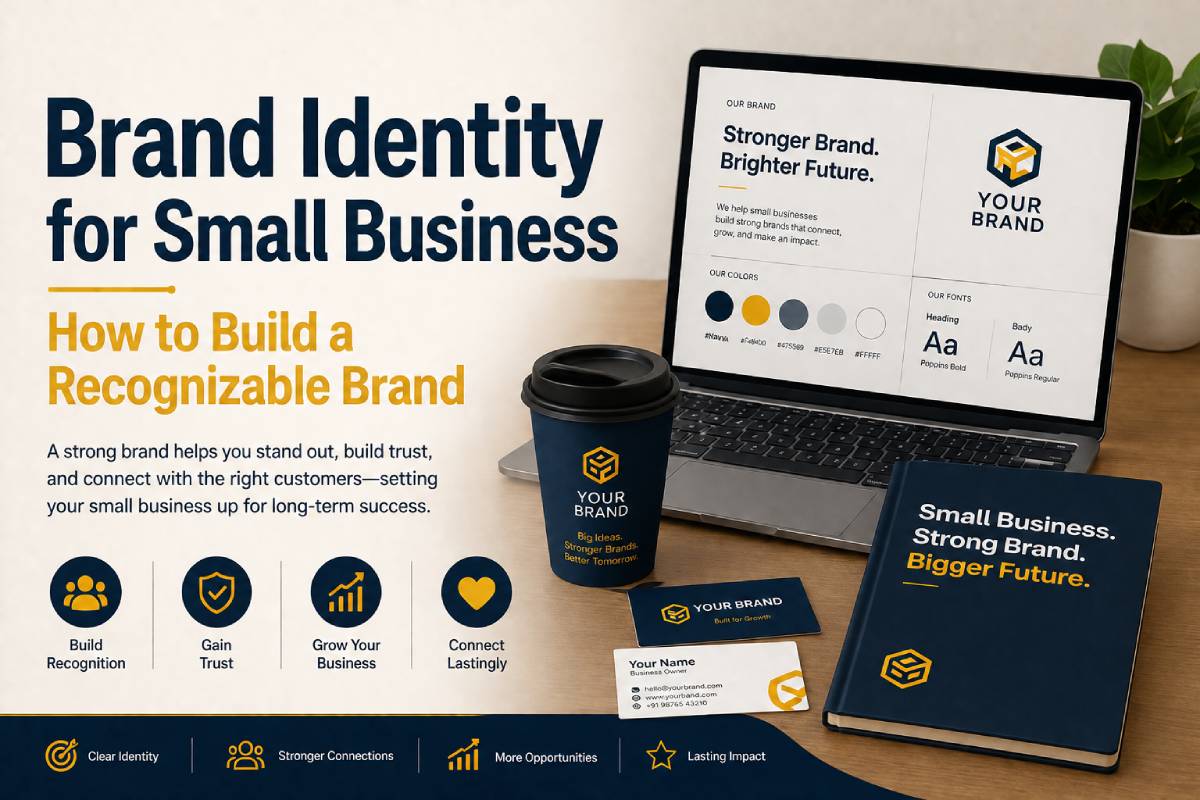


Creating brand identity for small businesses is not just about having a nice logo. It is about understanding what business should explore like, what business should normal like, and what business should feel like when a customer cooperates with it. A small business with a brand identity can seem more trustworthy, clearly tell people what it is about and stick in people’s minds when there are a lot of other companies trying to sell the same things.
You do not need a lot of money to make this work. What is important is that you have a plan and you use it all the time on your website, social media, packaging and when you talk to your customers.
Table of Contents
What Does Small Business Branding Include?
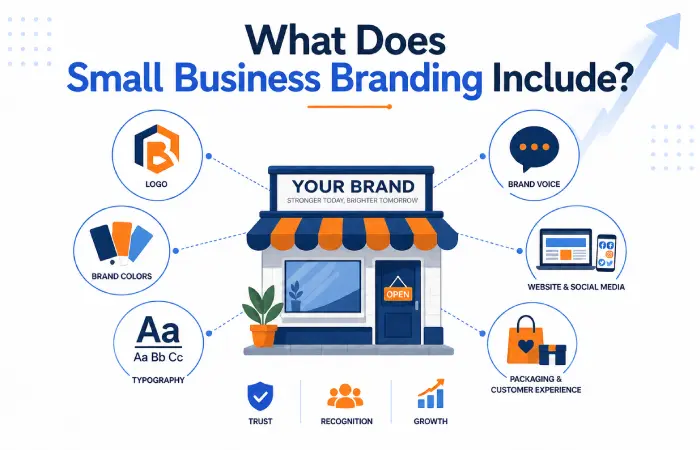
Small business branding is the way a company is seen and identified by people. It includes planning, looking good and talking to customers.
A complete identity normally includes:
- Business name and tagline
- Logo and alternative logo versions
- Primary and secondary colours
- Brand typography
- Photography or illustration style
- Tone of voice
- Mission, values and positioning
- Customer service experience
These parts need to work as a team. A strong logo alone cannot fix messages that’re not clear services that are not the same every time or a website that shows a totally different feeling.
Brand Identity, Branding and Brand Image Compared
These terms are connected, but they do not mean just the same thing.
| Term | Meaning | Small business example |
| Brand identity | Elements created and controlled by the business | Logo, colours, packaging and tone |
| Branding | The ongoing process of presenting and managing the brand | Advertising, content and customer communication |
| Brand image | How customers actually perceive the business | Affordable, premium, friendly or dependable |
| Brand strategy | The plan guiding positioning and communication | Target audience, promise and market difference |
A business controls its identity and branding activities. However, its brand image is formed by customers based on their complete experience.
Why Brand Identity Matters for a Small Business
Small companies often compare with established brands that have significant advertising budgets. A clear identity can make that competition more manageable.
Consistency helps customers connect different interactions with the same business. Someone who sees a social media post should be able to recognise the brand when visiting its website or receiving its packaging.
A well-planned identity may also:
- Improve brand recognition
- Build a more professional appearance
- Clarify what the business offers
- Support consistent marketing
- Make content creation easier
- Help employees communicate in a similar way
Brand identity does not create trust automatically. Trust develops when the company’s visual promises are supported by product quality, transparent information and dependable customer service.
Creating a Brand Identity for Small Business
Step 1: Define Your Target Customer
Begin with the people the business is expected to serve. Consider their needs, budgets, locations, buying habits and common concerns.
For example, a financial consultancy serving Indian start-ups should probably communicate differently from a handmade gift shop aimed at young consumers. Trying to appeal to everyone usually produces a generic identity.
Step 2: Establish Your Brand Position
Positioning explains where the business turns within its market. Write clear answers to these questions:
- What problem does the business solve?
- Who is the primary customer?
- What makes the offer meaningfully different?
- Why should customers believe in the business?
- What feeling should the brand create?
Use specific and supportable differences. Claims such as “best quality” or “number one service” are difficult to prove and rarely create useful positioning.
Step 3: Develop a Business Branding Strategy
A practical business branding strategy should define the brand’s purpose, values, personality, promise and key message.
One useful positioning statement is:
This is an internal guide rather than an advertising slogan. It helps the business evaluate future messaging and design decisions.
Step 4: Choose Visual Identity
Select a logo, color palette, typography and image style that support the meant personality.
Business does not need many colors or fonts. Two principal types and a limited color palette are normally difficult to manage. Check that text remains clear on mobile screens and that the logo works at both large and small sizes.
Step 5: Create a Consistent Voice
Decide whether the brand should sound friendly, direct, technical, comforting or formal. Document several examples of phrases the company would and would not use.
A legal service might need a calm and precise voice. A youth focused fitness brand may use shorter, more energetic language while avoiding unsupported health promises.
Step 6: Document and Apply the Identity
Create basic guides covering logo usage, colors, fonts, imagery and tone. Apply them to priority customer touchpoints first:
- Website
- Social media profiles
- Email templates
- Sales documents
- Packaging or printed materials
- Business listings
Review these touchpoints periodically to catch inconsistencies.
Affordable Brand Identity Design Options
Affordable brand identity design does not have to look careless. A small company can control costs by completing its research and positioning before hiring a designer.
| Approach | Typical advantage | Main limitation | Suitable for |
| DIY design tools | Low initial cost | Greater risk of generic results | Testing an early idea |
| Freelance designer | Flexible scope and pricing | Quality and experience vary | Small businesses with a clear brief |
| Branding studio | Strategy and design support | Higher investment | Established businesses repositioning |
| Phased development | Spreads work and cost over time | Requires careful consistency | Growing businesses |
Free design tools can help create early assets, but templates may also be used by many other companies. Customisation and consistent application are therefore important.
Branding Tips for Small Business Owners
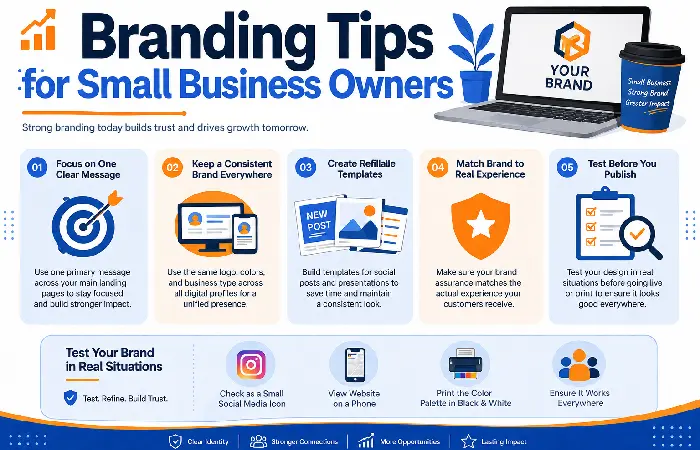
Effective branding tips for small businesses usually focus on clarity rather than decoration. Use one primary message across your main landing pages. Keep the same logo, colors and business type across digital profiles. Create refillable templates for social posts and presentations. Most importantly, make sure that the brand assurance matches the customer’s actual occurrence.
Before accepting any design, test it in practical situations. Check the logo as a small social media icon, view the website on a phone and print the color palette in black and white.
Common Startup Brand Identity Mistakes
A new company can unintentionally weaken its startup brand identity by making too many changes too quickly.
Common mistakes include:
- Copying a competitor’s visual style
- Designing before defining the audience
- Using too many fonts and colours
- Following every short-term design trend
- Changing the logo repeatedly
- Using an inconsistent tone
- Making claims without evidence
- Ignoring accessibility and readability
Being different is important. That does not mean that everything has to be special. Sometimes it is better to have a system that you use all the time rather than a complicated design that is hard to keep track of. This is because a simple system is often easier to maintain than an one and it can be just as effective as a design that is difficult to maintain, which is why simplicity is key when it comes to design and being different, like distinctiveness.
How Quickly Will Branding Produce Results?
Building an identity does not usually lead to sales or search rankings right away. It takes time for people to get to know a brand. This happens when people see the brand times and it is always giving them something useful like good products, helpful information and service they can count on.
People might see the look of a brand quickly, but it can take a few months for them to really start to think of the brand in a new way. Businesses can see how they are doing by looking at how many people’re coming to their website on their own searching for the brand by name coming back to the website talking about the brand asking questions and giving feedback.
These things should be looked at along with all the marketing work the business is doing. A brand is one part of making a business grow. It is not a replacement for making sure the products are what people want, getting the products to the people and taking care of the customers.
Frequently Asked Questions
What is brand identity for small business?
A small business brand identity is a mix of visual, verbal and experiential factors that makes the business recognizable. It could incorporate the brand’s logo, colors, fonts, messaging, values and communication style.
Does a small business need professional branding?
Expert help is really useful. You do not need it right at the start. A small business can begin with an idea of what it is, about and some simple pictures then it can get more complicated designs as the business gets bigger and has more money to spend.
How much does small business branding cost in India?
The costs can change a lot depending on experience, research, work done and changes made. A simple freelance logo package might begin with a few thousand rupees, but full branding strategy and identity work from a skilled agency can cost much more. Pay attention to what’s included and what rights you get instead of just looking at the first number.
Can a business change its identity later?
A business may want to update or completely change its identity when the people are trying to reach the way it is seen or what it is offering changes. Businesses that have been around for a while need to make this change in a way so that it does not cause people to forget about the business. Established businesses like this need to be careful when they change their identity so that people can still remember the business.
Is a logo the same as brand identity?
No, a logo is a single brand asset in a broader brand system. Brand identity consists of its associated colours, typefaces, messaging, imagery, values and brand experience.
.Conclusion
How Small Businesses Can Create Brand Identity A clear small business brand identity starts with knowing who you want to serve and an attainable positioning you can realistically claim in your market. Your logo and colors should be the result of these foundational brand identity choices.
Small businesses can develop more recognizable, differentiated brand identities, not to mention develop greater awareness of their brand without necessarily spending a fortune, by creating a cohesive and unified system using an uncluttered visual guide, a unified tone of voice, and an accurate brand promise.