




Digital marketing for small business is the process of getting an existing or local businesses customer to visit customers via advertising other than physical advertisements. The process can be using Google’s Business Profile, putting relevant blog articles on an internet company’s website, managing paying Advertisement Campaign or making regular contact with and by existing customers using their e-mail accounts and/ or WhatsApp.
Table of Contents
This Article Is Part of the Marketing Resource Hub
Explore more guides, tutorials, strategies, and marketing resources inside our
Marketing Resource Hub .
The goal of making an online presence does not mean that you must exist on the entire and all the Web page online. Making better results is about choosing the few of the online platforms that matters to get and/or bring measurable targets to gain more attention to your company and refine your plan as you collect real client facts.
What Is Small Business Digital Marketing?
Digital marketing for small businesses involves the strategic use of the internet to reach and capture customers as well as retain them. Elements may include websites, listings in search engines relevant to locals, social platforms, electronic mail, lists online, paid marketing.
The blend varies based on what type of business you’re in; one could include local searches, testimonials as well as Facebook while others may invest much more in educational blogs, and electronic marketing.
The target market are usually leads, appointments, site check in and revenue rather than simply click views and following counts.
Why Online Marketing for Small Business Matters
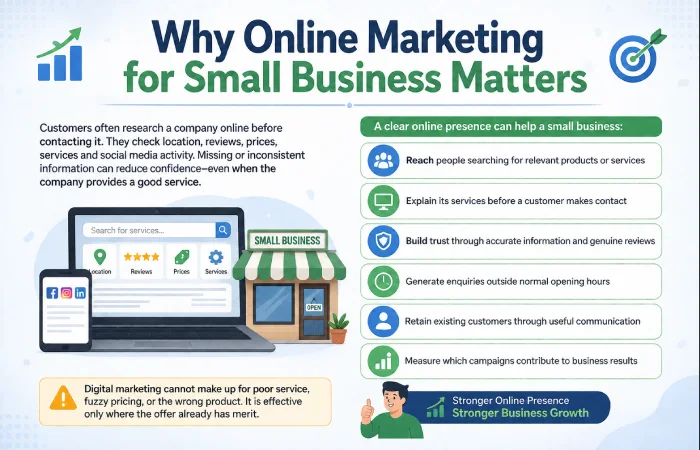
Customers often research a company online before contacting it. They may check its location, reviews, prices, services and social media activity. Missing or inconsistent information can reduce confidence even when the company provides a good service.
A clear online presence can help a small business:
- Reach people searching for relevant products or services
- Explain its services before a customer makes contact
- Build trust through accurate information and genuine reviews
- Generate enquiries outside normal opening hours
- Retain existing customers through useful communication
- Measure which campaigns contribute to business results
- Digital marketing cannot make up for poor service, fuzzy pricing, or the wrong product. It is effective only where the offer already has merit.
Comparing the Main Digital Marketing Channels
Each channel plays an important role. Business should choose channels based on a client’s actual actions rather than those which seem to trend the most for everyone.
| Digital channel | Best suited for | Main advantage | Common limitation |
| Local SEO | Shops and location-based services | Reaches nearby customers with intent | Results can take time |
| Content and SEO | Businesses answering researched questions | Can build long-term organic visibility | Requires useful, original content |
| Social media | Visual products and community engagement | Supports conversation and discovery | Organic reach may fluctuate |
| Paid search | Services with existing search demand | Can produce traffic quickly | Competitive clicks may be expensive |
| Email marketing | Retention and repeat purchases | Direct access to opted-in customers | Requires a quality subscriber list |
| WhatsApp marketing | Support and customer updates | Convenient for many Indian customers | Excessive messages can feel intrusive |
A neighbourhood clinic might prioritise local SEO and reviews. An online clothing store may benefit more from Instagram, product content and remarketing. A B2B company could concentrate on its website, search visibility and LinkedIn.
How to Build a Digital Marketing Plan for Business Growth
Any digital marketing plan needs to relate back to a business goal; every single activity in the plan must tie in directly to an objective to have meaning. Below is an example workflow that will kick-start any plan:
Step 1: Define a Specific Goal
Select one primary outcome, such as receiving 20 qualified enquiries per month, increasing appointment bookings or generating more repeat orders. A broad objective such as “become popular online” is difficult to evaluate.
Step 2: Understand the Intended Customer
Identify the customer’s location, needs, budget, concerns and preferred platforms. Consider what questions the person may ask before making a purchase.
Step 3: Select Two or Three Channels
Begin with a reliable website or landing page, one channel for discovery and one channel for retention. Avoid opening accounts on every platform if they cannot be maintained properly.
Step 4: Create Useful Content
Publish content that answers real questions about pricing, suitability, comparisons, processes and expected outcomes. Useful content should help a visitor make an informed decision rather than repeat the target keyword.
Step 5: Add a Clear Conversion Path
Direct them: Next, you might instruct visitors on where to make a phone call, what time to come to the store, or which type of appointment they are making the.
Step 6: Measure and Improve
Track qualified calls, forms, messages and sales. Review the data monthly, improve promising campaigns and stop activities that repeatedly attract irrelevant users.
Local Internet Marketing Strategies
The important first step for businesses that serve an individual city or town is local search. Set up a Google Business profile or claim one that already exists and be sure that it contains the correct business name, address, phone number, hours, and category.
Add authentic photographs and respond professionally to customer reviews. The contact details displayed on the website should match those used on important directories. Google’s official local ranking guidance recommends keeping Business Profile information complete and accurate.
Location-specific pages can also be useful when a business genuinely operates in multiple areas. Avoid creating dozens of nearly identical city pages without unique information or a legitimate local service.
Social Media for a Small Business
A small business does not need to be published every day. Consistent, useful communication is more valuable than frequent low-quality posts.
Content could include:
- Answers to common customer questions
- Product demonstrations
- Explanations of how a service works
- Behind-the-scenes processes
- Genuine customer experiences
- Practical industry advice
Numbers of “followers,” or even “likes,” might be a metric for how much attention your page receives, but never let these be an indicator of revenue generation. If you’re in fashion, food or the beauty industry, you’re better off focusing your energies on Instagram. For a B2B company, you might even consider setting up a profile on LinkedIn!
Followers and “likes” can provide a signal about attention received, but they should never be confused with revenue. Your sales, website traffic and lead generation driven from society should be carefully measured.
Paid Advertising: Benefits and Limitations
Paid advertising can generate visibility faster than organic marketing, but it does not guarantee profitable sales. A campaign must reach the right audience and send visitors to a page that matches the advertisement.
Search advertisements work well when people are actively looking for a service. Social advertisements can introduce a product to people based on interests or behaviours.
Start with a controlled test budget. Measure the cost per qualified lead or sale rather than judging performance by clicks alone. A campaign receiving cheap clicks, but no serious enquiries is not performing effectively.
Setting a Realistic Digital Marketing Budget
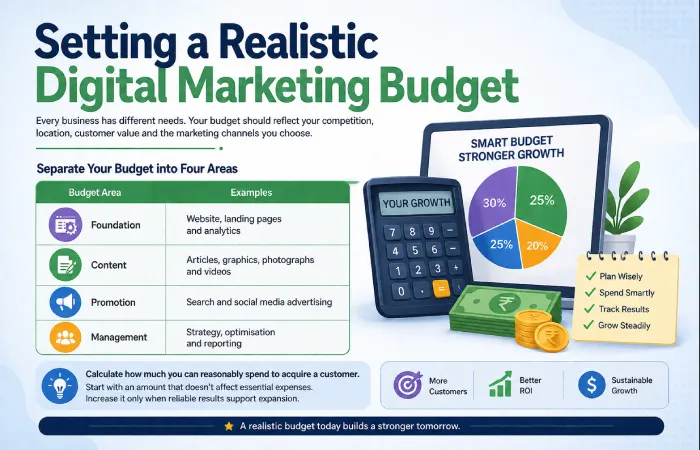
Each company does not have its budget. It largely varies from different competition, geographical locations of businesses, customers’ values and chosen channels of marketing activities for communication.
Separate expenditure into four areas:
| Budget area | Examples |
| Foundation | Website, landing pages and analytics |
| Content | Articles, graphics, photographs and videos |
| Promotion | Search and social media advertising |
| Management | Strategy, optimisation and reporting |
Calculate how much the business can reasonably spend to acquire a customer. Begin with an amount that does not affect essential operating expenses, then increase it only when reliable results support expansion.
Performance Expectations and Realistic Timelines
Paid advertising may begin generating traffic within days, although several rounds of testing may be required to find profitable targeting. Local SEO & content marketing trends take longer to see, generally takes Months to become established.
Trends based on your own competition, Website quality, Customer demand, Price and quality, reputation, reply to times, even a highly optimized page could just have to miss this, and never. Google explains in its SEO Starter Guide that SEO helps search engines understand content, but visibility also depends on usefulness and accessibility.
Assess advertising frequently to control spending. Organic campaigns generally need a longer evaluation period. Avoid agencies or tools confirming guaranteed rankings, permanent sales or instant traffic growth.
Common Digital Marketing Mistakes
Many businesses get the following things wrong. Concentrate on the ‘traffic’ rather than the ‘business,’ post flimsy, artificially produced blog and content posts, purchasing backlinks and testimonials, reaching far-too-wide audiences, driving every advert toward the website homepage.
Frequently asked Questions
Is digital marketing cheap for a small business?
It can be. A decent website, Google Business Profile and a social channel can be the base. Advertising can begin with testing and limited spending.
What’s the best digital marketing channel for small businesses?
Customer behavior is key. Local companies may do well with Google Business Profile, while others who focus on aesthetics will do well with social media. If your business answers detailed questions on customers’ issues, investigate SEO and information rich content.
How long does digital marketing take to deliver results?
Paid advertising can take days or weeks to get traffic, but successful profitable optimisation may need more testing. SEO and content will usually take 3-6 months and sometimes longer depending on the size of the industry and the authority of your site.
Can I manage this myself?
Yes. A focused approach can be managed internally by a small business when both roles and responsibility for results are clear. Outside advice can be brought in for things like technical SEO, analytics or running ad campaigns.
Conclusion
Digital marketing for a small business works effectively when it is focused, measurable and related to what the customer wants. Start with a single objective and couple it with a few key channels and provide useful content for customers to decide based upon.
Look at the result of enquires and sales in preference to website traffic or social interaction alone. If the approach is realistic and the execution consistent with regular refinement the efforts will grow and in time become a valued part of business growth.