


Last Updated: September 13, 2026
Reading over an Instagram marketing agency case study is good for understanding the agency’s experience and approach to work. But you shouldn’t take screenshots and percentage increases as confirmation that an agency can achieve similar results with another client.
A useful case study explains what changed, how long the work took and which resources were required. It should also acknowledge limitations rather than presenting every positive result as an agency achievement.
Table of Contents
What Is an Instagram Agency Case Study?
A case study from an Instagram agency showcases their marketing project from its starting state to its given results and could include everything from their organic posting, to Reels, their paid advertising, and/or their use of influencer Marketing.
A complete case study should include:
- Client type and business model
- Initial problem or objective
- Starting performance
- Campaign period
- Strategy and deliverables
- Advertising and production investment
- Measurement method
- Results and limitations
- Lessons or next actions
Client confidentiality may prevent an agency from publishing sensitive figures. It should still provide enough context to make the results meaningful.
Instagram Marketing Agency Case Studies Guide
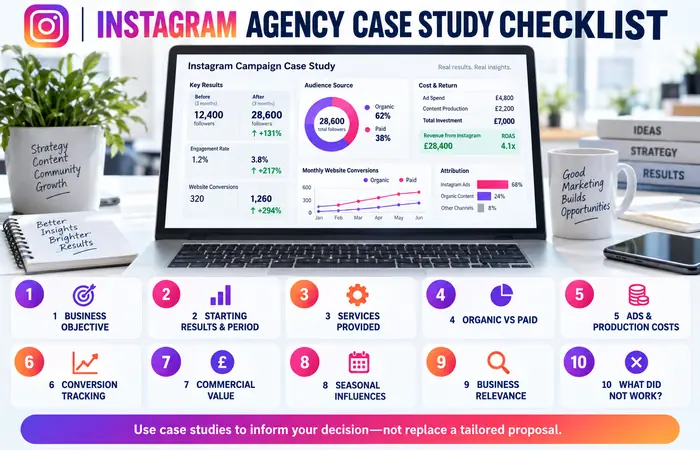
Use this workflow to evaluate a case study:
- Identify the original business objective.
- Check the starting performance and measurement period.
- Review the exact services the agency provided.
- Separate organic results from paid results.
- Look for advertising and production costs.
- Confirm how conversions were measured.
- Calculate the commercial value of reported results.
- Consider seasonal or promotional influences.
- Check whether the example resembles your business.
- Ask the agency to explain what did not work.
Case studies should support your decision, not replace a proposal designed around your own business.
Strong vs Weak Instagram Case Studies
| Evidence area | Strong case study | Weak case study |
| Objective | Defines a measurable business goal | Says only “increase growth” |
| Baseline | Provides starting figures | Shows final results alone |
| Timeframe | Gives clear campaign dates | Omits the period measured |
| Work completed | Explains content and campaigns | Uses vague descriptions |
| Costs | Separates fees and media spend | Hides the investment |
| Results | Reports business and platform metrics | Focuses only on impressions |
| Attribution | Explains the tracking method | Claims all sales came from Instagram |
| Limitations | Provides context and qualifications | Presents results as guaranteed |
A case study with moderate, well-explained results may be more trustworthy than one claiming extraordinary growth without supporting detail.
Instagram Marketing Agency Case Studies for Beginners
Beginners should distinguish between platform metrics and commercial outcomes.
Reach, video views and engagement indicate how people interacted with content. Leads, bookings, purchases and acquisition costs show whether the activity contributed to a business goal.
A video with 1,000,000 views might bring in much less cash than 15,000 viewers because those 1,000,000 viewers were on the other side of the state, whereas those 15,000 viewers resulting qualified leads.
Ask the agency why each metric matters rather than accepting a report filled with large numbers.
Best Instagram Marketing Agency Case Studies
The best case studies closely match the prospective client’s:
- Business model
- Customer journey
- Product price
- Market location
- Campaign objective
- Available budget
- Content resources
- Sales cycle
A case study for an established fashion retailer may offer limited guidance to a new B2B consultancy. The platforms may be the same, but their audiences, buying processes and content requirements are different.
Look for examples demonstrating repeatable decision-making. A reliable agency should explain its research, creative testing and response to weak performance.
Instagram Marketing Agency Case Studies Cost
The cost behind the results matters. A reported campaign may include several separate expenses:
| Cost component | Why it matters |
| Agency retainer | Cost of strategy and management |
| Advertising spend | Amount paid directly for distribution |
| Production | Photography, editing, models and locations |
| Influencer fees | Payments or products supplied to creators |
| Discounts | Reduced margin from promotional offers |
| Tools | Reporting, scheduling or tracking software |
| Internal time | Client staff involved in approvals and support |
The fact that a campaign makes 10 Lakh of sales does not guarantee a positive bottom line. Product costs, advertising, agency fees, discount factors, returns and taxes plus fulfillment costs must also be calculated to obtain this.
Instagram Marketing Agency Case Studies Examples
The following are illustrative formats, not claims about real clients.
Local Fitness Studio
A studio wants more trial-session bookings. The agency produces trainer videos, member-approved stories and local lead campaigns.
A meaningful case study would report advertising spend, enquiries, qualified leads, bookings and the percentage of visitors who became paying members.
Ecommerce Beauty Brand
A beauty retailer wants to increase product sales. The agency tests demonstration Reels, creator content and catalogue campaigns.
The report should include purchase value, customer acquisition cost, average order value, refunds and return on advertising spend—not only product-page visits.
B2B Software Company
A software company wants demonstration requests. The agency creates educational carousels, short product videos and founder content.
Qualified demo bookings and sales-pipeline value would usually be more useful than total follower growth.
Instagram Marketing Agency Case Studies Tips
When discussing a case study with an agency:
- Ask whether results were organic or paid
- Request the total campaign period
- Check whether the figures were independently verified
- Ask which attribution window was used
- Confirm whether repeat customers were included
- Examine results across several months
- Request comparable industry examples
- Ask what the agency would change
- Avoid assuming percentages equal large absolute gains
A 200% increase may represent growth from one monthly enquiry to three. Always request the underlying numbers.
Comparing Case Studies with a Live Proposal
Case studies show past work; a proposal explains how the agency will approach your situation. The proposal should connect relevant lessons to your audience, budget, resources and commercial target.
Retain ownership of Instagram, Facebook and advertising assets. Historical results do not justify giving an agency passwords or permanent ownership of business accounts.
Expectations and Limitations
Case studies are selected examples and may represent an agency’s strongest projects. They are not forecasts or guarantees.
Instagram distribution, advertising competition, demand and customer behaviour can change. Tracking platforms may also report different conversion totals because their attribution methods differ.
Consider use cases as the second selection factor after strategy, but also include relevant experience, communications, price, security, and the contract.
Frequently Asked Questions
Are Instagram marketing agency case studies reliable?
They can be useful when they include baseline, timeframe, costs, methodology and measurable results. Unsupported screenshots should be treated cautiously.
Which metrics should a case study include?
The metrics should match the objective. They may include qualified leads, sales, acquisition cost, booking rate, order value or return on advertising spend.
Should an agency reveal the client’s advertising budget?
It should ideally provide the investment or a meaningful range. Results without cost information are difficult to evaluate.
Can case studies predict my results?
No. They demonstrate previous experience but cannot guarantee future performance for a different business, offer or market.
Conclusion
Credible Instagram marketing agency case studies explain the starting point, strategy, investment, timeframe and commercially relevant outcomes. Examine the underlying numbers, compare similar business situations and treat every case study as evidence—not a promise.