

Last Updated: September 13, 2026
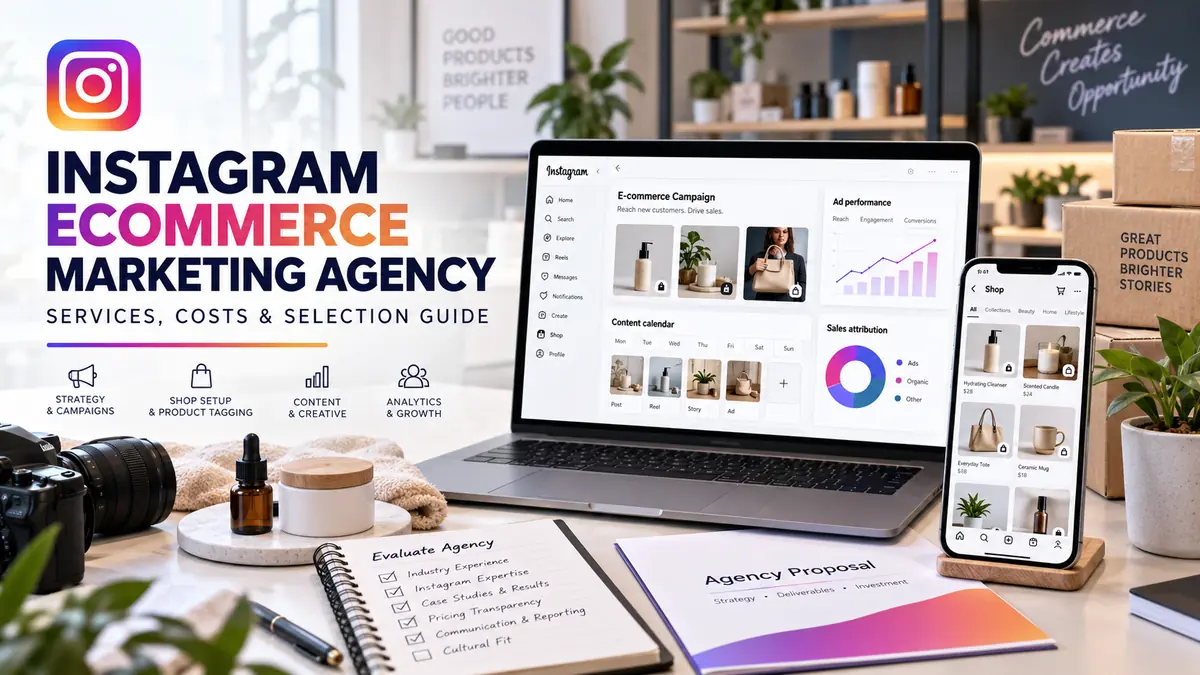
An Instagram ecommerce marketing agency connects content creation with measurable online-store results. Unlike general social media management, e-commerce marketing can involve product catalogues, website tracking, conversion campaigns and revenue analysis alongside regular posts and Reels.
Hiring an agency does not guarantee profitable sales. Product demand, pricing, website experience, margins and fulfilment quality remain important parts of performance.
Table of Contents
What Does an Instagram Ecommerce Agency Do?
An e-commerce agency plans how products are presented and promoted throughout the Instagram customer journey. Its services may include:
- Instagram account and competitor audits
- Product-focused content strategy
- Reels, Stories and carousel production
- Product catalogue configuration
- Meta Pixel and Conversions API support
- Paid sales and remarketing campaigns
- Creator and user-generated content
- Landing-page recommendations
- Community management
- Revenue and return-on-ad-spend reporting
The agency may manage the complete process or work alongside the retailer’s internal content, website and customer-support teams.
Instagram Ecommerce Marketing Agency Guide
A typical agency engagement follows this workflow:
- Review the store, products and commercial objectives.
- Calculate margins and an acceptable acquisition cost.
- Audit the Instagram account and advertising assets.
- Check the product catalogue and website tracking.
- Define customer groups and content themes.
- Produce organic and advertising creative.
- Launch controlled campaign tests.
- Monitor delivery, sales and product-level performance.
- Improve creative, audiences and landing pages.
- Report revenue, costs and recommended actions.
The business should provide accurate product information, stock availability and promotional terms. Advertising an unavailable product or outdated price creates wasted spending and customer complaints.
Instagram Ecommerce Marketing Agency for Beginners
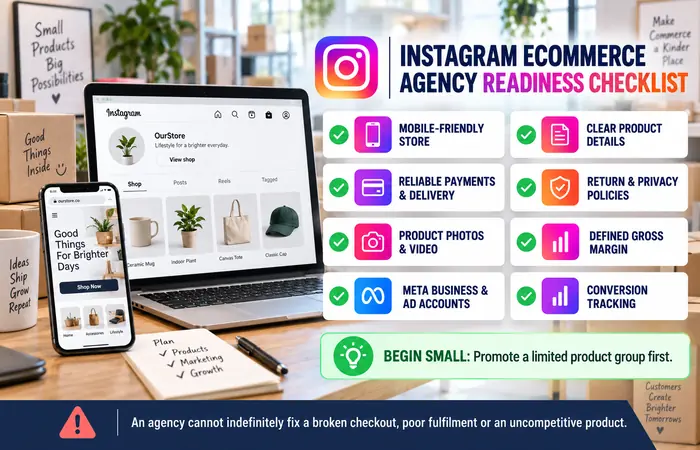
New online retailers should establish the following foundations before hiring an agency:
- A working mobile-friendly store
- Clear product descriptions and prices
- Reliable payment and delivery processes
- Return and privacy policies
- Product images or video footage
- A defined gross margin
- Meta business and advertising accounts
- Website conversion tracking
An agency can identify weaknesses, but it cannot compensate indefinitely for a broken checkout, unreliable fulfilment or an uncompetitive product.
Beginners should start with a limited product group rather than promoting the entire catalogue immediately. This makes creative testing and sales analysis more manageable.
General Instagram Agency vs Ecommerce Specialist
| Area | General Instagram agency | Ecommerce specialist |
| Main focus | Content and engagement | Product sales and customer acquisition |
| Catalogue knowledge | May be limited | Usually important |
| Conversion tracking | Basic or optional | Central requirement |
| Reporting | Reach, followers and engagement | Revenue, purchases and acquisition costs |
| Website involvement | Limited | Often reviews product and checkout pages |
| Creative approach | Brand and community content | Product demonstrations and sales content |
| Best suited to | Awareness-led organisations | Online retailers |
A general agency may still be suitable when it has proven retail experience and the necessary advertising and tracking capabilities.
Best Instagram Ecommerce Marketing Agency
The best agency should understand both creative communication and commercial numbers. Ask candidates to explain how they would evaluate:
- Gross margin and target acquisition cost
- Product demand and seasonality
- Catalogue quality
- Tracking reliability
- Creative testing
- Average order value
- New versus returning customers
- Refunds and cancelled orders
Review case studies carefully. Revenue growth alone is incomplete without advertising spend, fees, profit margin and the period measured.
Meta provides shopping advertising tools for eligible businesses, but availability and features can depend on the account and market. Its Shops Ads learning resource explains how shopping-focused campaigns can promote products across Facebook and Instagram.
Instagram Ecommerce Marketing Agency Cost in India
The following figures are broad planning estimates rather than standard prices:
| Service level | Illustrative monthly agency fee |
| Basic content management | ₹15,000–₹35,000 |
| Content plus advertising support | ₹35,000–₹75,000 |
| Full-funnel e-commerce management | ₹75,000–₹1,50,000 |
| Advanced brand with frequent production | ₹1,50,000–₹3,00,000+ |
Additional expenses may include:
- Meta advertising spend
- Product photography
- Models and locations
- Creator or influencer fees
- Tracking applications
- Website development
- Catalogue or feed software
- Applicable taxes
Advertising management may be billed as a fixed retainer, a percentage of spend or a hybrid fee. Request an itemised quotation and clarify whether taxes are included.
Instagram Ecommerce Marketing Agency Examples
A skincare store might use ingredient explainers, routine demonstrations and customer-created videos. Its agency could run campaigns for starter bundles and measure completed purchases, order value and customer acquisition cost.
A fashion retailer may create styling Reels, collection launches and dynamic product advertising. The catalogue must reflect current stock, prices and product links.
A home décor business could publish room transformations and creator demonstrations. Higher-priced products may require a longer consideration period, so assisted conversions and qualified website visits may also be useful.
Instagram Ecommerce Marketing Agency Tips
Before appointing an agency:
- Retain ownership of all Meta and Instagram assets
- Provide authorised access instead of passwords
- Separate agency fees from advertising spend
- Agree on the number of creative variations
- Confirm responsibility for catalogue errors
- Define reporting and approval deadlines
- Include raw-file ownership in the contract
- Review cancellation and notice terms
- Reject guaranteed sales or ROAS claims
- Compare Meta reports with store transactions
Ask how performance will be handled when an item goes out of stock. Campaigns and product feeds should be updated promptly to avoid paying for unusable traffic.
Ecommerce Metrics the Agency Should Report
An e-commerce report should extend beyond followers and likes. Useful metrics include:
| Metric | What it indicates |
| Conversion rate | Percentage of visits resulting in orders |
| Customer acquisition cost | Cost of gaining a new customer |
| Average order value | Average revenue per transaction |
| Return on ad spend | Reported revenue relative to advertising spend |
| Refund rate | Orders later returned or refunded |
| Creative performance | Results generated by each content variation |
Return on ad spend is not the same as profit. Product costs, agency fees, fulfilment, discounts and returns must also be considered.
Performance Expectations and Limitations
Developing new campaigns often involves creative and audience testing to develop sustainable trends. A good week is not the sole indicator of consistent profitability and certainly may not reflect profitability long term especially during periods of promotion or heightened demand.
Meta and store reports may show different conversion totals because their attribution methods differ. Confirm actual revenue through the e-commerce platform and financial records.
An agency can improve execution and analysis, but it cannot control advertising auctions, platform changes, customer demand or logistics.
Frequently Asked Questions
What does an Instagram ecommerce marketing agency manage?
It may manage product content, Reels, catalogues, conversion tracking, paid campaigns, creator partnerships and performance reporting.
Does the agency fee include advertising spend?
Usually not. The business generally pays Meta directly, while the agency charges separately for campaign management.
Does a small online store need an e-commerce specialist?
A specialist can be useful when sales campaigns, catalogues and tracking are central requirements. A general agency with verifiable e-commerce experience may also be suitable.
Can an agency guarantee profitable Instagram sales?
No. Profitability depends on advertising, product margins, pricing, demand, website conversion and operating costs.
Conclusion
A capable Instagram ecommerce marketing agency should combine relevant creative work with catalogue accuracy, dependable tracking and commercially meaningful reporting. Choose an agency that understands margins and customer acquisition—not one that measures success only through followers and engagement.