




Learning how to start an affiliate marketing website, an affiliate scheme can build an online income stream where you do not need to make or supply your own products, you add helpful information then recommend the right products or services and if a reader makes a purchase through your affiliate link from your website.
Table of Contents
This Article Is Part of the Influencer Marketing Resource Hub
Explore more guides, tutorials, strategies, and marketing resources inside our Affiliate Marketing Resource Hub .
Affiliate marketing, as said earlier, isn’t aget rich quick scheme. What is needed is a niche (that you can concentrate on), credible and valuable content, getting found on search engines, and continuous improvement. Here’s how beginners in India should approach it in a realistic way.
What Is an Affiliate Marketing Website?

An affiliate website is one that matches search queries with appropriate products or services. The website owner registers on an affiliate program and is provided with an affiliate link. The link is then placed naturally within the content for users to click and view.
As an illustration, a tech website may compare budget laptops, explain what each specification entails and provide readers with a link to buy from a trusted reseller. The web publisher can receive a commission if the reader then buys via that link, at the same price to the buyer.
Common content categories include:
- Product reviews
- Comparisons
- Buying guides
- Tutorials and explainers
- Alternatives to popular products
- Discount and deal pages
Clear navigation is essential. Visitors should be able to move easily between categories, reviews and related guides.
How to Start an Affiliate Marketing Website Step by Step
Follow this workflow to build the site on a solid foundation:
Choose a specific niche:
Select a subject you understand or are prepared to research carefully. Technology accessories, software, fitness equipment and personal finance tools are examples.
Study the audience:
Identify the problems audience want to solve and the inquiries they ask before purchasing.
Buy a domain and hosting:
Choose a impressive domain, reliable hosting and an SSL certificate.
Install a content management system:
WordPress is widely used because it supports themes, SEO tools and affiliate-link management.
Create essential pages:
Add About us, Contact us , Privacy Policy, Affiliate Disclosure and Terms pages.
Research keywords:
Combine informational keywords with product focused terms that have realistic competition.
Publish useful content:
Create original guides supported by accurate details, screenshots, testing or credible sources.
Join relevant programmes:
Apply only to programmes closely connected with your subject.
Add links transparently:
Place affiliate links where they help readers and disclose your commercial relationship.
Measure and improvement:
Track rankings, clicks and conversions, then update weak or outdated pages.
Affiliate Marketing Website Requirements
A beginner website does not need an expensive custom design. It does need a dependable technical and editorial foundation.
| Requirement | Basic option | Why it matters |
| Domain name | Short, brandable domain | Builds recognition |
| Hosting | Entry-level managed hosting | Keeps the website accessible |
| CMS | WordPress or similar platform | Simplifies publishing |
| Mobile-friendly design | Lightweight responsive theme | Improves usability |
| SEO setup | Sitemap and basic SEO plugin | Supports crawling and indexing |
| Legal pages | Disclosure and privacy pages | Improves transparency |
| Analytics | Search Console and analytics software | Measures performance |
| Original content | Helpful reviews and guides | Gives visitors a reason to return |
In India, an initial domain and basic hosting package may cost a few thousand rupees per year. Premium themes, writers and SEO software are optional rather than immediate requirements.
How to Build a Niche Affiliate Website
A narrow subject usually gives a new website clearer topical direction. Instead of targeting “technology”, you could focus on productivity software for small Indian businesses. Rather than covering all fitness products, you might specialise in home workout equipment.
Build connected topic clusters around the main subject. A laptop focused website, for instance, could cover student laptops, work laptops, processors, battery life, buying mistakes and model comparisons. Link these pages logically so visitors and search engines can understand their relationship.
Affiliate Website for Beginners: Content Comparison
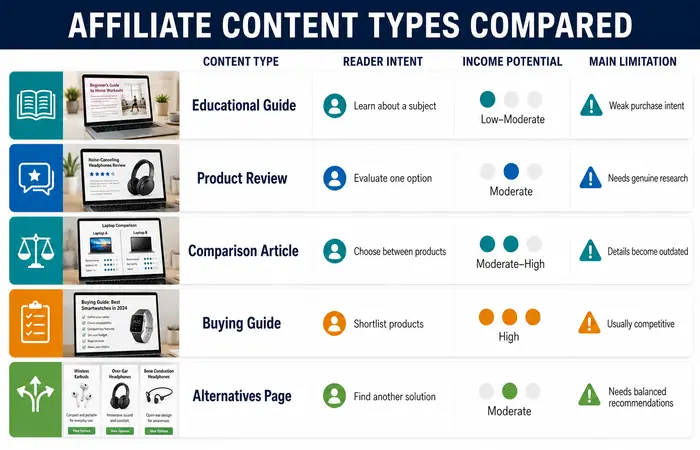
| Content type | Reader’s intention | Income potential | Main limitation |
| Educational guide | Learn about a subject | Low to moderate | Purchase intent may be weak |
| Product review | Evaluate one option | Moderate | Requires genuine research |
| Comparison article | Choose between products | Moderate to high | Details become outdated |
| Buying guide | Shortlist suitable products | High | Usually competitive |
| Alternatives page | Find another solution | Moderate | Needs balanced recommendations |
A healthy affiliate blog uses several formats instead of publishing only sales focused reviews.
Trustworthiness and Affiliate Disclosures
Explain how products are selected and whether they were personally tested. Never claim first-hand experience when the article is based only on specifications or external research. Mention important limitations, show when an article was updated and correct factual errors promptly.
Every page containing affiliate links should carry a visible disclosure. Readers deserve to know that the website may receive compensation.
Explain how products are selected and whether they were personally tested. Never claim first-hand experience when an article is based only on specifications or external research. Follow Google’s guidance for writing high-quality reviews by providing original analysis, useful evidence and balanced information about benefits and limitations.
Affiliate Websites Versus Typical Blogs
A general blog may earn through advertising, services or sponsorships. An affiliate blog is more closely connected to purchase decisions and therefore needs stronger product research, clearer disclosures and regular updates.
The advantage is that a small, focused audience may still generate commissions. The limitation is that earnings can change when rankings, commission rates or programme terms change.
Performance Expectations and Realistic Earnings
New websites commonly take several months to attract consistent organic traffic. Publishing ten articles does not guarantee rankings or commissions. Results depend on competition, content quality, backlinks, product demand and conversion rates.
Treat the first six to twelve months as a building and testing period. Focus initially on publishing a useful collection of related articles rather than setting a fixed income target.
Who Should Start an Affiliate Blog?
Affiliate publishing may suit people who enjoy research, writing, SEO and gradual business development. It is less suitable for anyone expecting guaranteed passive income or unwilling to update content.
A simple use case is a software professional creating detailed comparisons of tools already used at work. Their practical experience can make the recommendations more credible and specific.
Frequently Asked Questions
How much does it cost to create an affiliate marketing website?
A basic site will require you to buy a domain name and hosting space. Prices will rise significantly if a high level of software, design assistance or written content.
Can I start affiliate marketing without a website?
Yes, some programs allow for promotion via video, social media, or by e-mail. Each program has it’s own rules, so review those when you apply.
How long does an affiliate website take to make money?
No set timeframes- it might take several months for a new site to get traffic, gain credibility and get conversions.
How do I start an affiliate blog with no experience?
Choose a niche you can achieve and grasp how to do basic keyword research, and write a few truly valuable posts before submitting for programs.
Is it difficult to learn how to start an affiliate marketing website?
Setting up the tech will be manageable for all those newcomers to this world. Being successful enough at generating great content, along with good traffic usually takes more time, effort, and is not a easy fit.
Conclusion
Understanding how to start an affiliate marketing website, Creating an affiliate marketing website is just the first step. By focusing on a specific niche, answering genuine questions and being transparent about affiliate disclosures and by learning and adjusting what works through experience you can achieve gradual improvements. Keep your initial website basic with a realistic budget and only expand once you see clear evidence in your stats about what readers enjoy.
How to Become an Affiliate Marketer Topic Cluster