




How to become an affiliate marketer If you want to make some seriously big gains and discover the how of become an affiliate marketer, then start thinking about it like a content business as opposed to a passive income hack. You recommend products/services by including a link with a tracking code in your content, and you get paid a commission when one of your referred visitors registers or buy something through your link.
Table of Contents
This Article Is Part of the Influencer Marketing Resource Hub
Explore more guides, tutorials, strategies, and marketing resources inside our Affiliate Marketing Resource Hub .
The model can start relatively cheap, but it will not be research, content, building audiences and measuring performance-free. Beginners may take several months to get a regular commission after the sites are published and evaluated. The outcome is very dependent on the niche, traffic source, offer conditions, purchase intent and recommendation quality.
This guide explains the complete process for beginners in India, including niche selection, affiliate programme comparison, website creation, content planning, link promotion, disclosure requirements and realistic income expectations.
What Is Affiliate Marketing?
Affiliate marketing is a performance-based arrangement between a business and a publisher, creator or marketer.
The business supplies a trackable affiliate link. The affiliate publishes that link within useful content such as a product comparison, tutorial, buying guide, video or email. When a visitor follows the link and completes a qualifying action, the affiliate may receive a commission.
Four parties are usually involved:
The merchant: The company selling the product or service.
The affiliate: The person or organisation recommending the offer.
The customer: The person who clicks the link and potentially makes a purchase.
The affiliate network or tracking platform: The system that records clicks, conversions and commissions.
Many businesses control their own programmes. However, there are networks, that through one account will allow an affiliate to gain entry to many merchants’ programs.
How Affiliate Marketing Works
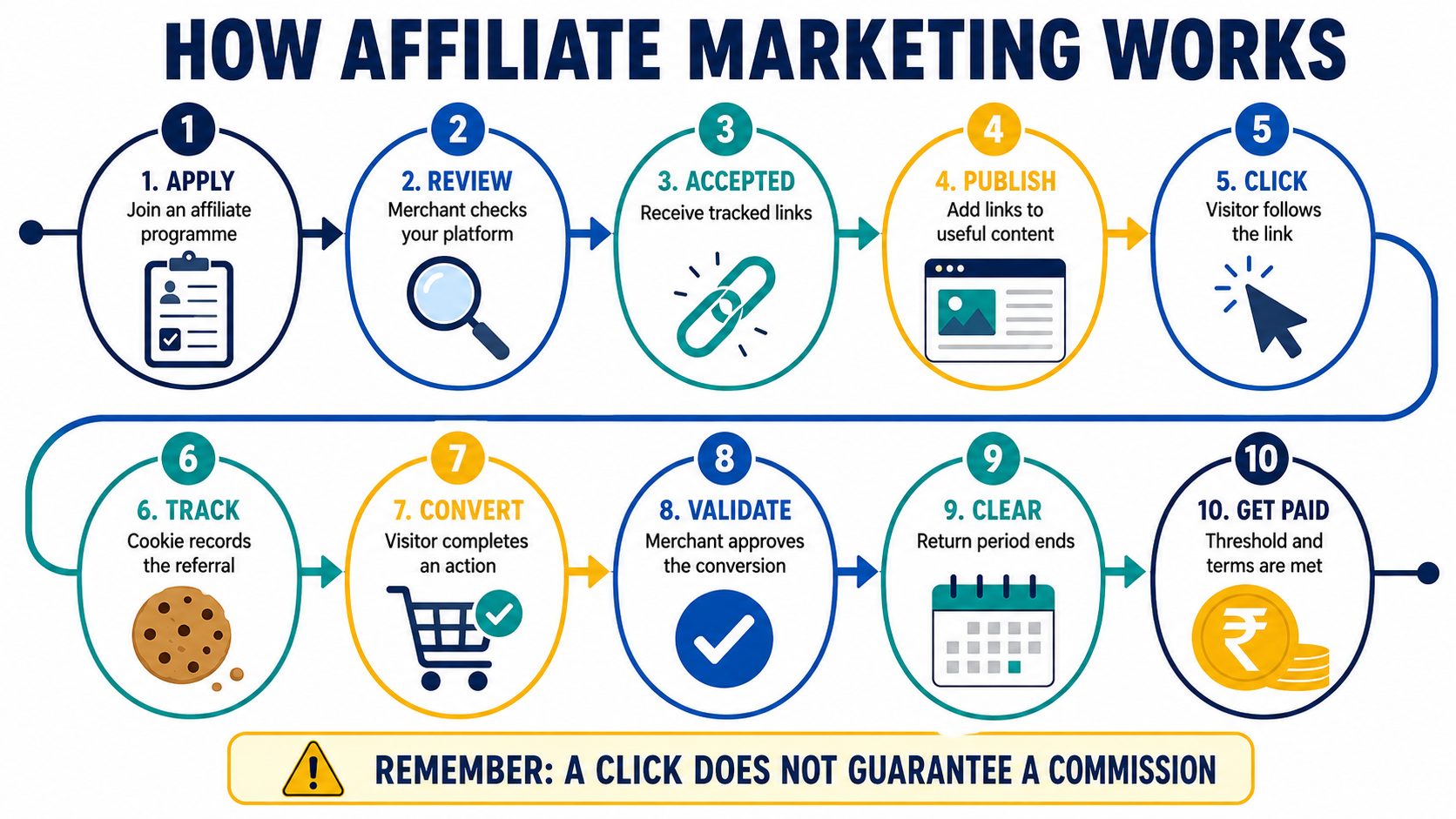
The basic process is straightforward but tracking and payment rules differ between programmers.
- You apply to an affiliate programme.
- The merchant reviews your website, social profile or promotional plan.
- If accepted, you receive access to tracked links or promotional assets.
- You publish useful content and insert the appropriate affiliate link.
- A visitor clicks the link.
- A tracking cookie or another attribution method records the referral.
- The visitor completes an eligible action within the attribution period.
- The merchant validates the conversion.
- The commission becomes payable after any return or cancellation period.
- You receive payment once the programme’s minimum threshold and payment conditions are met.
A click does not automatically produce income. Visitors may compare alternatives, leave the merchant’s website, block tracking, use another device or buy after the programme’s attribution window has expired.
Affiliate Marketing Models Compared
| Affiliate model | How payment works | Suitable content | Main limitation |
| Pay per sale | Commission is paid for an approved purchase | Reviews, comparisons and buying guides | Returns or cancellations may reverse commissions |
| Pay per lead | Payment is made for a qualified enquiry or registration | Service guides, finance education and software content | Invalid or duplicate leads may be rejected |
| Pay per action | A defined action must be completed | App downloads, trials or account registrations | The required action may involve several steps |
| Recurring commission | Commission continues while the referred customer remains eligible | SaaS and subscription content | Income stops when customers cancel |
| Fixed bounty | A set amount is paid for each approved referral | Hosting, education or financial-service content | The offer may have strict eligibility rules |
| Influencer affiliate model | Links or codes are promoted through social content | Videos, demonstrations and social recommendations | Platform reach and algorithms can fluctuate |
Do not select a programme only because its advertised commission is high. Conversion rate, refund policy, attribution period, brand reputation and customer suitability can have a greater effect on actual earnings.
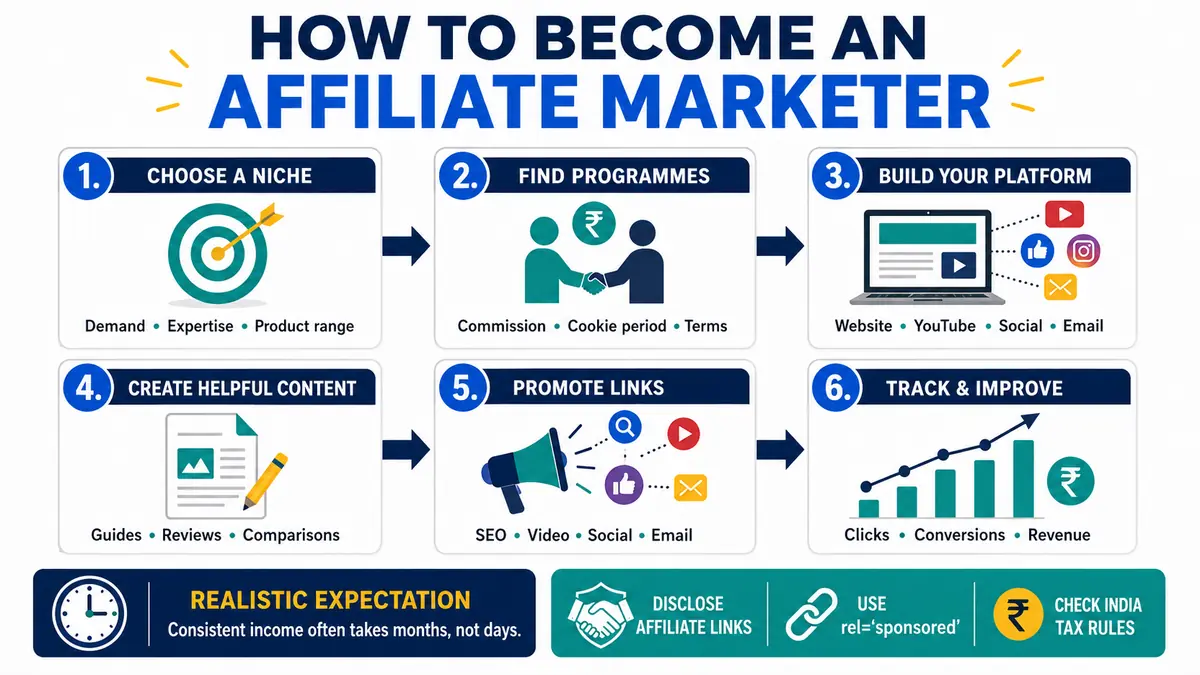
How to Become an Affiliate Marketer Step by Step
The most sustainable strategy will be one that focuses on building one audience, one set of problems and a small but credible publishing infrastructure around these elements
Step 1: Define the audience
Avoid starting with a broad idea such as “I will promote anything that pays well”. Instead, identify a recognisable audience.
Examples include:
- First-time freelancers choosing invoicing software
- Students comparing online learning platforms
- Small Indian businesses looking for marketing tools
- Home fitness beginners buying basic equipment
- Travellers comparing luggage and accessories
- New website owners choosing hosting and WordPress tools
Using a customer definition will help you determine what to create, which products to put into play and in what space you should be selling into.
Step 2: Select a focused niche
Choose a subject where audience demand, product availability and your ability to add value overlap. A useful niche should support more than one article or product.
“Technology” is too broad. “Affordable productivity tools for Indian freelancers” is more focused and provides clearer content opportunities.
Step 3: Choose a publishing channel
A website is useful for search-driven articles, comparisons and evergreen resources. YouTube may be better for demonstrations, while Instagram can work for visual niches. Email helps you maintain a direct relationship with returning readers.
You do not need to launch on every channel. One primary platform and one supporting distribution channel are usually manageable for a beginner.
Step 4: Research affiliate programmes
Look for programmes serving your chosen audience. Read the terms before applying, paying particular attention to:
- Accepted traffic sources
- Commission structure
- Attribution or cookie period
- Minimum payment threshold
- Payment methods and currency
- Prohibited keywords or advertising methods
- Rules covering discount codes
- Reversal and refund policies
- Geographic restrictions
- Brand and trademark policies
Step 5: Build essential content
Publish a few really useful articles before you pack the site out with affiliate links. A visitor turning up for the first time must be able to understand what your subject is, be able to see how you’re doing it, and view some freebie content.
A sensible starting library could contain:
- One comprehensive beginner’s guide
- Two problem-solving tutorials
- Two product comparisons
- One individual product review
- One mistakes or troubleshooting article
- An About page
- A contact page
- A privacy policy and affiliate disclosure
Step 6: Add affiliate links selectively
Include links at the points where the reader should move to the next step. Do not “product tag” every occurrence of every mention or “copy-paste” the same call to action after each paragraph.
The surrounding text should explain what the reader will find after clicking.
Step 7: Attract qualified traffic
Search optimisation, YouTube, social media, communities and email can all generate traffic. Concentrate on people actively trying to solve the problem related to the offer.
One hundred readers searching for “best invoice software for a two-person business” may be more commercially relevant than thousands of untargeted social impressions.
Step 8: Track outcomes
Monitor clicks, approved conversions, reversal rates and earnings per click. Compare these results by article, product and traffic source.
Do not optimise only for the largest number of clicks. A page producing fewer but better-qualified referrals may create more revenue and fewer refunds.
Step 9: Update and expand
Product prices, interfaces, programme terms and availability change. Review important commercial articles regularly and show readers when the content was last checked.
Expand into adjacent topics only after you have covered the main questions within your first niche.
How to Choose an Affiliate Marketing Niche
A suitable niche is not necessarily the one with the highest commission. It is one in which you can consistently produce credible material for an audience that buys relevant products.
Assess each potential niche against the following factors.
Audience demand
Look for repeated questions, product searches and unresolved problems. Search suggestions, online communities, retailer categories, customer reviews and industry forums can reveal how people describe their needs.
Do not rely on search volume alone. A niche can have moderate traffic but strong commercial intent.
Commercial depth
A strong niche usually contains several related product categories rather than one short-lived offer.
For example, a website about working remotely might cover:
- Productivity software
- Video conferencing tools
- Office equipment
- Cybersecurity services
- Project-management platforms
- Online training
- Accounting tools
This variety reduces dependence on one merchant.
Your knowledge and access
First-hand use can improve review, but you do not need to begin as the industry’s leading expert. You must be willing to research carefully, test what you can and distinguish personal experience from information supplied by a company.
Never imply that you have used a product when you have not.
Competition
Competition is not automatically negative because it can demonstrate commercial demand. The question is whether you can offer a clearer angle, original evidence or better audience targeting.
A broad article on the “best laptops” may be difficult for a new publisher. A well-researched guide to laptops for Indian digital-marketing students under a defined budget has a more specific purpose.
Compliance and risk
Health, finance, gambling and legal niches carry additional responsibilities. Incorrect claims can cause real harm, and certain products or promotional methods may be regulated.
Beginners may find software, education, home, productivity or hobby niches easier to handle, although every niche still requires accurate claims and transparent advertising.
Niche scoring table
Score each proposed niche from one to five.
| Criterion | Question to ask | Weight |
| Audience need | Are people repeatedly seeking solutions? | 25% |
| Product range | Are several reputable offers available? | 20% |
| Knowledge | Can I contribute useful, accurate information? | 20% |
| Content potential | Can I identify at least 30 worthwhile topics? | 15% |
| Competition opportunity | Is there a specific underserved angle? | 10% |
| Compliance suitability | Can I promote the topic responsibly? | 10% |
A scoring system does not guarantee success, but it helps prevent decisions based entirely on commission percentages.
Best Affiliate Programs for Beginners
To find suitable affiliate programs for beginners you need to make sure that each one is suitable for your target audience, approved by your traffic source, and clearly explained terms. You must remember that available, commission rates and requirements will be different in every program and application need to be check directly.
Retailer programmes
Retailer programmes can be useful for websites covering household products, technology, books, fashion or hobbies. They offer a broad catalogue, but percentage commissions may be modest and product prices can change frequently.
SaaS programmes
Software-as-a-service companies may offer fixed, percentage-based or recurring commissions. These programmes suit tutorials, case studies, comparisons and workflow content.
They often require more detailed explanations because readers want to understand integrations, pricing tiers and limitations before subscribing.
Hosting and website-tool programmes
Hosting companies, themes, plugins and website builders commonly operate affiliate programmes. The category can be commercially attractive, but it is also competitive.
Publishers should test services where possible and avoid presenting hosting speed or uptime claims without supporting evidence.
Education programmes
Course platforms and training companies may pay for course purchases, subscriptions or leads. Check instructor quality, refund rules, certification claims and learner reviews before recommending a programme.
Affiliate networks
Networks bring multiple merchants into a common interface. This can simplify reporting and payment management, although each advertiser may have separate approval rules and attribution terms.
Direct brand programmes
A brand-managed programme may provide closer communication or specialist materials. However, relying on one direct programme creates risk if the brand changes its commission structure or closes the programme.
Programme evaluation checklist
Before joining, answer these questions:
- Does the product serve the audience I already plan to help?
- Is the company’s website clear about pricing and cancellation?
- Can I understand how a conversion is attributed?
- Are payment methods practical for an Indian publisher?
- Does the programme permit websites, email, video or paid traffic?
- Are commissions held during a validation period?
- What happens when a customer receives a refund?
- Can the merchant change or terminate the programme?
- Are there restrictions on displaying prices?
- Does the product have credible customer support?
Avoid publishing a list that calls every high-paying programme “best”. Explain who each programme suits and where it may fall short.
How to Start an Affiliate Marketing Website
A website gives you control over content organisation, but it brings technical and editorial responsibilities.
Choose a domain
Select a name that can accommodate future growth. A narrow product name may become restrictive, while a misleadingly broad name can weaken the site’s identity.
Avoid using a merchant’s trademark in your domain unless you have explicit permission.
Arrange hosting and content management
Beginners commonly use WordPress because it supports editorial workflows, SEO plugins and analytics integrations. Alternatives include hosted website builders and specialist publishing platforms.
Choose hosting based on reliability, support, security and expected traffic rather than headline discounts alone.
Build a simple structure
A basic affiliate website should include:
- Home page
- Clearly defined category pages
- About page
- Author information
- Contact page
- Privacy and cookie information
- Affiliate disclosure
- Editorial or review policy
- Individual articles
- HTML sitemap or clear navigation
Organise articles into topic clusters. For example, an affiliate-marketing site could use separate sections for niche selection, programme research, content production, website development, promotion and analytics.
Install only essential tools
Useful categories include:
- Search optimisation
- Caching and performance
- Security
- Backup
- Analytics
- Link management
- Image optimisation
Too many plugins can complicate maintenance or reduce performance. Add a tool only when it solves an identified problem.
Configure affiliate links correctly
Google recommends that publishers tag ad links and paid placement links with nofollow. Although nofollow is still acceptable in some instances, sponsored is what you should use for compensated links. Google specifically asks websites involved in affiliate programs to categorize affiliate links properly.
An example is:
<a href=”https://merchant.example/product” rel=”sponsored”>
View the product details
</a>
This technical attribute does not replace a reader-facing disclosure. Both serve different purposes.
Measure site performance
Configure analytics and programme tracking from the beginning. Record:
- Organic landing-page visits
- Search queries
- Affiliate-link clicks
- Click-through rate
- Approved conversions
- Reversals
- Revenue by page
- Earnings per click
- Conversion rate
- Content update dates
Avoid collecting personal information unless you have a legitimate need and appropriate privacy practices.
How to Create Affiliate Marketing Content
Strong affiliate content helps a reader make a decision that would otherwise require more time, research or risk.
Use problem-first content
Begin with the reader’s question rather than the product you want to sell.
Weak approach:
This software has many excellent features. Click here to buy it.
Better approach:
A freelancer who sends fewer than ten invoices a month may not need an advanced accounting package. The free tier covers basic invoicing, although automated tax reports require a paid plan.
The second version gives the reader a decision framework.
Create content for different stages
Informational content
This attracts people learning about a problem.
Examples:
- What is email automation?
- How does web hosting work?
- How to organise freelance expenses
Commercial investigation content
This serves readers comparing possible solutions.
Examples:
- Email platform A versus platform B
- Best invoicing tools for Indian freelancers
- Shared hosting versus managed WordPress hosting
Transactional support content
This helps people close to taking action.
Examples:
- Product pricing explained
- How to start a free trial
- Which subscription tier is suitable?
A balanced site needs all three. Publishing only “best product” lists can make the website look thin and overly commercial.
Add original value
Google’s spam policies distinguish value-adding affiliate pages from thin affiliates. Useful pages may include original reviews, testing, price context, product comparisons and meaningful navigation rather than repeating merchant descriptions. Google Search Essentials
Ways to add value include:
- Original screenshots
- Test results
- A documented evaluation method
- Indian pricing or availability context
- Comparisons based on real use cases
- Clear drawbacks
- Setup instructions
- Accessibility observations
- Customer-support tests
- Update histories
Build a review methodology
Explain how products are selected and assessed. A marketing-tool review might examine:
- Ease of setup
- Core features
- Reporting quality
- Integrations
- Support
- Indian payment compatibility
- Pricing transparency
- Data-export options
- Suitability by team size
Do not award numerical scores unless the criteria and weighting are explained.
Write balanced recommendations
Every legitimate product has limitations. Mentioning them builds trust and helps prevent unsuitable purchases.
A balanced conclusion may say:
This platform is a practical option for a small team that needs simple automation. It may not suit an enterprise requiring complex permissions and detailed attribution reporting.
How to Promote Affiliate Links
Promotion should place relevant recommendations in front of an appropriate audience. It should not involve dropping links indiscriminately across comments, groups or private messages.
Search engine optimisation
SEO can attract readers who are actively researching a problem. Focus on clear intent, accurate information, internal links and original value.
Useful search-led formats include:
- How-to articles
- Product comparisons
- Alternatives pages
- Pricing explainers
- Troubleshooting guides
- Use-case guides
- Product-category hubs
Search traffic can compound over time, but rankings are neither immediate nor guaranteed.
YouTube
Video works well for software walkthroughs, demonstrations, unboxings and side-by-side tests. Mention the commercial relationship verbally where appropriate and place a clear disclosure near affiliate links in the description.
Do not hide the disclosure below a long block of text or hashtags.
Social media
Use social platforms to distribute short demonstrations, results, mistakes, checklists or excerpts from longer content. The social post should provide value even if the viewer does not click.
Platform algorithms can change, so avoid building the entire business around one social account.
Email marketing
An email list can bring readers back to new comparisons, tutorials and updates. Obtain valid consent, offer a straightforward unsubscribe option and avoid sending an affiliate link without context.
A useful email explains the problem, identifies who the recommendation suits and links to a detailed resource.
Online communities
Participate because you can answer questions, not merely because a community contains potential buyers. Follow each forum or group’s promotion rules. When permitted, link to a useful resource only if it directly addresses the question.
Paid advertising
Some affiliate programmes prohibit bidding on brand names, direct-linking or specific advertising platforms. Paid campaigns can also lose money quickly when commissions are smaller than acquisition costs.
Beginners should understand conversion tracking and programme restrictions before paying for traffic.
Affiliate Link Promotion Methods Compared
| Channel | Initial cost | Time to gain traction | Main advantage | Main limitation |
| SEO website | Low to moderate | Usually several months | Can attract persistent, high-intent traffic | Rankings can fluctuate |
| YouTube | Low to moderate | Several weeks or months | Demonstrations can build confidence | Production requires time and skill |
| Social media | Low | Potentially fast but inconsistent | Direct interaction with an audience | Reach depends on platform algorithms |
| Low to moderate | Requires list-building | Direct access to returning readers | Consent and deliverability must be managed | |
| Paid advertising | High and variable | Immediate traffic | Fast testing and measurable targeting | Losses can accumulate quickly |
| Communities | Low | Gradual | Access to real audience questions | Promotion is often restricted |
A combined approach might use search content as the permanent resource, YouTube for demonstrations and email for returning readers. Begin with fewer channels and add another only when your current process is manageable.
Affiliate Marketing: From Research to Commission
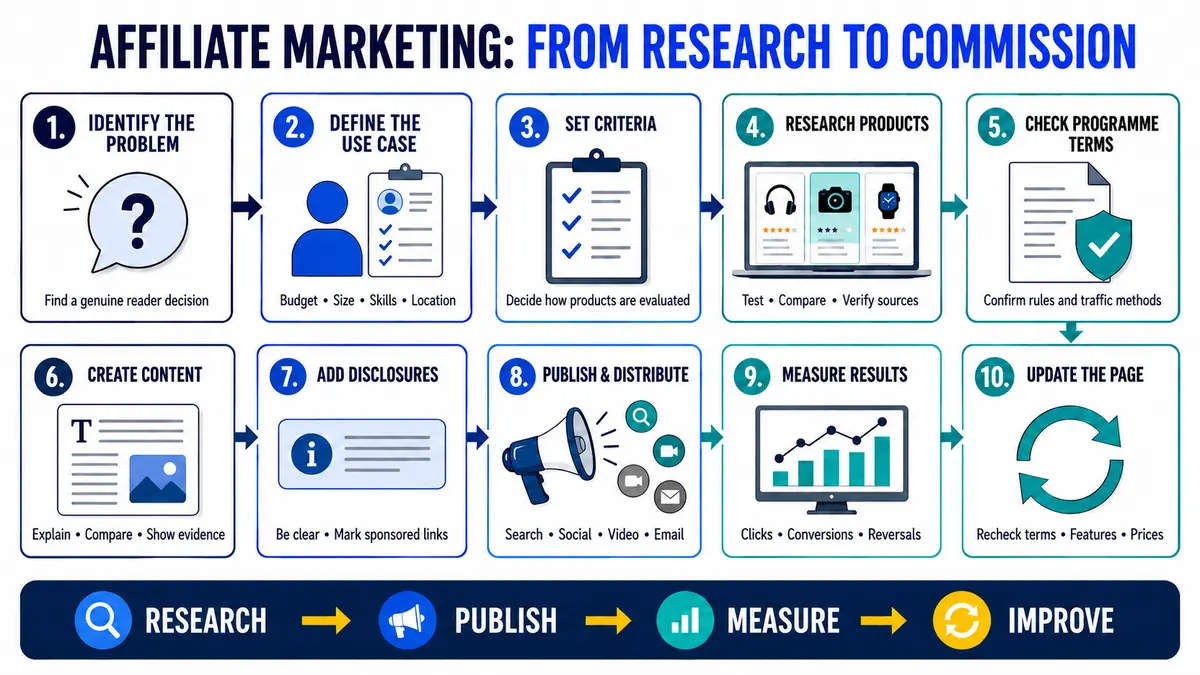
Use this repeatable workflow for each commercial article.
1. Identify a reader problem
Choose a question connected to a genuine decision, such as selecting a CRM for a three-person sales team.
2. Define the use case
Specify budget, business size, experience level, location and required features.
3. Create selection criteria
Decide how products will be evaluated before choosing a winner.
4. Research suitable products
Use official documentation, hands-on testing, customer-support conversations and reliable independent sources.
5. Verify programme terms
Confirm the programme is active and that your intended promotion method is allowed.
6. Produce the content
Explain the problem, compare options, show evidence, discuss limitations and recommend products by use case.
7. Add disclosures
Place an understandable affiliate disclosure before or close to the first affiliate link. Add the appropriate HTML link qualification.
8. Publish and distribute
Share the page through relevant search, social, video, email or community channels.
9. Measure performance
Monitor impressions, page engagement, affiliate clicks, approved conversions and reversals.
10. Update the page
Recheck important information when programme terms, product features, prices or availability change.
Affiliate Disclosures and Responsible Promotion in India
An affiliate relationship is a material connection because you may receive a commercial benefit from a recommendation. Readers should be able to recognise that relationship without searching for it.
The Advertising Standards Council of India says promotional content should be distinctly labelled, including when a material connection exists and the benefit is not purely monetary. It also advises influencers to conduct due diligence regarding claims they promote. ASCI’s influencer guidance
A plain-language website disclosure could say:
Affiliate disclosure: This article contains affiliate links. If you complete an eligible purchase through one of these links, we may receive a commission at no additional cost to you. This does not affect our evaluation criteria.
Good disclosure practices include:
- Place the disclosure before or near the first affiliate link.
- Use language an ordinary reader can understand.
- Do not rely only on a separate disclosure page.
- Clearly label sponsored social content.
- Disclose free products, discounts or other material benefits.
- Avoid unverifiable health, financial or performance claims.
- Keep evidence supporting objective claims.
- Distinguish editorial opinion from paid placement.
Disclosures do not make misleading claims acceptable. They explain the commercial relationship; the underlying recommendation must still be fair and supportable.
Tax and Record-Keeping Considerations for Indian Affiliates
Affiliate income may create income-tax, bookkeeping, GST or foreign-payment obligations depending on how the activity is structured, the location of the merchant and the level of income.
Keep records of:
- Affiliate reports
- Invoices
- Bank statements
- Foreign remittance documents
- TDS certificates where applicable
- Business expenses
- Refunds and reversed commissions
- Exchange rates used for accounting
- Contracts and programme terms
The appropriate income-tax return depends on the nature of the income and the taxpayer’s circumstances. The Income Tax Department notes that ITR-3 can apply to individuals and Hindu Undivided Families with profits or gains from business or profession. Its ITR-4 guidance also states that people earning commission or brokerage are not eligible for the presumptive taxation scheme under Section 44AD. Income Tax Department
This is general information, not individual tax advice. Consult a chartered accountant familiar with digital businesses and cross-border receipts before deciding how to classify income, claim expenses or handle GST.
How to Make Money With Affiliate Marketing
Affiliate revenue can be expressed with a simple model:
Revenue = qualified traffic × affiliate click rate × conversion rate × average commission
Suppose an article receives 2,000 relevant visits in a month:
- 20% click an affiliate link: 400 clicks
- 3% of those clicks produce approved sales: 12 sales
- Average commission is ₹500: ₹6,000 revenue
These figures are an illustration, not a benchmark. Different products, channels and audiences can perform very differently.
Improve qualified traffic
Publish content that closely matches a buying problem. More traffic is helpful only when it includes people who may reasonably need the product.
Improve click quality
Give readers enough information to decide whether the offer suits them before they click. This can reduce unqualified referrals and refunds.
Improve conversion relevance
Match products to use cases rather than naming one overall winner. A lower-priced beginner product may convert better for a budget audience than a feature-heavy premium tool.
Increase content depth
Build a connected topic cluster around the decision. A person who first finds an informational guide may later read your comparison and pricing article.
Diversify merchants
Promoting more than one credible merchant can reduce risk. However, avoid adding programmes that do not fit the audience merely to increase the number of links.
Update successful pages
Commercial pages can lose accuracy as prices, features and policies change. Prioritise pages already attracting qualified traffic.
Realistic Affiliate Marketing Expectations
Affiliate marketing can become a meaningful income stream, but dependable results rarely appear immediately.
The first three months
A beginner may spend this period:
- Selecting a niche
- Setting up a website or channel
- Learning content production
- Publishing the first 10–20 substantial resources
- Applying to programmes
- Configuring analytics
- Receiving little or no commission
This phase primarily builds assets and skills.
Three to six months
Some content may begin receiving impressions, rankings, video views or social engagement. Earnings may remain irregular. It is usually too early to conclude that the model has failed solely because income is low.
Six to twelve months
Consistent publishers may have enough data to identify which topics, offers and formats work. Results can still vary substantially, and many sites will not reach full-time income.
Beyond one year
A developed content library, returning audience and email list can create more stable opportunities. Nevertheless, programme closures, search changes, competition and product demand remain business risks.
What affects the timeline?
- Existing knowledge and audience
- Publishing consistency
- Competition
- Content quality
- Buying intent
- Product price
- Merchant conversion rate
- Programme terms
- Search and social-platform changes
- Seasonal demand
Anyone promising guaranteed daily earnings or a fixed timeline is ignoring these variables.
Advantages and Limitations of Affiliate Marketing
| Advantages | Limitations |
| Relatively low initial operating cost | Income is not guaranteed |
| No need to manufacture or hold stock | The merchant controls programme terms |
| Can work with websites, video, email or social content | Traffic can be affected by platform changes |
| Performance can be measured | Tracking and attribution are imperfect |
| Content may continue attracting visitors after publication | Accurate content needs regular updates |
| Several products can serve one audience | Payments may be delayed by validation periods |
| Can complement an existing content business | Competitive niches require substantial effort |
The model is most suitable for people prepared to research, publish consistently and recommend products selectively. It is less suitable for anyone expecting immediate passive income without building an audience.
Common Affiliate Marketing Mistakes
Choosing programmes before choosing an audience
This creates disjointed content and weakens trust. Audience needs should guide programme selection.
Copying merchant descriptions
Rewritten sales material adds little value and may introduce inaccurate claims. Use original comparisons, testing and explanation.
Hiding the affiliate relationship
A vague disclosure in the website footer is not enough. Make the connection visible where the recommendation appears.
Promoting too many products
A long catalogue can overwhelm readers. Present a short list based on clear use cases.
Ignoring programme terms
Trademark bidding, direct paid advertising, email promotion or coupon use may be restricted. Violations can lead to rejected commissions or account closure.
Publishing unsupported income claims
Screenshots and exceptional results can create unrealistic expectations. Provide context, costs and timeframes.
Depending on one traffic source
Search, social or video platforms can change. Develop an owned website or email audience alongside platform-based distribution.
Focusing only on commission rate
A 50% commission has little value if the product is unsuitable or rarely converts. Consider earnings per click and long-term customer satisfaction.
Ignoring refunds and reversals
Displayed commissions may remain pending until the validation period ends. Use approved, paid commissions when reviewing financial performance.
A 90-Day Beginner Action Plan
Days 1–15: Research
- Define one audience.
- List its ten most important problems.
- Evaluate three possible niches.
- Identify at least five relevant programmes.
- Check programme restrictions and payment methods.
- Choose one main content platform.
Days 16–30: Build the foundation
- Register a suitable domain if using a website.
- Create the essential legal and trust pages.
- Configure analytics and search tools.
- Plan 20 content topics.
- Prepare an editorial and review methodology.
Days 31–60: Publish core content
- Produce one substantial guide each week.
- Add supporting tutorials and definitions.
- Create two detailed comparisons.
- Apply to suitable programmes.
- Add clear disclosures.
- Begin distributing content through one supporting channel.
Days 61–90: Measure and improve
- Review which pages receive impressions and clicks.
- Improve titles and introductions where appropriate.
- Add internal links between related articles.
- Update incomplete comparisons.
- Track affiliate clicks separately from approved conversions.
- Create new content based on real audience questions.
At day 90, assess whether your content process is sustainable. Do not judge the entire project only by revenue at this early stage.
Who Should Consider Affiliate Marketing?
Affiliate marketing may suit:
- Bloggers who already publish product-related content
- Specialists who can explain complex buying decisions
- Video creators producing demonstrations or tutorials
- Newsletter publishers with a focused audience
- Small businesses recommending complementary services
- Educators who can create accurate, practical resources
It may not suit people who:
- Need guaranteed income immediately
- Do not want to publish or communicate regularly
- Are unwilling to disclose commercial relationships
- Plan to make claims without verification
- Depend entirely on copied or automatically generated material
- Do not want to maintain old content
Conclusion
To learn how to become an affiliate marketer , you must know a particular audience, find a niche and create content that leads people into purchases. The real order of business: Establish a trusted place to publish, select relevant affiliate programs, then disclose connections and analyze accepted conversions – not merely clicks.
An affiliate venture can begin on a very small budget, but it isn’t inherently easy, certain or entirely passive. Set aside time to spend doing market research, drive traffic to your site, revise material, and experiment with new strategies. Beginners who prioritize usefulness, comprehensiveness, and honestly sourced recommendations are most likely to be able to turn a meaningful long-term advantage.
How to Become an Affiliate Marketer Topic Cluster