
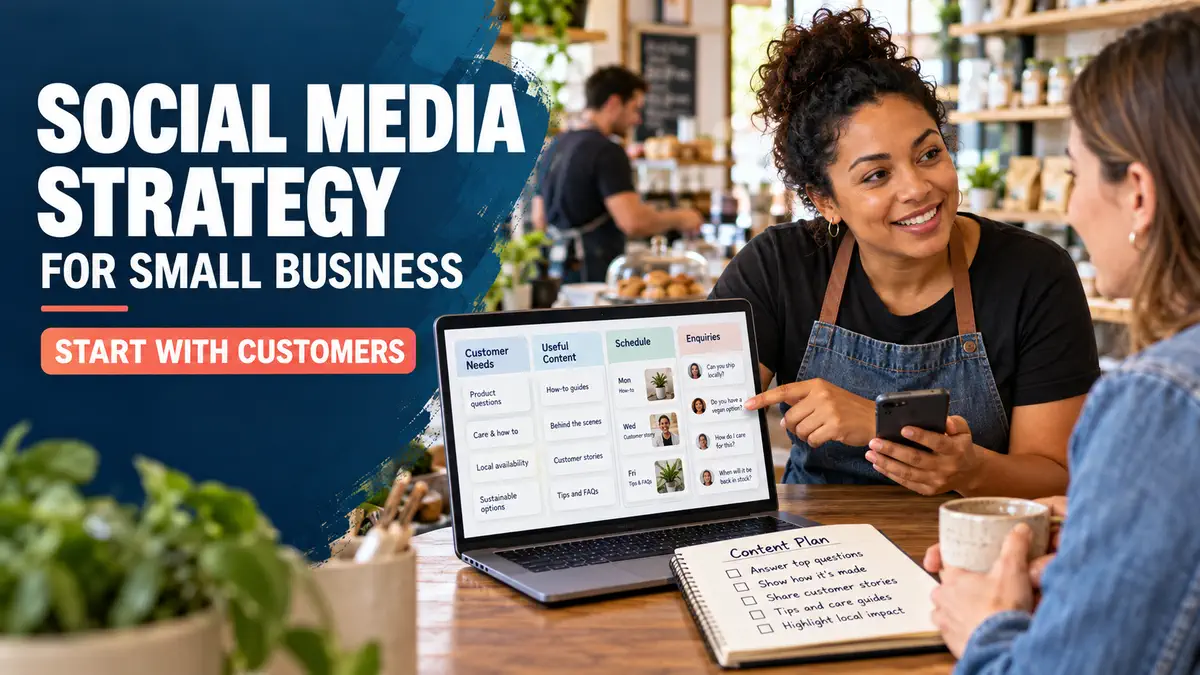



A social media strategy for small business should begin with what customers need to know before they buy. A local repair service might need to explain its service area and booking process. An online shop may need clearer sizing and delivery information. Posting frequently will not resolve those unanswered questions.
Choose one business goal for the next month, then build a realistic routine around it.
Table of Contents
Social Media Strategy for Small Business Guide: Pick a Goal
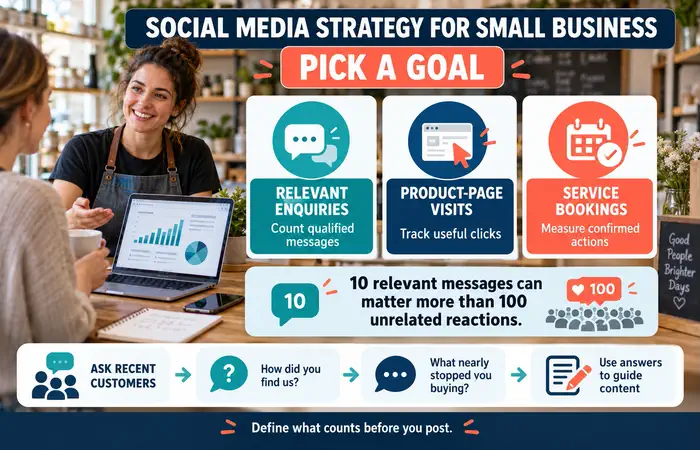
A useful goal might be more relevant enquiries, visits to a product page or bookings for a service. Define what counts. Ten messages asking for a job may matter more than a hundred reactions from people outside your service area.
Ask recent customers how they found you and what nearly stopped them buying. Their answers can guide content more effectively than copying a competitor’s posting schedule.
Best Social Media Strategy for Small Business: Compare Approaches
| Approach | Suitable when | What to watch |
| One active platform | Customers mainly use one network | Avoid depending entirely on a platform you do not control |
| Two complementary platforms | The same audience uses both for different reasons | Adapt posts rather than copying them unchanged |
| Organic posts plus a small paid test | An offer and landing page are already clear | Track spending and relevant enquiries |
| Frequent posts across many networks | A team can create and respond consistently | Time cost and declining content quality |
For most small teams, the most-effective thing you can do is the one you can hold up while you serve your customers. Start small-one or two platforms-and scale gradually, another only when there is data that you’re engaging appropriate customers.
Social Media Strategy for Small Business for Beginners: Weekly Workflow
- Collect customer questions. Note what people asked in messages, calls or at the counter.
- Choose three post ideas. Explain a service, answer a question and show a genuine example.
- Check the details. Confirm prices, stock, location, dates and links.
- Publish and respond. Make someone responsible for replies during stated business hours.
- Record useful results. Track relevant enquiries, bookings or website visits alongside reach.
Review the process weekly. If every post takes hours to produce, simplify the format before adding more work.
Social Media Strategy for Small Business Examples
An Indian tailoring shop could show an alteration example, explain typical turnaround and tell customers how to request a quote. It should confirm each job’s price after assessing the garment rather than promising a universal rate.
A neighbourhood bakery could share ordering deadlines, cake-size guidance and photos of products it genuinely makes. A consultant could explain common client problems and how an initial conversation works.
In all three cases, the content helps a prospective buyer take the next step.
Social Media Strategy for Small Business Cost
Organic posting can begin without buying advertising, but creating content and answering messages takes time. A paid campaign adds media spend and possibly design or management costs. Set a budget you can afford to test and decide beforehand what result would make the experiment useful.
Do not pay for extra software simply because other businesses use it. Add scheduling or analytics tools when they solve a recurring problem. A clear offer and reliable response process deserve attention first.
Social Media Strategy for Small Business Tips
Keep business information consistent across your profile, website and posts. Use genuine photos with permission. Check that someone can fulfil a promotion before it goes live.
Followers are not the be all end all As I said, followers are more useful as context than conversion. A small local business might get a higher number of low quality enquiries, with fewer good ones. Don’t expect immediate results with regular posting.
FAQs
Which platform should a small business use first?
Choose the platform where your customers already look for businesses like yours and where you can respond consistently.
How often should a beginner post?
Start with a schedule you can maintain while creating accurate, useful posts. Review results before increasing frequency.
Should every post sell something?
No. Answering practical questions can help people decide whether your offer suits them.
Conclusion
A social media strategy for small business is effective when it communicates your offer to customers and provides a manageable plan for your team. Set a destination, create useful solutions and measure success by the appropriate business results.