




Social impact measurement should answer more than “How many people did we reach?” Reach is useful, but it does not show whether lives, opportunities or environmental conditions improved. A training programme can report attendance as an output; it needs follow-up evidence to understand whether participants gained useful skills or employment.
Begin with a small number of questions that can influence decisions.
Table of Contents
Social Impact Measurement Guide
| Level | Question | Example |
| Input | What resources were used? | Staff time and training funds |
| Activity | What did the organisation do? | Delivered workshops |
| Output | What was directly produced? | Number completing training |
| Outcome | What changed afterwards? | Participants applying the skill |
| Longer-term impact | What broader change occurred? | Improved and sustained livelihood |
| Unintended effect | What else changed? | Exclusion caused by travel requirements |
The further you move from an activity, the harder it becomes to establish how much change the organisation caused. Avoid claiming full credit when other factors contributed.
Best Social Impact Measurement Approach
There is no single best method for every organisation. A small pilot may use attendance records, a short follow-up survey and interviews. A mature programme may need comparison data, external evaluation or specialised measurement.
UNDP’s enterprise impact standards are voluntary tools intended to help organisations integrate impact management into decision-making. Its 2026 guide for smaller businesses also presents impact measurement and management as a practical process rather than reporting alone.
Select an approach proportionate to the decision and the risk of being wrong.
Social Impact Measurement for Beginners: Workflow
- Define the problem and intended outcome.
- Ask affected people what meaningful improvement looks like.
- Create a simple theory of change linking activities to outcomes.
- Select a few indicators, including quality where possible.
- Record a baseline before the intervention.
- Collect data consistently and with appropriate consent.
- Analyse differences between groups, not just the average.
- Discuss what else could explain the result.
- Use the findings to improve or stop the activity.
Collect only data you can protect and use. Sensitive personal information creates responsibilities and may not be necessary.
Social Impact Measurement Examples
A skills programme could record enrolment and completion, then follow up to learn whether participants used the skill. It should also note who dropped out and why.
An affordable-energy enterprise could count installations, but should also investigate reliability, continued use and whether the solution supports the intended livelihood or service outcome.
A waste-recovery enterprise might track material collected, worker income and safety incidents. A higher collection total would not compensate for unsafe working conditions.
Social Impact Measurement Cost and Expectations
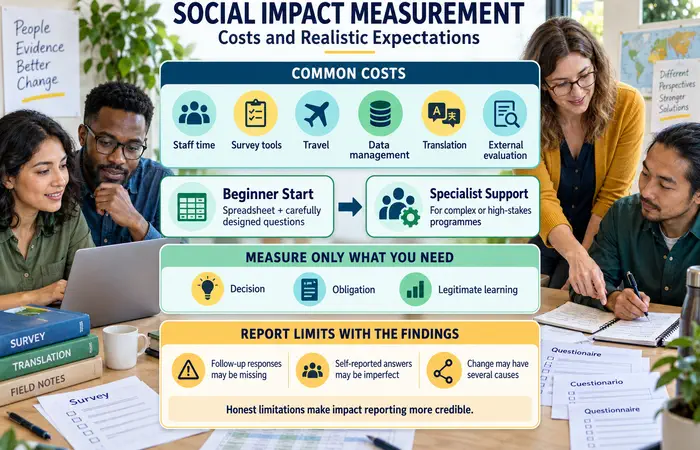
Costs may include staff time, survey tools, travel, data management, translation and external evaluation. A beginner can start with a spreadsheet and carefully designed questions, but complex or high-stakes programmes may require specialist support.
Do not collect dozens of indicators because a template includes them. Each measure should support a decision, obligation or legitimate learning need.
Impact data will contain limitations. People may not respond to follow-up questions, self-reported answers may be imperfect and changes may have several causes. Report those limits alongside the findings.
Social Impact Measurement Tips
Define every indicator so staff collect it consistently. Disaggregate results where appropriate to identify groups that may be excluded. Combine numbers with responsibly gathered qualitative feedback.
A common mistake is selecting only positive indicators after a programme has begun. Set the main measures before implementation and include possible negative effects.
FAQs
What is the difference between output and outcome?
An output is what the organisation directly delivers. An outcome is a change experienced after that activity.
Does every social enterprise need an external evaluator?
No. The approach should reflect scale, complexity, risk and reporting requirements.
What is the best social impact measurement tool?
No tool fits every case. Begin with the decision, outcome and data you can collect responsibly.
Conclusion
Social impact measurement helps an organisation understand what changed, for whom and with what limitations. Define outcomes early, collect proportionate evidence and use the findings to improve decisions rather than merely promote success.