




The simplest social entrepreneurship meaning is building and operating an organisation that addresses a social or environmental problem while using a practical model to sustain its work. A social entrepreneur may sell affordable energy systems, organise producer cooperatives or offer services that improve access to education.
Profit and social impact are not necessarily opposites. The important question is how the organisation earns money, uses its resources and protects its mission while it grows.
Table of Contents
Social Entrepreneurship Meaning Guide
Social entrepreneurship usually combines four elements:
- A clearly defined social or environmental problem
- A product, service or process designed to address it
- A model for generating or securing sufficient resources
- A method for checking whether meaningful change occurs
The organisation could operate as a company, cooperative, trust, society or another permitted structure. The label “social enterprise” does not automatically describe one specific legal form in every country.
Social Enterprise vs Charity vs Conventional Business
| Model | Primary purpose | Common source of funds | Main question |
| Social enterprise | Create impact through a sustainable model | Sales, grants, contracts or blended funding | Does growth strengthen the mission? |
| Charity or nonprofit | Serve a defined public-benefit purpose | Donations, grants or programme income | Are resources reaching the intended need? |
| Conventional business | Create value for customers and owners | Product or service revenue | Is the business commercially sustainable? |
| Cooperative | Serve members through collective ownership | Member activity and trading income | Are members benefiting fairly? |
These categories can overlap. A nonprofit may earn programme income, while a company can adopt a strong social mission. Examine governance, revenue, beneficiaries and how surplus is used rather than relying only on a label.
Social Entrepreneurship Meaning for Beginners: A Workflow
- Define the problem. Identify who experiences it and why current options fall short.
- Speak with affected people. Avoid designing a solution based only on assumptions.
- Create a small offer. Test a service, product or delivery process.
- Decide who pays. The customer and beneficiary may be the same person—or different groups.
- Track cost and outcomes. Check whether the model can operate without weakening service quality.
- Review unintended effects. A solution can create new barriers even when its intention is positive.
For example, affordable learning material is not genuinely accessible if delivery costs place it beyond the intended customer’s budget.
Social Entrepreneurship Meaning Examples
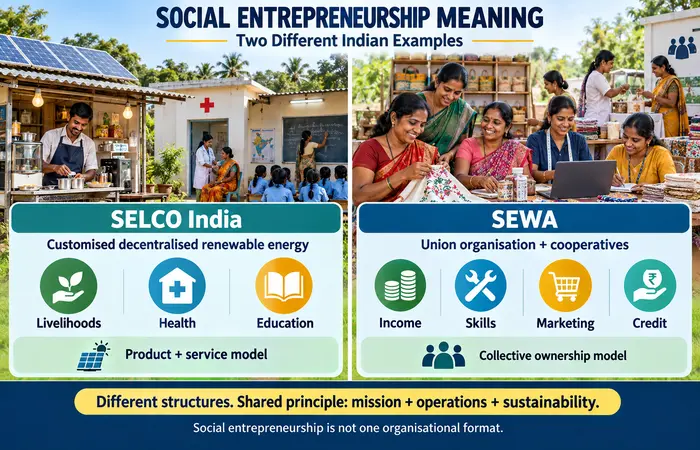
SELCO India describes itself as a social enterprise providing customised decentralised renewable-energy solutions to underserved communities. Its work illustrates how a product and service model can be connected to livelihood, health and education needs.
SEWA combines union organisation with cooperatives that support income, skills, marketing, credit and other services for women workers. This demonstrates how collective ownership can form part of social entrepreneurship.
These examples use different structures and methods. Social entrepreneurship is defined by the relationship between mission, operations and sustainability—not by copying one organisational format.
Social Entrepreneurship Meaning, Cost and Expectations
Starting costs depend on the solution. A skills-based service may require limited equipment, while clean-energy, healthcare or manufacturing models can require research, infrastructure and working capital.
Budget for more than product development. Community consultation, staff training, safe delivery, impact measurement and regulatory compliance also take money and time.
Social entrepreneurship cannot guarantee that an intervention will work. Early results may show that the offer needs to change. Treat evidence from affected communities as a reason to improve the model, not merely material for promotion.
Social Entrepreneurship Meaning Tips
Write the mission in terms of a specific group and outcome. Identify who pays and who benefits. Keep financial and impact records from the beginning.
One common mistake is counting activities as impact. Distributing 500 products is an output; whether people could use them and experienced the intended benefit is an outcome requiring further evidence.
FAQs
What is social entrepreneurship in simple words?
It means using an entrepreneurial model to address a social or environmental problem sustainably.
Must a social enterprise be nonprofit?
No. Its permitted structure depends on the jurisdiction and model.
Can a social enterprise earn profit?
It can generate surplus, but its governance and decisions should protect the stated social mission.
Conclusion
The social entrepreneurship meaning goes beyond starting a business that supports a good cause. It involves building a sustainable model in which the intended social or environmental outcome influences products, operations, governance and measurement.