
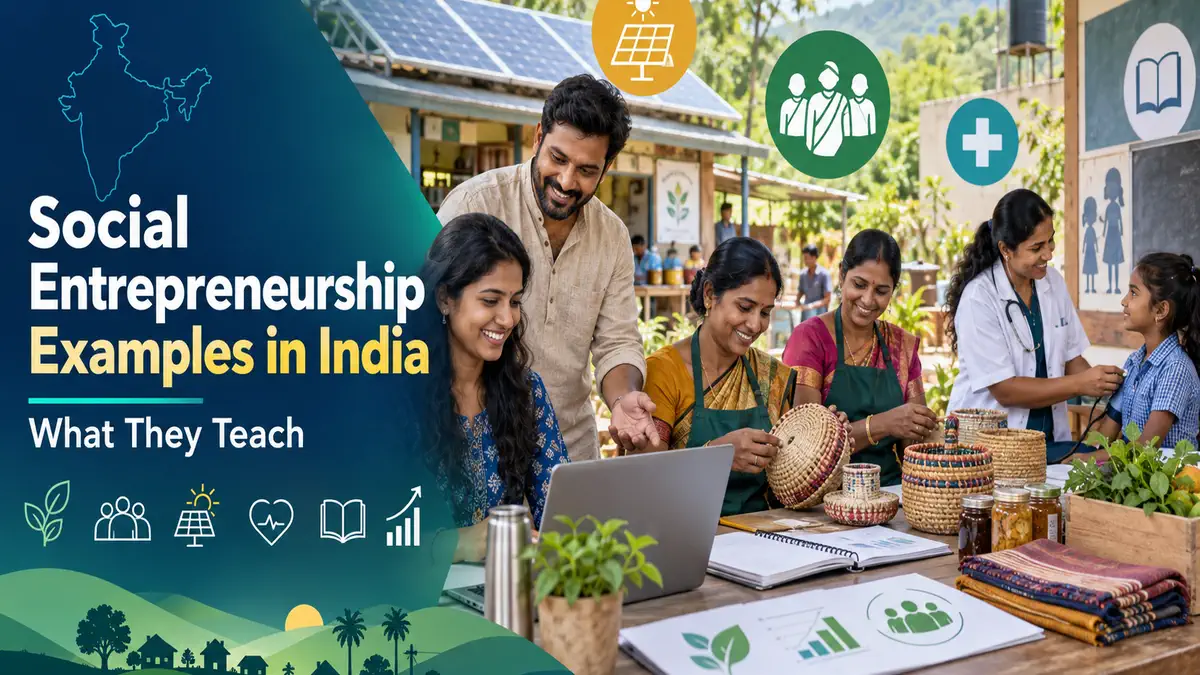



Useful social entrepreneurship examples in India show more than inspiring missions. They explain the problem addressed, the operating model and the role communities play. India’s social-enterprise landscape includes companies, cooperatives, trusts and nonprofit organisations, so the examples should not all be described as if they have the same legal structure.
The following cases are based on information published by the organisations themselves.
Table of Contents
Social Entrepreneurship Examples in India Guide
| Organisation | Area of work | Model lesson |
| SELCO India | Decentralised sustainable energy | Adapt the solution to users’ circumstances |
| SEWA and its cooperatives | Women’s livelihoods and collective services | Combine member ownership with enterprise support |
| Goonj | Material-led and community-led development | Treat communities as stakeholders rather than passive recipients |
| SELCO Foundation | Sustainable energy ecosystem development | Support institutions and enterprises around the solution |
These examples are not a ranking. Each operates within a different structure, context and theory of change.
SELCO India: Customised Energy Solutions
SELCO India describes itself as a social enterprise delivering customised decentralised renewable-energy solutions to underserved communities. Its work spans areas such as livelihoods, healthcare, education and household energy.
The practical lesson is that affordability is not limited to lowering a product’s price. Design, financing, maintenance and the user’s income pattern can all affect whether a solution remains usable.
SEWA: Women-Led Cooperative Enterprise
SEWA states that it has formed trade cooperatives to improve income, skills, marketing and access to credit. It also uses cooperatives to support services including banking, healthcare, childcare and insurance.
This example shows that social entrepreneurship can be collectively owned. A cooperative’s success should be evaluated through member benefit, governance and sustainability—not just sales.
Goonj: Community Resources and Participation
Goonj works across rural and urban India and describes communities as equal stakeholders in solving their challenges. It also describes material and voluntary community labour as alternative resources for development.
Goonj is an NGO rather than a conventional commercial enterprise. It is relevant to social-entrepreneurship study because its model demonstrates innovation in resource mobilisation and community participation. The distinction in legal and revenue structure should remain clear.
Social Entrepreneurship Examples in India for Beginners: How to Analyse Them
- Identify the specific problem addressed.
- Determine who benefits and who pays.
- Examine the organisation’s legal and governance structure.
- Understand how products or programmes reach people.
- Look for evidence about outcomes rather than publicity alone.
- Consider whether the model could operate in another context without losing its purpose.
Avoid copying an organisation’s visible product while ignoring the partnerships, trust and support systems behind it.
Social Entrepreneurship Examples in India: Cost and Expectations
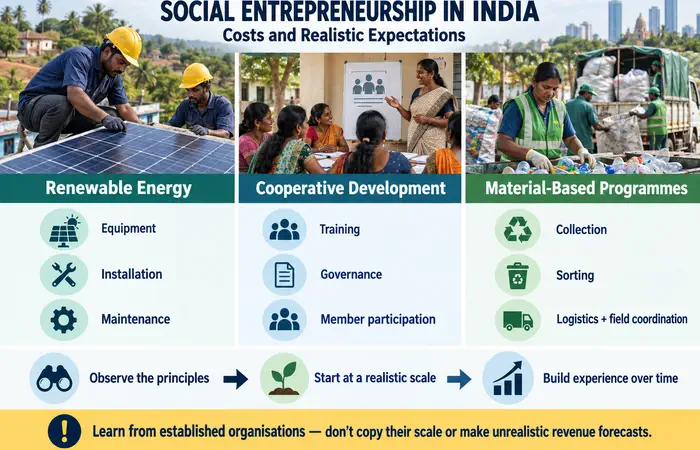
The cost of a model depends on its sector. Renewable-energy work may require equipment, installation and maintenance. Cooperative development requires training, governance and sustained member participation. Material-based programmes require collection, sorting, logistics and field coordination.
These organisations also operate at a scale and level of experience that a beginner cannot reproduce immediately. Use their work to understand principles, not to create unrealistic revenue forecasts.
Tips for Learning From Indian Social Enterprises
Read the organisation’s current website, reports and legal information. Separate claims made by the organisation from independently verified results. Note whether the people affected by the work participate in design and decision-making.
A common mistake is calling every NGO a social enterprise. Some nonprofit organisations use entrepreneurial methods, but the terms are not automatically interchangeable. Describe the exact structure when known.
FAQs
Which are the best social entrepreneurship examples in India?
There is no universal ranking. SELCO India, SEWA-linked cooperatives and Goonj offer useful examples of different models.
Are all Indian social enterprises companies?
No. Companies, cooperatives, trusts and nonprofit organisations may all use socially entrepreneurial approaches.
Can I copy one of these models?
You can learn from its principles, but your solution must reflect the community, regulations and economics of your context.
Conclusion
Social entrepreneurship examples in India demonstrate that social innovation can use energy services, collective enterprise or community resources. Study how each organisation connects mission, delivery, governance and evidence before applying its lessons elsewhere.