
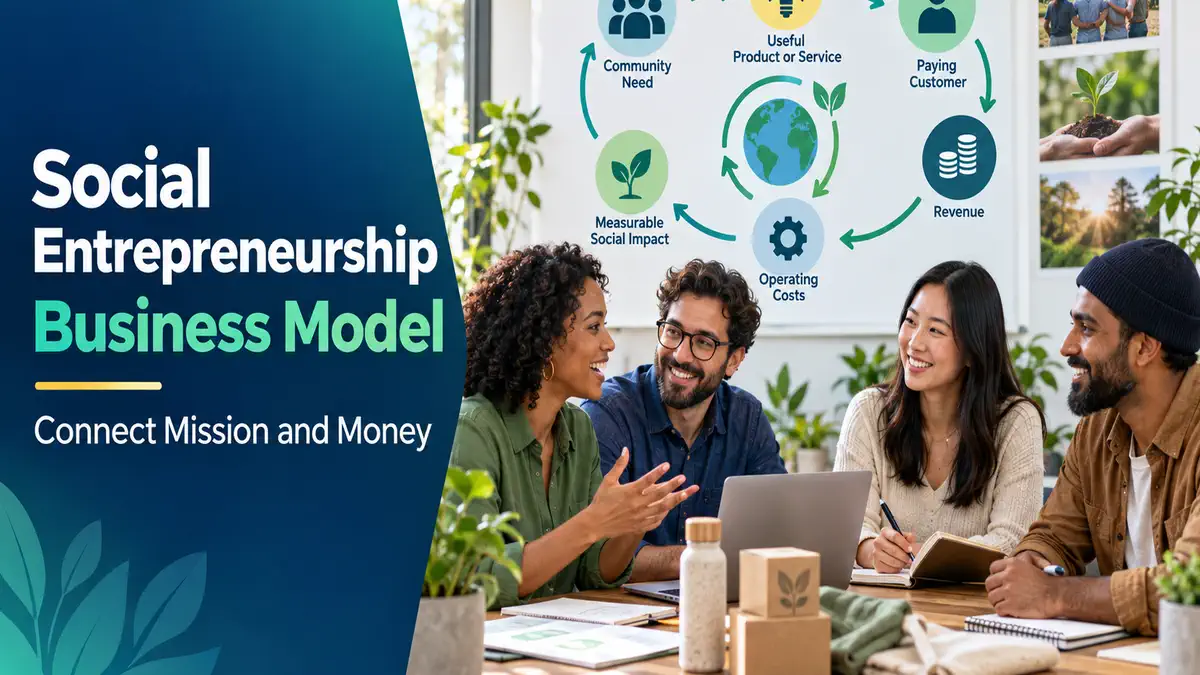



A social entrepreneurship business model must explain two things at the same time: how the organisation addresses a problem and how it obtains the resources to keep operating. A mission without an operating model may remain dependent on uncertain funding. A profitable activity with no protected social purpose may drift away from the people it intended to serve.
The model should make trade-offs visible rather than claiming that every decision benefits everyone equally.
Table of Contents
Social Entrepreneurship Business Model Guide
| Component | Question to answer |
| Problem | What specific social or environmental issue exists? |
| Beneficiary | Who should experience the intended improvement? |
| Customer | Who uses or purchases the offer? |
| Payer | Who provides the revenue? |
| Value proposition | Why would the customer or payer participate? |
| Delivery | How does the offer reach the beneficiary? |
| Revenue | Which sales, contracts or grants support operations? |
| Costs | What does reliable and responsible delivery require? |
| Impact | What outcome will be measured? |
| Governance | How will the mission be protected? |
Do not assume the beneficiary, customer and payer are always the same person.
Best Social Entrepreneurship Business Model Options
| Model | How it works | Principal risk |
| Direct sales | Beneficiaries or customers buy the product | Excluding people unable to pay |
| Cross-subsidy | Higher-margin sales support lower-cost access | Subsidy depends on commercial demand |
| Institutional payer | A government, company or foundation pays | Dependence on a small number of contracts |
| Cooperative | Members own and use the enterprise | Weak participation or governance |
| Blended revenue | Sales combine with grants or donations | Complexity and unclear cost allocation |
No model is automatically best. Select one that reflects who receives value, who can pay and what mission protections are needed.
Social Entrepreneurship Business Model for Beginners: Workflow
- Describe the problem and intended outcome.
- Identify beneficiaries, customers and payers separately.
- Write the value offered to each group.
- Map the delivery process and essential partners.
- Calculate direct and shared costs.
- Test whether the expected revenue covers responsible delivery.
- Define impact indicators and feedback channels.
- Review how growth could change access or quality.
If a model works only because founders provide large amounts of unpaid labour, include that fact in the cost calculation.
Social Entrepreneurship Business Model Examples
SELCO India’s approach connects customised energy solutions with the needs of underserved communities. The lesson is not simply “sell solar systems”; it is to align technology, delivery and continued service with user circumstances.
SEWA’s union-and-cooperative approach combines collective voice with enterprises supporting livelihoods and access to services. This illustrates how governance and member ownership can be part of the business model.
Social Entrepreneurship Business Model Cost
Include product development, salaries, training, transport, maintenance, community engagement, compliance and measurement. Separate expenses required to deliver the core product from costs incurred specifically to reach or support the intended group.
A cross-subsidy model needs evidence that the profitable segment is large enough. A grant-supported model needs a plan for what happens when a grant ends. A cooperative needs resources for participation and governance, not only production.
Social Entrepreneurship Business Model Tips
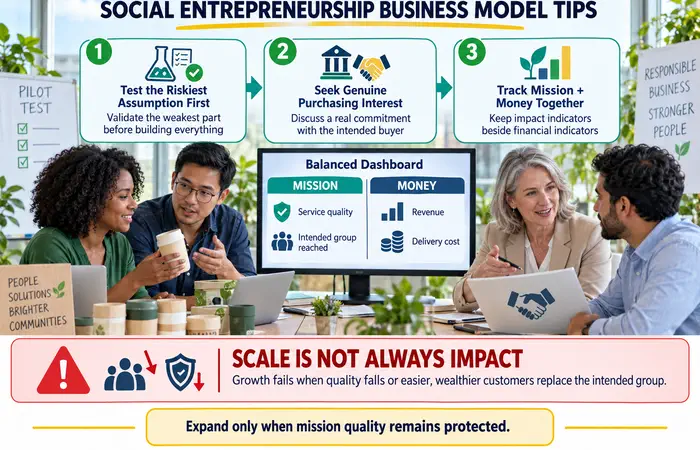
Test the riskiest assumption first. If the model depends on an institution paying, seek a genuine purchasing discussion before building the whole programme. Keep mission indicators beside financial indicators in management reports.
One common mistake is confusing scale with impact. Reaching more people can be positive, but not if service quality falls or the organisation begins serving easier, wealthier customers while excluding its intended group.
FAQs
What is the best social entrepreneurship business model?
There is no universal best model. It must fit the problem, payer, costs and mission.
Can a social enterprise use grants and sales together?
Yes. It should track how each income source supports the model and what restrictions apply.
Why is governance part of the model?
Governance influences who makes decisions and how the mission is protected during growth.
Conclusion
A social entrepreneurship business model connects the intended outcome with customers, payers, delivery, costs and governance. Test those relationships together before treating the model as sustainable.