
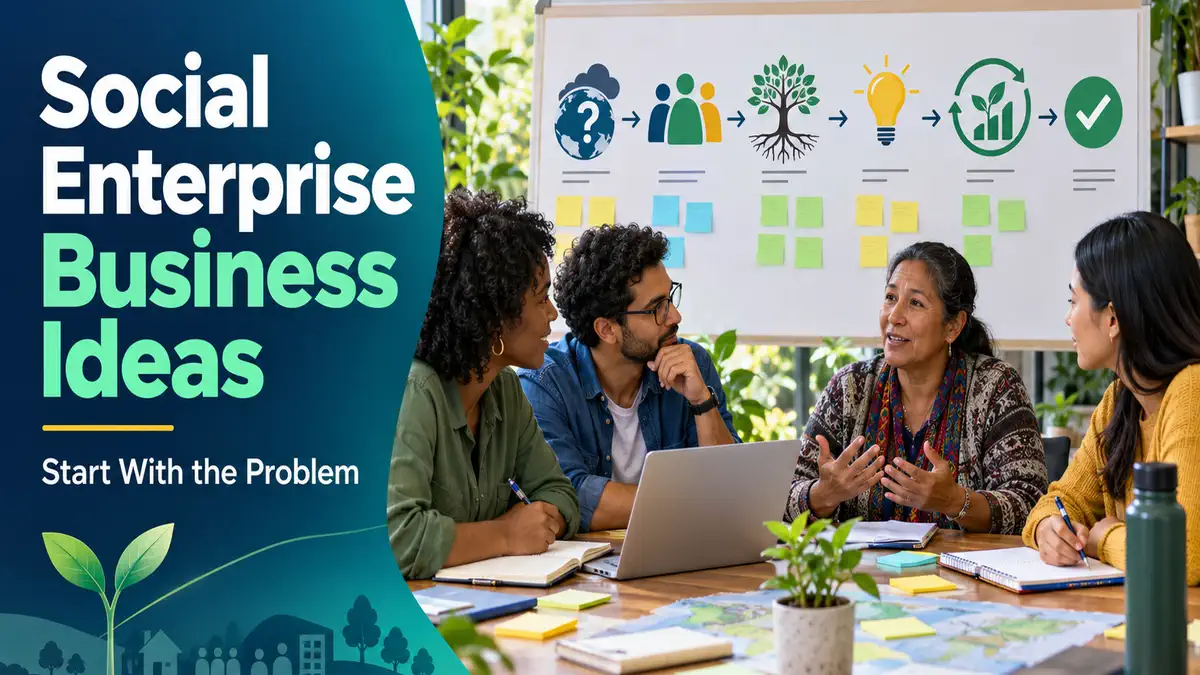



The strongest social enterprise business ideas do not begin with a fashionable product. They begin with a well-understood problem and the people affected by it. A founder should learn how the problem is currently managed, why existing options fail and whether the proposed customer is able and willing to pay.
The beneficiary and customer may be different. A school, company or donor might pay for a service delivered to another group.
Table of Contents
Best Social Enterprise Business Ideas Compared
| Idea | Intended benefit | Possible payer |
| Repair and reuse network | Longer product life and local employment | Customers, manufacturers or municipalities |
| Affordable energy service | Reliable energy for underserved users | Households, institutions or finance partners |
| Inclusive skills and employment | Access to training and paid work | Employers, learners or programme partners |
| Farmer processing collective | Better value retention for producers | Buyers, members or distributors |
| Assistive-product service | Improved access and independence | Users, institutions or insurers |
| Waste collection and recovery | Cleaner communities and recovered materials | Households, businesses or local bodies |
These are starting directions rather than ready-made businesses. Each needs local research, regulatory checks and financial testing.
Social Enterprise Business Ideas Guide: Four Questions
First, define the problem without assuming a solution. Second, identify who experiences it. Third, determine who has both a reason and ability to pay. Finally, decide what evidence would show improvement.
Suppose women producers receive low prices because they sell individually. A collective sales platform may help, but only if it improves market access after transport, quality-control and management costs are counted.
Social Enterprise Business Ideas for Beginners: Pilot Workflow
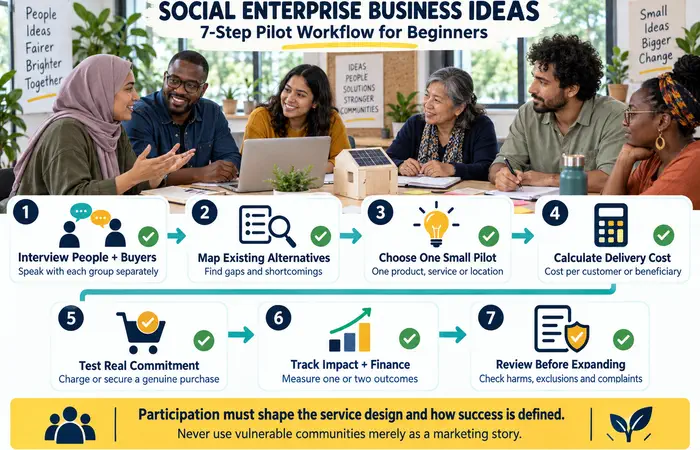
- Interview affected people and relevant buyers separately.
- Map the existing alternatives and their shortcomings.
- Choose one small product, service or location.
- Calculate delivery cost per customer or beneficiary.
- Charge or secure a genuine purchasing commitment.
- Track one or two outcomes alongside financial performance.
- Review harms, exclusions and complaints before expanding.
Do not use vulnerable communities merely as a marketing story. Participation should influence the service design and how success is defined.
Social Enterprise Business Ideas Examples
A repair cooperative could train local technicians and earn revenue from repairs and maintenance contracts. Its impact measures might include paid work created and products kept in use.
A farmer-owned processing unit might earn revenue from buyers while returning value to members. Governance and quality consistency would matter as much as demand.
An affordable-energy service could combine product sales, financing partnerships and maintenance. SELCO India’s customised approach shows why user needs, finance and after-sales support need to work together.
Social Enterprise Business Ideas Cost and Expectations
Cost depends on the sector. A training service may begin with staff time and rented space, whereas processing, energy or waste operations may need equipment, licences, transport and working capital.
Prepare two budgets: the commercial cost of delivering the product and the additional cost of achieving the social purpose. If serving remote users costs more, the funding or pricing model must recognise that reality.
Expect the first model to change. Discovering that a proposed beneficiary cannot afford the service is not a reason to hide the result; it is evidence that another payer or delivery model may be needed.
Social Enterprise Business Ideas Tips
Choose a narrow problem and location for the pilot. Separate outputs from outcomes. Build a feedback and complaint process. Confirm legal, safety and sector-specific requirements before operating.
A common mistake is subsidising an unsustainable model during a pilot and assuming it will become viable at scale. Calculate what each additional customer costs and identify which expenses genuinely decline with volume.
FAQs
What makes a business idea a social-enterprise idea?
Its social or environmental mission is built into the model, delivery and measurement.
Must beneficiaries pay for the service?
No. Another customer or funding partner may pay, but that arrangement must be sustainable and transparent.
Which idea is best for beginners?
Choose a problem you understand and can test safely on a limited scale.
Conclusion
Social enterprise business ideas become credible when a real problem, sustainable payer and measurable outcome fit together. Test a narrow version, listen to affected people and improve the model before expanding.