



Use this SEO title and meta description checklist after the article is finished. Because it can be easier to define what a page does when you know what it really does. Write for a person choosing between clicking and not, then look at the text of your WordPress SEO inputs and the actual page.
Google may generate a different title link or snippet from the page content, so a preview is a useful editing aid, not a promise of exactly what will appear. Google explains the sources it may use for title links.
Table of Contents
SEO Title and Meta Description Checklist Guide
| Check | What to look for | Example |
| Main topic | The title identifies the page’s subject | “On-Page SEO Checklist” |
| Distinct purpose | It differs meaningfully from related pages | “Image SEO Checklist” covers images specifically |
| Accuracy | The article fulfils the title’s promise | A “cost guide” actually discusses costs |
| Readability | The title makes sense without the site name | Clear wording, no keyword list |
| Description | It summarises the page and its value | Mentions the checks a reader can perform |
| Live output | One intended title and description are present | Inspect the published page |
Google recommends descriptive, concise and distinct title text. It does not specify a fixed character count that guarantees an uncut title; display length varies with the available space. Its snippet guidance also explains that snippets can be drawn from page content.
Best SEO Title and Meta Description Checklist for a New Page
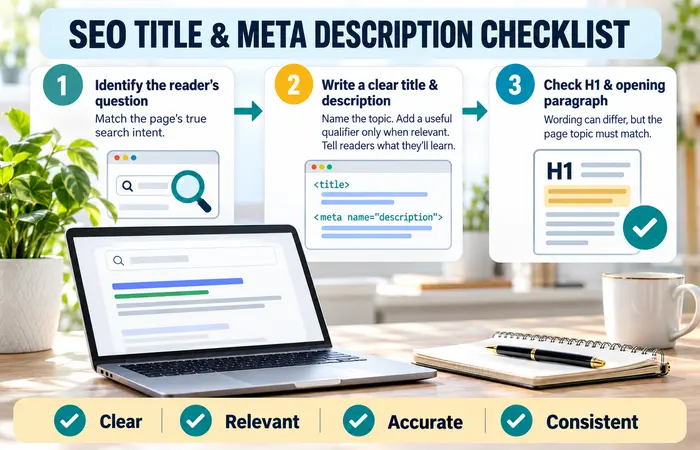
First, identify the reader’s question. Write a title that names the subject and distinguishes this page from your other articles. Place a useful qualifier, such as “for beginners” or “in India”, only if the page genuinely covers it.
Instructional: Briefly explain what readers will be able to do after reading this. If you want to include the main phrase in the description, you may. (However, you may not have to-see both examples.)
Finally, compare the title with the visible H1 and opening paragraph. They do not have to match word for word, but they should describe the same page.
SEO Title and Meta Description Checklist for Beginners: Workflow
- Finish the article and identify its single main intent.
- Draft two short, accurate titles; choose the clearer one.
- Write a description that adds detail rather than repeating the title.
- Enter both in the relevant WordPress SEO fields.
- Preview the page and inspect its published source or SEO output.
- Check that another active plugin or theme setting has not created conflicting metadata.
If you update an old title, note the date. Review its search performance over a sensible period rather than judging the edit after one day.
SEO Title and Meta Description Checklist Examples
For an article explaining image alt text, “Image Alt Text: How to Describe Website Images” promises a practical explanation. “Best Image SEO Alt Text Keywords | Images | Ranking Tips” is harder to read and suggests several competing purposes.
A matching description could say: “Learn when an image needs alt text, how to describe it clearly and when decorative images should use an empty alt attribute.” The description tells a reader what the page contains without making a ranking promise.
SEO Title and Meta Description Checklist Cost and Tips
Writing and checking metadata does not require a paid subscription. The cost is editorial time, especially if many pages have duplicated or outdated titles. Start with important pages and templates that affect groups of URLs.
A common mistake is copying the same description across every category or article. Another is changing the title to target a query the content barely addresses. Correct the underlying page or choose a more accurate title.
FAQs
Does Google always show my meta description?
No. It may create a snippet from page text that better matches a particular search.
Is there an ideal title character count?
There is no fixed count that guarantees display. Prioritise concise, descriptive wording.
Should the title and H1 be identical?
They can be, but consistency of meaning matters more than exact matching.
Conclusion
An SEO title and meta description checklist helps you publish distinct, accurate search-facing text. Check the live output, keep the promise aligned with the page and review performance without expecting full control over Google’s display.