


A heading structure SEO checklist is useful when an article feels difficult to scan. Read only its headings, from top to bottom. Can you tell what question the page answers and what each section contributes? If not, the outline needs work before any keyword adjustments.
Headings are part of the page’s structure, but they are not a substitute for helpful explanations underneath them.
Table of Contents
Heading Structure SEO Checklist Guide
| Element | Practical check | Common problem |
| Main title or H1 | States the page’s central subject | Several competing prominent titles |
| H2 | Introduces a main section | A vague heading such as “Other Things” |
| H3 | Divides a relevant H2 section | An H3 unrelated to its parent section |
| Sequence | Helps readers follow a sensible order | Advice appears before the problem is explained |
| Content | Delivers what the heading promises | Heading followed by a single generic sentence |
| Navigation | Makes long articles easier to scan | Important answers are buried |
Google’s SEO Starter Guide advises organising content so readers can understand it. Google also notes that a clear, prominent main title can help it understand the page when generating a title link. There is no requirement to force an exact number of headings into every article. Google’s title-link guidance explains the role of prominent page text.
Best Heading Structure SEO Checklist: Outline by Intent
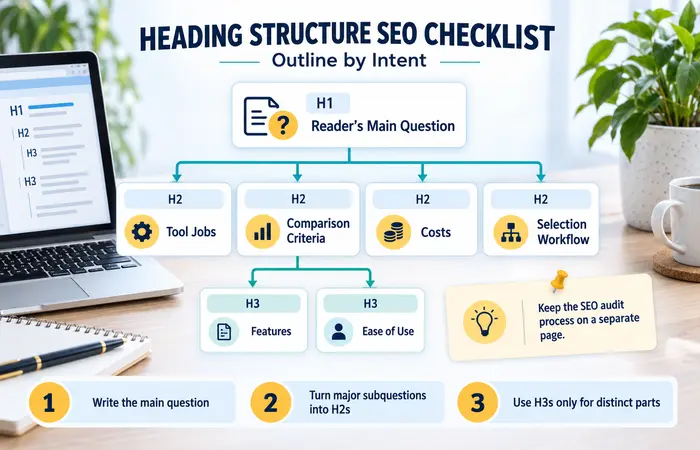
Write the reader’s main question at the top of a draft. List the major steps or subquestions they need answered. Make those your H2 sections. Use H3 headings only where a main section has distinct parts worth separating.
For a page about choosing an SEO tool, sensible H2s might cover the job each tool performs, comparison criteria, costs and a selection workflow. A separate article about conducting an audit should go deeper into the audit process. This gives each page a clear purpose.
Heading Structure SEO Checklist for Beginners: Workflow
- Write a descriptive article title.
- Draft H2s in the order a reader would need them.
- Add H3s only where they clarify a substantial H2.
- Read the headings alone to check the outline.
- Read each section to confirm it answers its heading.
- Inspect the published WordPress page for unintended heading tags.
Some themes style text to look like a heading even when it is an ordinary paragraph. Conversely, a decorative sidebar label may use a heading tag. Review the main article area rather than making broad changes across the theme.
Heading Structure SEO Checklist Examples
Consider a guide on internal linking. “How to Choose a Relevant Destination” tells a reader what the section covers. “Important Tips” could describe almost anything. Under the first H2, an H3 such as “Check the destination page” makes sense; an H3 about image compression belongs elsewhere.
A frequent mistake is turning every secondary keyword into an H2 even when the phrases repeat the same question. Combine overlapping ideas into one useful section. Headings should reflect the article’s reasoning, not a list copied from a keyword tool.
Heading Structure SEO Checklist Cost and Tips
Reorganising an outline costs editorial time, not a paid tool. On a large site, use a crawl or content inventory to find pages with confusing structures, then review important pages manually.
Do not add headings merely to reach a target count. Long sections may benefit from a clear subheading; short explanations often do not. After editing, check the mobile view to make sure headings are readable and the content still flows naturally.
FAQs
Must every article have exactly one H1?
A clear main title is a sound editorial choice. Focus on making the primary title obvious and the remaining structure understandable.
Does every H2 need an H3?
No. Add an H3 only when it helps divide a substantial section.
Will adding keywords to headings guarantee rankings?
No. Headings should describe useful content that satisfies the reader’s question.
Conclusion
A heading structure SEO checklist helps you give an article a readable outline. Make the main purpose obvious, order sections logically and ensure the text beneath each heading fulfils its promise.