



The relationship between social signals and SEO is often oversimplified. Likes, shares and follower counts are visible measures of social engagement, but businesses should not assume that increasing these numbers will automatically improve Google rankings.
Social media can still support search performance indirectly. It distributes content, builds recognition, attracts referral visits and puts useful resources in front of people who may later cite them.
Table of Contents
What Are Social Signals?
Social signals are interactions or indicators associated with social platforms, including:
- Likes and reactions
- Shares, reposts and saves
- Comments and replies
- Profile mentions
- Video views
- Follower growth
- Clicks to a website
These figures describe activity on a platform. They are not interchangeable with backlinks, organic-search clicks or conversions.
Social Signals and SEO Guide
| Social activity | Possible SEO-related benefit | Important limitation |
| Sharing a research report | More people may discover and cite it | Shares do not guarantee links |
| Building expert visibility | May increase branded searches | Recognition takes time |
| Joining industry discussions | Creates relationships with publishers | Participation must be genuine |
| Promoting evergreen guides | Can generate recurring referral visits | Organic reach may be limited |
| Publishing short videos | Expands discovery across formats | Views may not reach the website |
| Maintaining profiles | Helps users verify a brand | Inactive profiles add little value |
There is no single “best social signals and SEO” tactic. The objective is to connect content distribution with useful audience actions.
Workflow: Using Social Media to Support SEO
- Select a search-led resource. Choose an article, study, tool or landing page that answers a real question.
- Adapt it for each platform. Turn findings into short posts, carousels, videos or expert threads.
- Link when useful. Direct readers to the full evidence rather than adding a link mechanically.
- Engage with relevant communities. Answer questions and involve cited experts.
- Track discovery. Use tagged URLs to measure social referral traffic.
- Watch for secondary outcomes. Record brand searches, newsletter sign-ups, mentions and earned links.
- Refresh successful material. Update and redistribute resources that remain useful.
Social Signals and SEO for Beginners
Beginners should choose one or two platforms where their audience is active. A B2B software company might prioritise LinkedIn, while a visual consumer brand may find Instagram or YouTube more suitable.
Create posts from existing expert material rather than maintaining a disconnected social calendar. For example, an SEO audit guide could become:
- A checklist carousel
- A short explanation video
- A poll about common audit problems
- A founder’s commentary post
- A link to the complete guide
Social Signals and SEO Cost
| Approach | Likely cost |
| Founder-led organic posting | Time and basic design |
| In-house social team | Salaries, tools and production |
| Freelance support | Per-post or monthly fee |
| Paid social distribution | Media budget plus creative work |
| Social listening platform | Monthly subscription |
Free activity can be useful, but it still carries a time cost. Paid promotion buys distribution; it does not purchase organic-search rankings.
Social Signals and SEO Examples
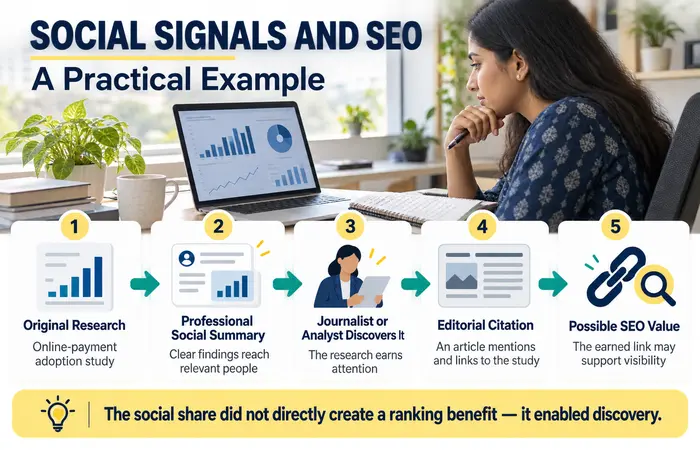
Suppose an Indian small-business platform publishes original research about online-payment adoption. A clear LinkedIn summary may reach journalists and industry analysts. One analyst may cite the research in an article, producing an editorial link.
The social share did not mechanically create the ranking benefit. It helped the research reach someone capable of generating a citation, mention or link.
Expectations Management
Google describes its ranking systems as using many factors and signals across vast numbers of pages. Its public ranking-systems guidance does not support reducing performance to a single social-engagement metric.
Social reach is also volatile. Platform algorithms change, posts lose visibility quickly and large follower numbers may not produce website visits. Evaluate social and search metrics separately before studying how they interact.
Pros and Limitations
Potential benefits: content discovery, referral traffic, brand familiarity, audience feedback and opportunities to earn coverage.
Limitations: no guaranteed ranking improvement, limited organic reach, attribution gaps and platform dependence.
Social Signals and SEO Tips
Publish original insights, include clear authorship, respond to genuine questions and make important resources easy to access. Track meaningful actions such as engaged visits and citations—not just reactions. Avoid buying followers or engagement; inflated numbers rarely represent interested customers.
Frequently Asked Questions
Are social signals an SEO ranking factor?
Businesses should not assume that likes or follower counts directly determine rankings. Social distribution can contribute indirectly through discovery, links, mentions and brand demand.
Do social profile links improve SEO?
They can help people find and verify a brand and may send referral traffic. Their direct ranking value should not be exaggerated.
Which platform is best for social signals and SEO?
The best platform is the one used by your target audience and relevant publishers. Audience fit matters more than maintaining every available account.
Conclusion
Social signals and SEO work together most credibly through distribution and discovery. Use social channels to circulate worthwhile content, build expert recognition and reach people who may become readers, customers or independent sources of coverage.