
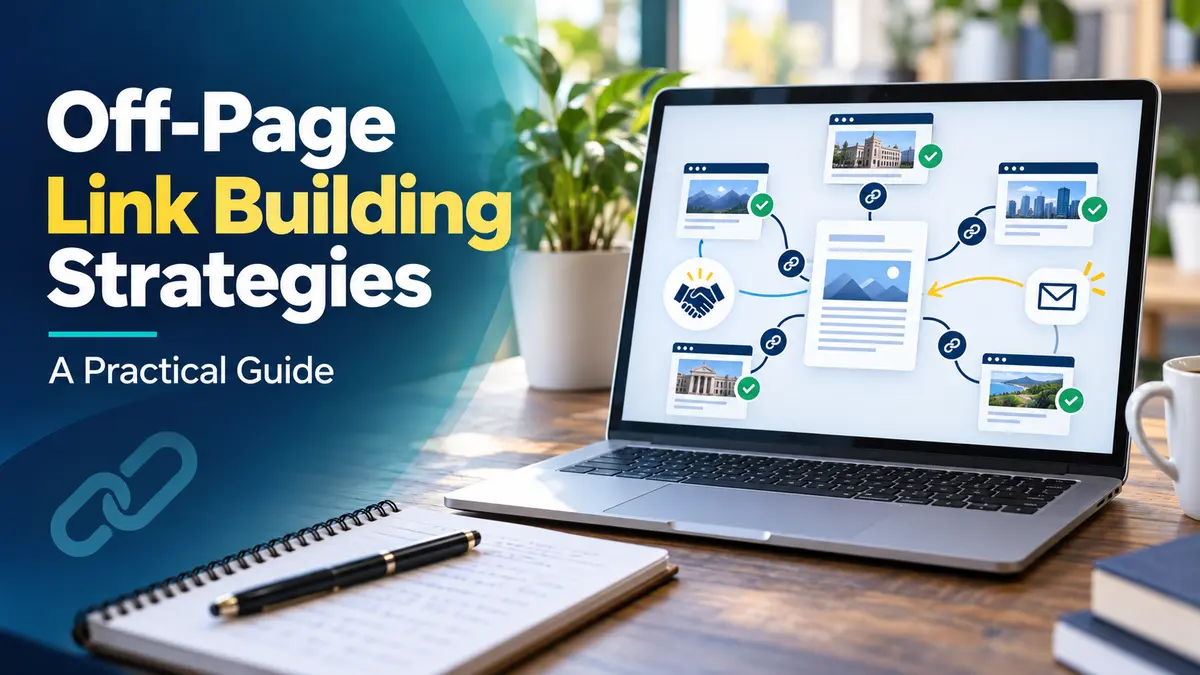



Good off-page link building strategies can improve how search engines and potential customers discover a website. However, link building is not a shortcut to guaranteed rankings. The safer approach is to earn relevant editorial links by publishing useful resources, building relationships and giving credible websites a genuine reason to mention your work.
Table of Contents
What Is Off-Page Link Building?
Off-page link building involves activities performed beyond your own website to attract hyperlinks, citations and brand mentions.
Search engines can use links to discover pages and understand their relevance. Google states that links are one signal used when determining page relevance, but links form only part of a much wider ranking system.
A useful backlink normally has three qualities:
- It comes from a relevant or respected source.
- It appears naturally within useful content.
- It helps readers find additional information.
Off-Page Link Building Strategies Guide
| Strategy | Best suited to | Effort | Main limitation |
| Digital PR | Original research and expert insights | High | Coverage is not guaranteed |
| Guest contributions | Specialist knowledge | Medium | Requires careful site selection |
| Resource-page outreach | Guides, tools and templates | Medium | Response rates vary |
| Broken-link outreach | Strong replacement resources | Medium | Opportunities can be limited |
| Local citations | Location-based businesses | Low–medium | Usually more valuable locally |
| Partnerships | Suppliers and industry groups | Medium | Links must arise naturally |
The best off-page link building strategies are rarely isolated tactics. A business might publish an original Indian market survey, pitch its findings to journalists and then adapt the research into guest articles and social content.
Workflow: How to Build Links Responsibly
- Set a relevant objective. Decide whether you need authority, referral traffic, local visibility or awareness.
- Create a link-worthy asset. Examples include original data, calculators, templates, detailed guides and expert commentary.
- Identify suitable websites. Prioritise topical relevance and genuine readership over third-party authority scores alone.
- Personalise the approach. Explain why the resource helps that website’s audience.
- Record responses and placements. Track the referring page, target URL, anchor text and referral visits.
- Review quality quarterly. Look for useful links and suspicious patterns rather than chasing raw totals.
Off-Page Link Building Strategies for Beginners
Beginners should start with assets they can produce credibly. A small accounting firm, for example, could publish a GST deadline calendar and share it with local business associations.
Begin with:
- Existing suppliers, partners and professional memberships
- Unlinked mentions of the brand or founder
- Reputable local and industry directories
- Expert quotations for journalists
- Resource pages that already cover the subject
Avoid buying bulk link packages, automating thousands of emails or placing keyword-heavy links on unrelated sites.
Off-Page Link Building Strategies Cost
Costs depend on whether work is completed internally or through specialists.
| Approach | Indicative requirement |
| In-house outreach | Staff time plus content production |
| Freelance support | Project or monthly fee |
| Digital PR campaign | Research, creative production and outreach |
| Local citations | Free manual listings or a management-tool fee |
| Premium research asset | Data, design and subject expertise |
There is no standard cost per legitimate editorial link. Paying for placement can also create policy risks. Google identifies buying or selling links for ranking purposes and large-scale article campaigns containing keyword-rich links as link spam.
Off-Page Link Building Strategies Examples
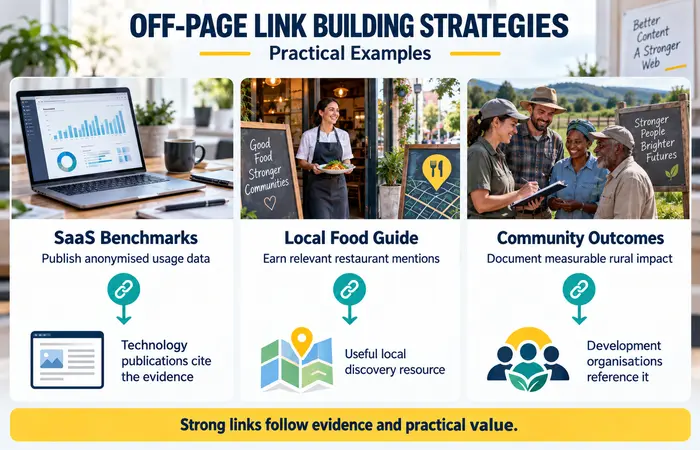
A SaaS company might publish anonymised usage benchmarks that technology publications cite. A restaurant could gain mentions through a local food guide, while a rural enterprise might earn links from development organisations by documenting measurable community outcomes.
These examples work because the linked material adds evidence or practical value.
Performance Expectations
A new campaign may take several months to produce consistent links. Many pitches will receive no response, and a strong mention may not immediately change rankings.
Measure progress through:
- Relevant referring domains
- Referral visits and enquiries
- Branded search growth
- Rankings for genuinely relevant topics
- Links earned without direct outreach
Pros and Limitations
Advantages
- Can strengthen discovery and topical credibility
- May generate referral traffic and brand awareness
- High-quality resources can continue earning links
Limitations
- Outcomes are unpredictable
- Good outreach requires time and judgement
- Poor-quality tactics can create reputational or search risks
- Link metrics from commercial tools are estimates, not Google scores
Off-Page Link Building Strategies Tips
Prioritise relevance, publish evidence, pitch a specific page rather than the homepage and keep outreach concise. Use descriptive but natural anchor text when you control it. Most importantly, never promise rankings in exchange for a link.
Frequently Asked Questions
Which off-page link building strategies work best?
Digital PR, original research, expert contributions and relevant resource links often provide lasting value. The best choice depends on your expertise, audience and available assets.
How many links does a website need?
There is no universal number. A few relevant editorial links may be more useful than hundreds of unrelated directory or forum links.
Are paid backlinks safe?
Links purchased to manipulate rankings conflict with Google’s spam policies. Advertising links should carry the appropriate sponsored qualification.
Conclusion
Sustainable off-page link building strategies focus on usefulness, relevance and editorial judgement. Create material worth citing, approach appropriate publishers and evaluate business outcomes—not simply the number of links acquired.