



Local citations & directory links – these will ensure a customer gets the same information in maps, directories, trade and community directories across the board. They will aid local discovery, but copying a business onto every poor directory is unneeded and won’t do without a Google Business Profile and well-developed website.
Table of Contents
What Are Local Citations and Directory Links?
A local citation is an online mention of a business’s core information, usually:
- Business name
- Physical address or defined service area
- Telephone number
- Website
- Opening hours
- Business category
A directory link is a clickable website link within a business listing. A citation may still exist without a link.
The information should reflect the business customers actually encounter. Virtual addresses, misleading names or duplicated locations can create confusion and may conflict with platform rules.
Local Citations and Directory Links Guide
| Source type | Example use | Priority |
| Google Business Profile | Maps and Google local results | Essential for eligible businesses |
| Major map platforms | Navigation and discovery | High |
| Industry directory | Professional verification | High when relevant |
| Local chamber or association | Regional credibility and referrals | Medium–high |
| Supplier or partner directory | Commercial discovery | Medium |
| General directory | Additional visibility | Depends on quality |
| Bulk, unmoderated directory | Usually little customer value | Low |
The best local citations and directory links are found where real customers search, not simply on sites offering instant submission.
Workflow: Building and Cleaning Citations
- Create a master record. Document the official name, address, phone number, URL, hours and categories.
- Claim priority profiles. Begin with Google Business Profile, major maps and trusted industry portals.
- Search for existing listings. Look for old telephone numbers, former addresses and duplicates.
- Correct important inconsistencies. Prioritise profiles that rank for your brand or send customers.
- Complete useful fields. Add services, accessibility details, photographs and accurate hours.
- Record access information. Maintain a listing spreadsheet with profile URLs and owners.
- Audit after changes. Recheck listings following a move, rebrand or telephone-number update.
Local Citations and Directory Links for Beginners
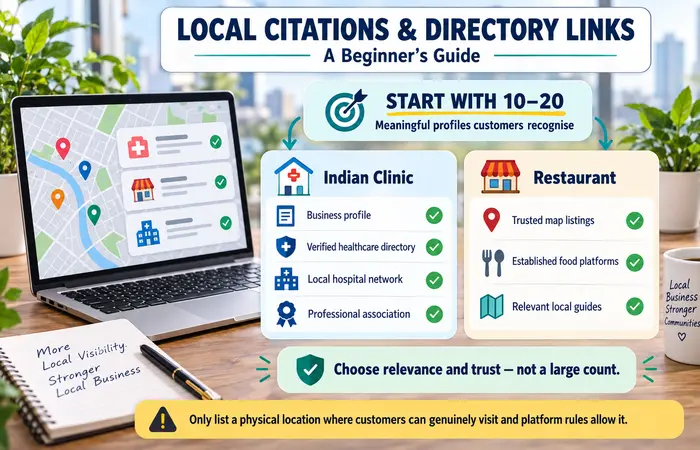
Beginners should focus on perhaps ten to twenty meaningful profiles rather than chasing a large count. Start with listings customers already recognise in your city or industry.
For an Indian clinic, useful sources could include its Google Business Profile, healthcare directories that verify practitioners, the local hospital network and a professional association. A restaurant may benefit more from maps and established food platforms.
Never create a physical-location listing where customers cannot actually visit if the platform’s rules do not permit it.
Local Citations and Directory Links Cost
| Method | Possible cost | Suitable for |
| Manual submission | Usually free plus staff time | One or a few locations |
| Citation-management tool | Subscription fee | Multiple profiles or locations |
| Specialist service | Setup and maintenance fee | Complex clean-up projects |
| Paid directory membership | Annual fee | Relevant professional bodies |
Free listings are often sufficient for a small business. A paid directory is worthwhile only when it has a genuine audience, meaningful verification or membership value. Payment does not guarantee stronger local rankings.
Local Citations and Directory Links Examples
A consistent listing might present:
Market Street Dental Care, 22 Market Street, Pune, Maharashtra, telephone number, website, weekday hours and “Dental clinic” as its primary category.
An inconsistent version could abbreviate the name differently, show an old Mumbai address and use a disconnected number. Minor formatting differences are usually less important than information that genuinely misleads customers.
Performance Expectations
Google explains that local results are mainly based on relevance, distance and prominence. Complete and accurate business information can help Google understand and match a profile, but there is no way to request or pay Google for better local ranking.
Expect citation work to improve information accuracy first. Calls, directions and local visibility may improve gradually, although results depend on competition, proximity, reviews, website quality and profile relevance.
Pros and Limitations
Benefits: improved customer confidence, correct contact information, referral traffic and broader local discovery.
Limitations: maintenance takes time, duplicate profiles can return, weak directories provide little value and listings cannot overcome an unsuitable location or poor service.
Local Citations and Directory Links Tips
Use one master business record, retain login ownership, choose the most precise category available and update holiday hours. Do not add keywords to the registered business name merely to influence visibility.
Frequently Asked Questions
Do local citations and directory links need identical formatting?
Core facts should be accurate, but harmless formatting differences such as “Road” versus “Rd” are less concerning than a wrong address or number.
Does every citation require a backlink?
No. An accurate mention can help customers confirm business information even without a clickable link.
Should service-area businesses publish a home address?
Follow each platform’s rules. If customers are not served at the address, it may need to be hidden.
Conclusion
Local citations and directory links should make a business easier to verify and contact. Concentrate on trusted platforms, maintain accurate details and judge success by customer actions rather than listing volume.