
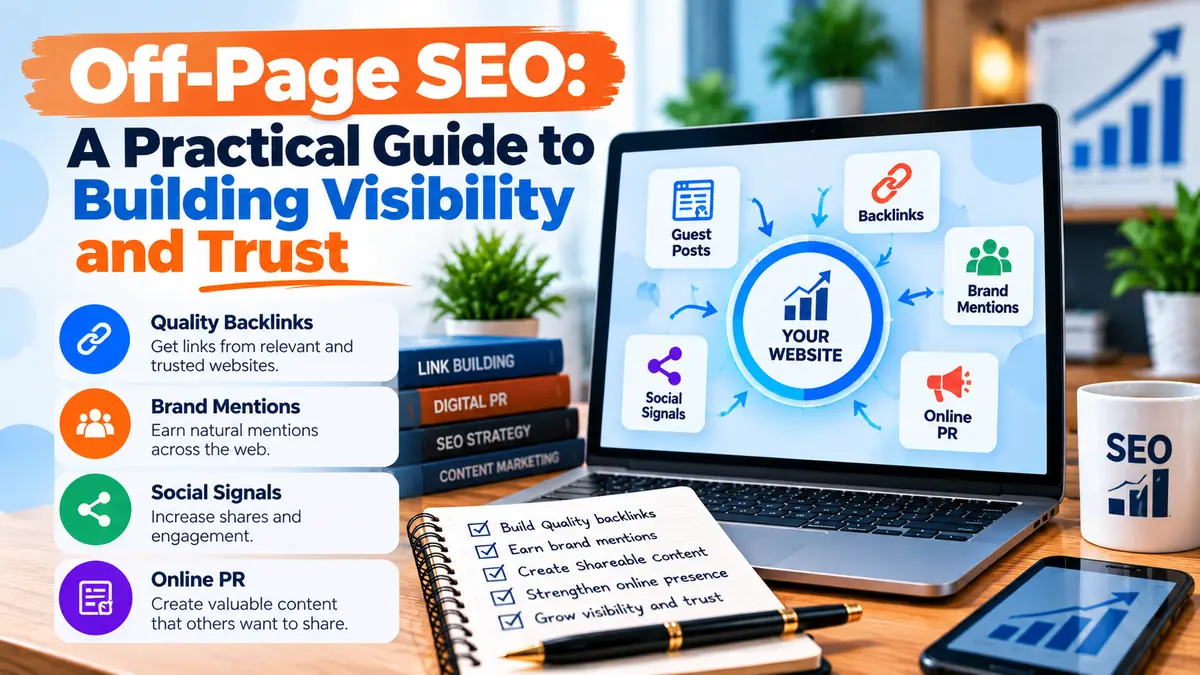



Off-page SEO is often reduced to a single instruction: “get more backlinks”. That advice misses the difficult part. A link from a useful, relevant article may introduce your business to potential customers, while a hundred links from unrelated directories may do little for readers and create avoidable risk.
For an Indian business, the opportunities also depend on its audience. A neighbourhood clinic, a nationwide ecommerce brand and a B2B software company need different kinds of mentions. This guide explains how to choose appropriate off-page activities, approach publishers, manage local information and measure progress without treating every link as a ranking shortcut.
Table of Contents
What is off-page SEO, and how does it work?
Off-page SEO refers to work beyond your own website that helps others find, evaluate and refer to your pages or business. The most familiar example is an external website linking to one of your pages. Other examples include an accurate business listing, an editorial mention, a relevant guest contribution and discussion of an original resource.
Google says it uses links to discover pages and as a signal when assessing page relevance. That does not mean every link has the same value or that acquiring links will make a particular page rank. The context, destination and reason a link exists all matter. Google Search Central
A useful way to think about the work is to ask three questions:
- Who should know this page or business exists?
- What would give them a genuine reason to mention or link to it?
- How will we tell whether that mention reached the right people?
Suppose a Hyderabad accounting firm publishes a clear checklist of documents small businesses need before meeting an accountant. A local business association may share it because members can use it. That is a stronger reason for a reference than offering to exchange links with unrelated websites.
Off-page SEO versus on-page and technical SEO
| Area | Where the work happens | Typical work | Main practical aim |
| On-page SEO | On your pages | Clear titles, useful content, headings and internal links | Help readers and search engines understand each page |
| Technical SEO | In the website’s setup | Crawl access, indexing controls, redirects and page performance | Make important pages accessible and usable |
| Off-page SEO | Beyond your website | Editorial links, relevant mentions, PR and business listings | Help the right people discover and reference your work |
The areas depend on one another. Outreach cannot make an unhelpful page useful, and a valuable page cannot serve visitors if it is unavailable or difficult to use.
Start with something worth referencing
Before contacting a publisher, look closely at the destination page. Would their reader gain something by opening it?
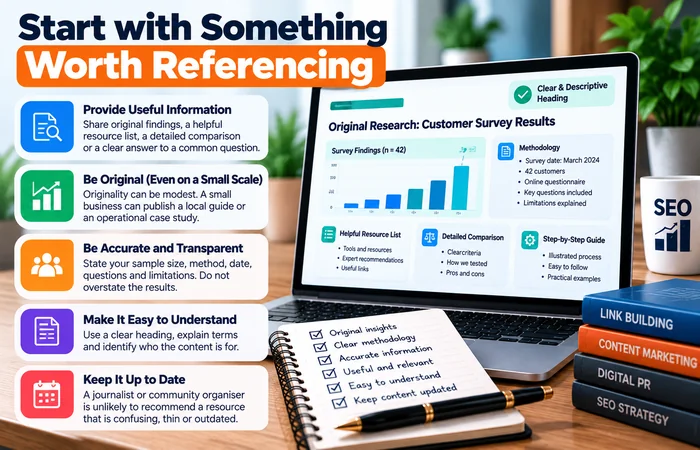
Pages that are easier to reference often contain information a writer would otherwise have to assemble themselves: original survey findings with a stated method, a well-maintained resource list, a detailed comparison, an illustrated process or a clear answer to a recurring customer question. Originality can be modest. A small business might publish a carefully explained delivery-area guide or an account of how it solved a common operational problem.
Accuracy matters more than presenting a large number. If you surveyed 42 customers, say so; do not imply that the results represent every customer in India. Include the date, questions and limitations where they affect interpretation. If you compare services, explain your criteria and how you checked them.
The page should also make its subject obvious within seconds. Give it a descriptive heading, explain terms, identify who it is for and keep it up to date. A journalist or community organiser has little reason to recommend a resource that is confusing, thin or visibly outdated.
Off-page link building strategies: choose relevance over volume
A sensible link-building strategy begins with the audience and the page you want to help them find. It then looks for websites that already speak to that audience. Consider these approaches:
- Create a referenceable resource. Publish a calculator, checklist, glossary, data explanation or practical guide that another writer could use.
- Contribute expertise. Respond to a relevant journalist’s or trade publisher’s genuine request with a specific, attributable answer.
- Suggest a useful addition. If an industry resource list omits a genuinely suitable guide, show its editor why your page helps their readers.
- Find relevant, unlinked mentions. Where a publisher has named your business, you can politely suggest a link that helps readers find the specific resource being discussed.
- Build relationships through real work. A joint webinar, professional association contribution or community project can lead to natural references when the activity is useful in its own right.
None of these approaches entitles you to a link. Editors choose what to publish and whether to link. Keep outreach short, identify the exact page you are referring to and explain its reader benefit. A generic message sent to hundreds of unrelated sites rarely demonstrates either.
Avoid using third-party metrics such as “domain authority” as a pass or fail score. These are tools’ estimates, not Google scores. Check the site itself: Is its topic relevant? Are its articles maintained? Does its audience plausibly overlap with yours? Would the placement still make sense if you could not count the backlink?
Google’s spam policies identify practices including links bought to manipulate rankings, excessive link exchanges, automated link creation and low-quality directory links. Those policies should shape the campaign before you spend money or contact publishers. developers.google.com
A simple prioritisation example
Imagine an Indian business that sells accounting software to small retailers. It has time for only one outreach activity this month:
| Opportunity | Audience fit | Useful reason for a mention | Main limitation |
| Contribute a GST record-keeping example to a small-business publication | High | Shows a practical process its readers need | Requires a strong, accurate example |
| Submit its homepage to 150 general directories | Low | Little reader benefit | Creates maintenance work and potential link-quality concerns |
| Publish a short report on common invoicing mistakes found in its own support queries | High, if anonymised and responsibly explained | Gives writers a specific, original source | Needs careful review of privacy and sampling limits |
The first and third options demand more effort. They also have a clearer purpose for the audience, whether or not a link follows.
Guest posting for SEO: write for the host’s readers
A guest article can introduce your expertise to an established audience. It works best when the host covers a subject closely related to yours and the contribution answers a question its readers actually have.
Begin by reading several recent articles on the publication. Look for a genuine gap, then send a brief pitch explaining your proposed topic, its angle and what you can contribute. A finance consultant might pitch an article on cash-flow questions new shop owners overlook. Sending the same general “top ten business tips” piece to dozens of unrelated sites gives an editor little reason to accept it.
If accepted, provide an original article that can stand on its own. A link to your site should serve the reader, such as pointing to a detailed worked example or a relevant author profile. Avoid forcing an exact-match keyword into the link text. Google specifically warns about large-scale article campaigns and optimised links in guest posts whose purpose is to manipulate search rankings. developers.google.com
There is also a practical limit: a guest article can be worthwhile for readership, introductions or referral enquiries even when it offers little measurable search benefit. Decide what success means before writing it. If the audience is irrelevant, an impressive-looking backlink report will not rescue the time spent.
Local citations and directory links for Indian businesses
A local citation is a public mention of a business’s identifying details, commonly its name, address and phone number. A listing may also show opening hours, a website, service area or category. These details matter most when people need to find or contact a business in a specific place.
For an eligible local business, start with its Google Business Profile and the listings that its customers actually consult. Use the real business name and accurate contact details. Check that the website, hours and location match what customers will encounter. If the business moves or changes its number, update important listings rather than creating fresh duplicates.
Google explains that local results are mainly based on relevance, distance and popularity. It also says there is no way to request or pay for a better local ranking. A complete, accurate profile helps people assess a business, but a directory submission cannot guarantee a particular map position. support.google.com
For example, a Pune training centre might reasonably maintain its verified Business Profile, its own contact page and an accurate listing with a relevant local education association. Submitting the same description to hundreds of obscure directories is unlikely to help prospective students choose a course.
Check eligibility before creating profiles. An online-only publisher with no qualifying customer-facing location should not invent a street address to pursue local listings. For a national website, industry-specific mentions and editorial resources may be more appropriate.
A citation accuracy checklist
- Use the business’s real-world name consistently.
- Check the phone number and website URL before submission.
- Describe the actual service and location without adding irrelevant keywords to the name.
- Record where the listing was created and who controls it.
- Review important entries when hours, addresses or services change.
Treat a directory primarily as a place where a customer might find reliable business information. A link is useful when it helps that customer reach the right page.
Digital PR for SEO: give publishers a reason to cover the story
Digital PR means developing and sharing information that a publication may want to report or explain. The best starting point is a story with a clear audience, credible evidence and a useful angle. “We launched a new blog post” usually is not enough.
An Indian ecommerce company, for instance, could analyse anonymised delivery questions received across several regions. If the sample is substantial and handled responsibly, it might publish a short report explaining which delivery details customers most often misunderstand. A retail publication could find that useful. The company would need to describe the period studied, the number of questions and what the data cannot establish.
Other possible sources include a carefully documented local project, a professional’s first-hand explanation of a timely issue, or a useful comparison that is kept current. The pitch should summarise the finding, identify the source and offer access to the supporting method. Do not describe ordinary observations as a nationwide trend without evidence.
Coverage may produce a link, an unlinked mention, referral visits or no immediate traffic. An editor may also decline the story. Judge the effort against the people reached and the quality of the resulting coverage, rather than an assumed number of backlinks.
If you pay for placement or supply material in exchange for a link, disclose the arrangement as appropriate and ensure links are qualified correctly. Google says paid and sponsored links should use attributes such as rel=”sponsored” or rel=”nofollow” when they should not pass ranking credit. developers.google.com
Social signals and SEO: what social sharing can realistically do
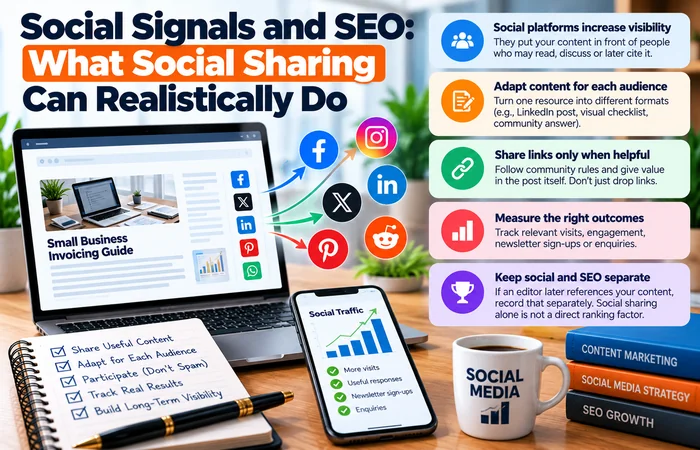
A post receiving likes or shares does not give you a reliable equation for Google rankings. Social platforms are useful here because they put a resource in front of people who may read it, discuss it or later cite it elsewhere. Those are different outcomes, and none is automatic.
A practical approach is to adapt the same resource for each audience. A detailed article on small-business invoicing might become a concise LinkedIn explanation for accountants, a visual checklist for shop owners and a short answer in a relevant community discussion. Link to the original page when it genuinely helps someone complete the task.
Avoid dropping links into every group you can find. Participate according to the community’s rules and answer the question in the post itself. A person should get some value without having to click through.
Measure social distribution on its own terms: relevant visits, useful responses, newsletter subscriptions or enquiries. If an editor later discovers and references your resource, record that separately. This keeps social engagement from being mistaken for proof of a search-ranking effect.
A workable off-page SEO workflow
This workflow is small enough for a business owner or content team to repeat. It also gives each activity a clear purpose.
1. Choose one audience and one useful page
Pick a page that answers a specific question for people you want to reach. Check its accuracy, mobile usability and contact or next-step information. If the page needs substantial work, improve it before outreach.
2. Record your starting position
Note the page’s current Google Search Console impressions and clicks, relevant search queries and referral visits. Record any existing mentions or links you already know about. These are starting observations, not promises that future changes will be caused by outreach.
3. Build a short, relevant prospect list
Look for publications, associations, resource pages and communities that serve the same audience. Read each prospect before adding it. Ten well-matched contacts may be more useful than a spreadsheet of hundreds gathered only from a metric filter.
4. Match the reason to the recipient
A journalist may need a sourced finding. A trade association may want a practical member resource. A podcast host may want an experienced guest. Write down why that audience would care before sending anything.
5. Contact people individually
Explain the proposed contribution in a few sentences. Point to the precise resource or finding. Be honest about your relationship to it and respect a refusal or lack of reply. Keep a simple record so the same person does not receive repeated, poorly timed pitches.
6. Check what was published
If a mention appears, read the page. Confirm that the description, business details and link destination are accurate. Thank the editor where appropriate; request a correction when there is a material mistake. Do not demand preferred anchor text.
7. Review outcomes and revise
Compare what happened with the original goal. Did the article reach the intended audience? Was there relevant referral traffic? Did someone make a qualified enquiry? Did the resource earn further independent references? Use the answers to improve the next resource or pitch.
For a small team, a monthly review is often easier to act on than checking rankings every morning. Keep notes on publication dates and other site changes so you do not credit every fluctuation to one outreach email.
Off-page SEO metrics: measure what the activity actually achieved
Backlink counts are easy to report and easy to misunderstand. A new link may appear in one tool before another, a publisher may remove a page, and a link can exist without sending useful visitors. Combine link checks with measures tied to your business goal.
| Metric | What it can tell you | What it cannot establish alone |
| Relevant referring pages | Whether appropriate publishers are referencing your work | That each link improved a ranking |
| Referral visits | Whether people arrived from a specific source | That every visit was valuable |
| Engaged visits or enquiries | Whether referred visitors took a useful next step | That the link caused all later conversions |
| Search Console clicks and impressions | How a page appeared and performed in Google Search over time | Why any single change happened |
| Branded search interest | Whether more people may be looking for your name | Which particular mention caused the interest |
| Listing accuracy | Whether customers can find consistent business information | That a listing will improve map rankings |
Google recommends considering Search Console alongside analytics data to understand how people discover a site and what they do after arriving. Keep the distinction between search performance and on-site behaviour clear when reporting results. developers.google.com
Review both the source and the destination. If a respected publication sends visitors to a vague homepage, the placement may underperform despite being relevant. A specific guide or service page might better answer the question that brought them there. Change destinations only where the publisher agrees and where the replacement genuinely serves readers.
How long should you wait for results?
There is no dependable number of days between earning a mention and seeing a search change. A publication may be discovered at a different time from your own page; search demand and competing pages also change. Referral visits might arrive as soon as an article is shared, while search trends need a longer observation period.
For planning, set a baseline, review immediate referral activity after publication and compare search data over subsequent months. Treat that as a measurement schedule, not a promise that rankings will improve within a set period. If nothing useful happens, inspect the audience fit, destination page and quality of the original resource before pursuing more of the same placements.
Common off-page SEO mistakes
Buying a fixed number of links each month. A package makes the input predictable, but says little about editorial relevance or reader value. Links bought primarily to manipulate rankings conflict with Google’s spam policies. developers.google.com
Using identical keyword-heavy anchor text. A publisher should be free to describe a page naturally. Repeatedly pushing an exact phrase can make contributions less useful and may indicate a campaign organised around rankings rather than readers.
Confusing a listing with an endorsement. A directory entry can help a customer find a business. It does not have the same editorial meaning as an independent article recommending a resource.
Pitching a weak destination. If the page repeats common advice without examples or evidence, publishers have little reason to refer readers to it. Improve the resource before increasing outreach volume.
Claiming every change as a win. Search rankings move for many reasons. Note when an activity occurred, compare relevant pages and queries, and explain uncertainty in reports.
Ignoring maintenance. A once-useful guide can become outdated. A business listing can show an old number. Revisit important resources and citations rather than treating publication as the final step.
What a realistic off-page SEO plan looks like
A small business does not need to run guest posting, PR, directory work and social campaigns at full speed simultaneously. Choose work that matches how customers discover and evaluate it.
A local service business may begin with accurate customer-facing information, its Business Profile, appropriate local or professional listings and useful answers to common customer questions. A B2B company may get more from a carefully documented guide, contributions to trade publications and informed participation in professional communities. A publisher might prioritise original explainers and relationships with writers who cover the same subject.
Each route has costs. Research and outreach take time. Maintaining listings requires attention when details change. Producing an original report requires careful methods. The benefit is also broader than rankings: relevant visitors, useful conversations and better information for prospective customers can make the work worthwhile even when a direct SEO effect cannot be isolated.
Review the plan against three tests: Would the activity make sense to a real reader? Is the information accurate? Can you describe success without relying only on a backlink count? If the answer to any is no, revise the activity before scaling it.
Frequently asked questions
Is off-page SEO only about backlinks?
No. Links are a prominent part of off-page SEO, but relevant editorial mentions, accurate business information and distribution of useful resources can also help people discover and assess a business. Measure each activity against its own purpose rather than assuming every mention carries the same search value.
Does guest posting still help SEO?
It can help a business reach a relevant audience and may result in a useful editorial reference. A guest post written chiefly to place optimised links at scale presents a different risk. Choose a host whose readers genuinely need the contribution, and let editorial value lead the decision.
Are directory submissions useful for a business in India?
Some are useful when customers actually use them and the business details are accurate. Prioritise an eligible Google Business Profile and relevant professional or local listings. Large batches of unrelated directory submissions are unlikely to solve a visibility problem.
Do social media likes directly improve Google rankings?
Do not plan around a fixed relationship between likes and rankings. Social sharing can bring readers to a useful page and expose it to people who may discuss or reference it. Track those outcomes separately from organic search performance.
How many backlinks does a new website need?
There is no universal target. Websites compete in different topics and have different levels of content quality, recognition and search demand. Start by making important pages useful, then seek relevant references that have a credible reason to exist.
How should I report off-page SEO results to a client?
Show the work completed, the publications or listings involved, referral visits and useful actions where measurable. Add Search Console trends for relevant pages and clearly separate observed changes from claims about what caused them. Include unsuccessful pitches and lessons when they inform the next decision.
Conclusion
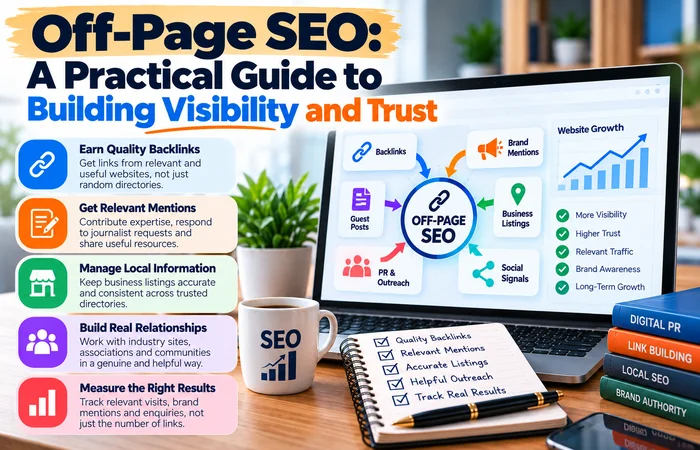
Off-page SEO works best as a steady effort to make useful pages visible to the people and publications that need them. For an Indian business, that might mean one accurate local listing, a strong industry contribution or an original guide that others can confidently reference.
Start with the audience and the quality of the destination page. Pursue relevant opportunities, follow publisher and search-engine rules, and measure real outcomes alongside search trends. That approach sets a more realistic expectation than buying links or promising a ranking position.