



Marketing Attribution Tools aid marketers in learning how various campaigns contributed to a customer getting converted. Rather than attributing full credit to the last click, a proper piece of software will consider multiple interactions along the entire customer journey. For a Business in India, this would make a more lucid observation of performance over Google Ads, Social Platforms, Email, offline sales.
However, attribution is not perfectly precise. Consent restrictions, disconnected devices, offline interactions and incomplete tracking can all affect the results.
Table of Contents
What Is Marketing Attribution Software?
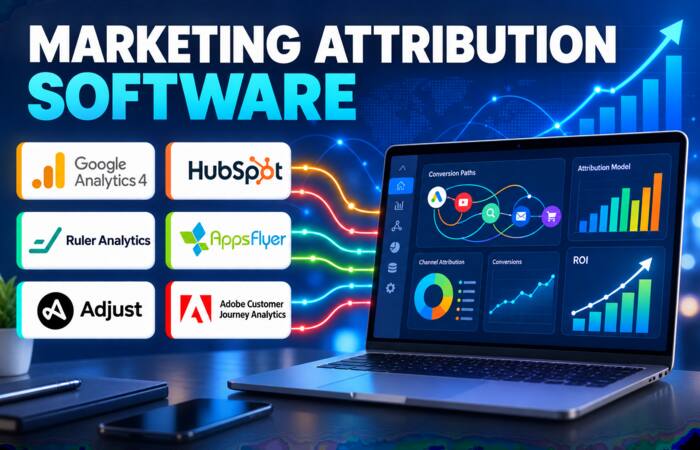
Marketing attribution software collects information from advertising platforms, websites, customer relationship management systems and other marketing sources. It then assigns conversion credit according to a selected attribution model.
According to Google Analytics’ official attribution guidance, an attribution model determines how conversion credit is assigned to different interactions across a customer’s journey.
Common models include:
- First-click attribution
- Last-click attribution
- Linear attribution
- Position-based attribution
- Time-decay attribution
- Data-driven attribution
A simple last-click model may suit a small business with a short buying journey. Organisations running several campaigns across multiple channels may benefit from multi-touch attribution tools or data-driven modelling.
Marketing Attribution Tools Compared
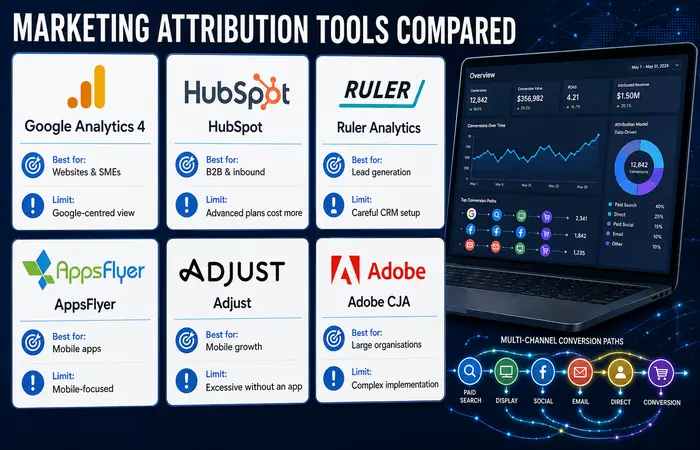
| Tool | Best suited to | Main capabilities | Important limitation |
| Google Analytics 4 | SMEs and website-based businesses | Attribution paths, channel reporting and Google Ads integration | Limited visibility outside the Google-centred digital journey |
| HubSpot | B2B and inbound marketing teams | CRM-connected campaign and revenue reporting | Advanced reporting may require higher-priced plans |
| Ruler Analytics | Lead-generation businesses | Call tracking, lead matching and revenue attribution | Requires careful CRM and tracking configuration |
| AppsFlyer | Mobile application marketers | App installation, campaign and cross-device measurement | More specialised than general website analytics |
| Adjust | Mobile growth teams | Mobile attribution, campaign measurement and fraud prevention | May be excessive for businesses without an app |
| Adobe Customer Journey Analytics | Large organisations | Cross-channel analysis and detailed journey exploration | Cost and implementation complexity can be substantial |
Features, integrations and pricing can change. Businesses should request a demonstration and confirm whether a platform supports their current advertising, CRM and ecommerce systems.
Key Features to Evaluate
Useful campaign attribution software should offer more than an attractive dashboard. Consider these practical capabilities:
- Integration with advertising and analytics platforms
- CRM and ecommerce connections
- Multi-channel journey reporting
- Custom conversion definitions
- Revenue and customer lifetime value tracking
- Model comparison
- Data export and dashboard controls
- Consent and privacy management
- Offline conversion imports
- Clear documentation and implementation support
Customer journey attribution is also particularly powerful for prospects who research your product multiple times before enquiring or purchasing. The prime example: your prospects discovered your company through Instagram, found it again through an organic search and converted it on email.
Marketing Attribution Workflow
Reliable implementation normally follows this process:
Define the conversion:
Decide whether the outcome is a purchase, qualified lead, subscription or booked appointment.
Standardise campaign tracking:
Apply consistent UTM parameters and naming conventions.
Connect data sources:
Integrate advertising platforms, analytics, CRM and sales systems.
Check data quality:
Remove duplicate events and test whether conversions are recorded correctly.
Select attribution models:
Compare last-click results with multi-touch or data-driven reporting.
Review business outcomes:
Connect campaign influence to revenue, margin or qualified opportunities.
Test budget changes:
Make limited adjustments and monitor their impact before reallocating heavily.
Multi-Touch Attribution Tools: Pros and Limitations
| Advantages | Limitations |
| Show how several channels contribute to a conversion | Depend on complete and accurate tracking |
| Reduce excessive reliance on last-click reporting | Cross-device journeys may remain incomplete |
| Help compare campaigns using shared definitions | Different platforms can report different totals |
| Connect campaign activity with leads or revenue | Data-driven models may require sufficient volume |
| Support more informed budget discussions | Attribution does not automatically prove causation |
Attribution identifies associations between marketing interactions and outcomes. It should not be treated as definitive proof that a campaign caused every reported conversion.
Performance and ROI Tracking Expectations
Reporting can be made more consistent with marketing ROI tracking tools, but you cannot retrieve information that was not gathered. The initial differences between an attribution platform, advertising dashboards and your CRM are expected, as each system may use different attribution windows, time zone settings or definition of a conversion.
Factor in at least a few weeks for execution, analysis and team education. If your company has long sales cycles, it could take months before you see significant patterns in revenues, use a combination of attribution reports and controlled experiments, sales data, as well as customer feedback in important investment decisions.
Who Should Use Attribution Software?
These platforms are most useful for:
- Ecommerce businesses advertising across several channels
- B2B companies with long lead-to-sale journeys
- Mobile application marketers
- Agencies managing measurable campaigns
- Organisations that connect marketing data with CRM revenue
A small business using one advertising channel may not need specialist software. Properly configured analytics, advertising platform reports and a spreadsheet may initially provide enough information.
How to Choose the Right Tool
Don’t start with a software vendor, begin with the measurement. Can it track your primary channels and associate the conversions back to revenue and does it present reports in a way your team can access?
Additionally, the Indian company should examine pricing currencies, taxes, local support availability times, data-storage policies and the necessary consent clauses. Ask for a pilot project that uses their actual campaign data – this typically shows up any integration issues much better than their sales presentation featuring carefully chosen data.
Frequently Asked Questions
Which marketing attribution tools are suitable for small businesses?
For small business entrepreneurs with simple sales and customer journey pipelines, Google Analytics 4 and some CRM-level reporting might be enough. Once there is more than just a one or two of your top paid and organic sales funnel will impact.
What is the difference between attribution and marketing mix modelling?
Attribution looks at customer or event-level touchpoints. Marketing mix modelling typically uses aggregate historical data to model channel contribution and explain external variables.
Can attribution software track offline sales?
Several can integrate offline conversions, CRM and call data to connect earlier activities. It relies upon common identifier and data quality in the sales team.
Are multi-touch attribution results completely accurate?
No. Limits on cookie use, consent preferences, shared devices, and offline activity will result in data loss. This analysis should be viewed as supporting a decision, not a precise catalog of all factors.
Conclusion
What makes for best-in-class marketing attribution toolset? Those tools are matched to the company’s channels, sales-funnel, technology-based and reporting needs. An overly intricate platform won’t deliver better decisions to campaign or track information that isn’t clean. First set forth with goals and validate your data, and supplement attribution with tests, and commercial wisdom.