



An influencer marketing platform can help to find appropriate influencers rather than just shifting through social media profiles and using spreadsheets and fragmented emails. It can also even help with audience analysis, blogger selection/activation, content approvals, affiliate tracking, payments and campaign success analysis.
Table of Contents
This Article Is Part of the Influencer Marketing Resource Hub
Explore more guides, tutorials, strategies, and marketing resources inside our Influencer Marketing Resource Hub .
But these platforms are not interchangeable. A small local shop embarking on its first Instagram campaign would require a significantly different platform setup than a nationwide consumer brand orchestrating dozens of creators across TikTok, YouTube, and Instagram.
This guide compares ten established influencer marketing platforms for businesses in the United States. It considers creator discovery, analytics, artificial intelligence, campaign management, ecommerce support, usability and access to free trials or entry-level tools.
Pricing, integration and usage limits can change. Businesses should request a current quotation and test essential functions before signing a long-term agreement.
What Is an Influencer Marketing Platform?
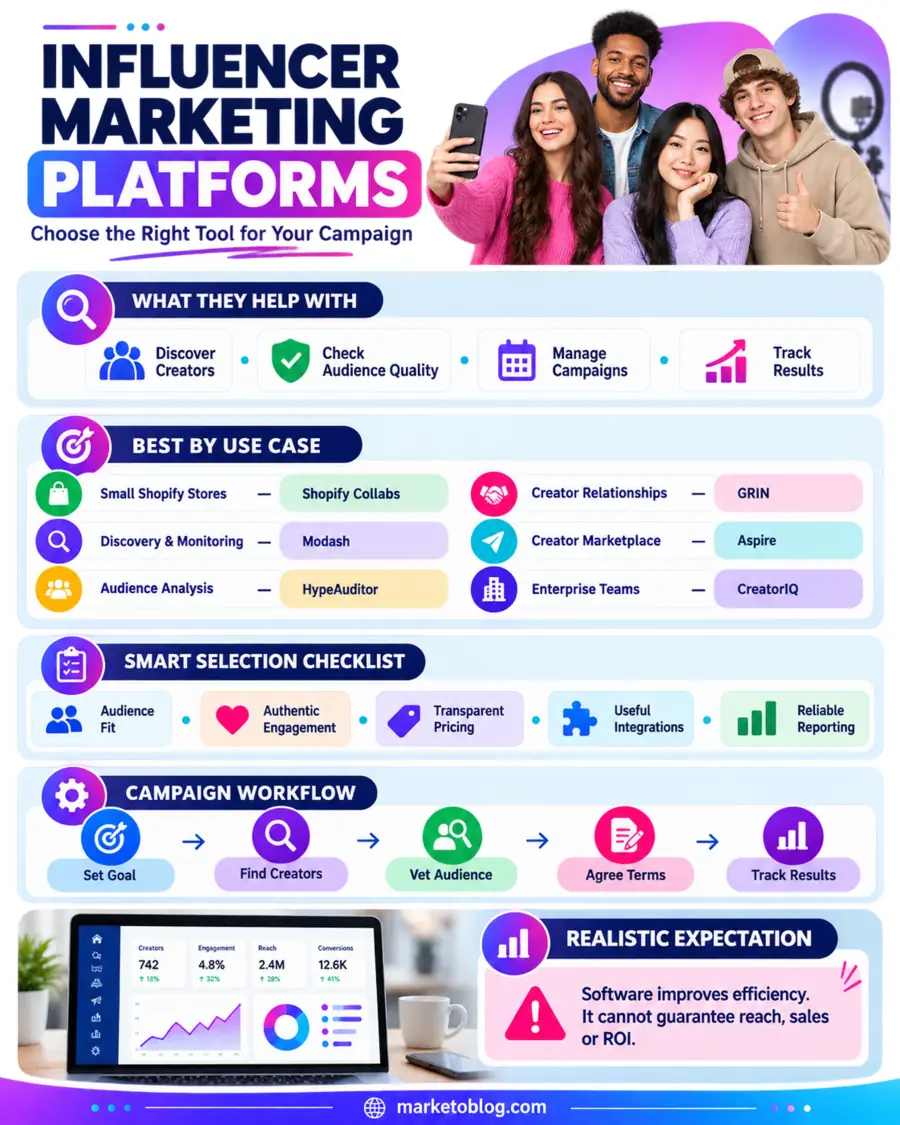
An influencer marketing platform is software that helps a business organise some or all of the influencer campaign lifecycle.
Depending on the product, this can include:
- Searching for creators by topic, location, audience or social network
- Evaluating follower authenticity and audience demographics
- Sending outreach messages and campaign invitations
- Creating campaign briefs and collecting applications
- Approving content before publication
- Distributing products or discount codes
- Managing contracts, usage rights and payments
- Monitoring live creator content
- Attributing traffic, leads or sales
- Producing campaign reports
Some products are primarily influencer discovery tools. Others provide an end-to-end creator relationship management system. Marketplace-style platforms take a different approach by allowing creators to apply directly to published opportunities.
A larger feature list is not automatically better. The most useful platform is the one that solves the operational problems a business actually has.
Influencer Marketing Platforms Compared
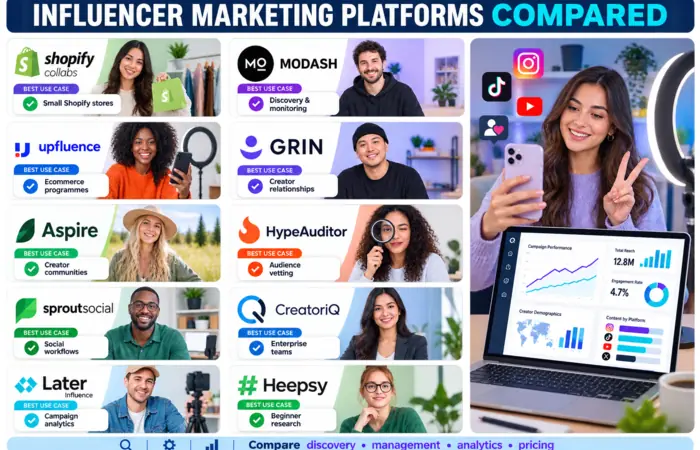
The following table provides a practical starting point. “Best for” reflects the platform’s apparent positioning and feature set, rather than a universal ranking.
| Platform | Best suited to | Notable capabilities | Access and pricing approach | Main limitation |
| Shopify Collabs | Small Shopify merchants | Creator recruitment, gifts, affiliate links, discount codes and commission tracking | Free to install; additional charges may apply | Designed specifically for Shopify merchants |
| Modash | Ecommerce teams needing discovery and monitoring | Creator search, audience analysis, campaign management, content tracking and Shopify integration | 14-day trial; paid subscription | Usage limits may constrain high-volume research |
| Upfluence | Established ecommerce programmes | Discovery, outreach, affiliate management, social commerce and payments | Custom quotation | May be too extensive for occasional campaigns |
| GRIN | Growing creator relationship programmes | Discovery, recruitment, product seeding, communication, content management and reporting | Trial or subscription availability should be confirmed | Requires process ownership and regular use |
| Aspire | Brands building creator communities | Marketplace, campaign applications, workflows, content and affiliate management | Brand pricing generally requires consultation | More system than a very small campaign needs |
| HypeAuditor | Audience vetting and competitive research | Discovery, audience-quality analysis, market research and campaign tracking | Paid plans; confirm current trial and limits | Detailed data can require interpretation |
| Sprout Social Influencer Marketing | Social teams needing connected workflows | AI-assisted discovery, audience insights, campaign management and collaboration | Demo or quotation | Best value may depend on the wider social stack |
| CreatorIQ | Enterprises and global organisations | Governance, discovery, brand safety, workflows, reporting and compliance | Custom enterprise quotation | Usually excessive for small businesses |
| Later Influence | Data-led campaign planning and reporting | Creator matching, campaign management, forecasting and performance reporting | Contact sales for current access | May not suit businesses seeking a simple finder |
| Heepsy | Smaller teams beginning creator research | Search filters, audience analysis, lists and outreach support | Limited free access may be available; verify current terms | Less suitable for complex enterprise operations |
1. Shopify Collabs: Best for Shopify-Based Small Businesses
Shopify Collabs application With Shopify Collabs, you can effortlessly onboard your influencers, create custom application pages, send out free products, devise unique discount codes, and keep track of the total commission-based revenue, all through one platform and your very own Shopify store.
The app is particularly relevant to a small direct-to-consumer business that wants to test performance-based creator partnerships. Instead of committing to a large software subscription, the merchant can structure offers around affiliate commission and product gifting.
Shopify describes Collabs as free to install, although additional charges may apply. Merchants should examine commission-processing costs, Shopify plan requirements and international payment charges before budgeting a programme. Shopify Collabs application listing
Advantages
- Familiar workflow for existing Shopify users
- Product gifting and affiliate functions
- Discount-code and referral-link tracking
- Relatively accessible starting point
- Creator application pages
Limitations
- Not designed for businesses outside Shopify
- Discovery depth may not match specialist databases
- Affiliate attribution does not capture every branding benefit
- Businesses still need creator-vetting and content-review procedures
Best use case: A Shopify beauty, fashion, food or lifestyle store testing a small group of product advocates.
2. Modash: Best for Ecommerce Discovery and Content Monitoring
Modash combines influencer discovery, profile analysis, relationship management, campaign monitoring and payment-related workflows. Its search coverage focuses on Instagram, TikTok and YouTube.
A useful feature is the ability to examine creators without requiring them to join a private marketplace first. Businesses can filter profiles according to factors such as location, niche, engagement, audience characteristics and content style.
Modash also offers natural-language AI search. For example, a marketer could describe a desired creator as “a US-based running coach producing beginner marathon videos” instead of building the search entirely through menus.
Its official pricing page currently advertises a 14-day free trial without a credit card. The trial includes usage limits, so it should be treated as a product evaluation rather than a permanent free influencer marketing platform. Modash trial details
Advantages
- Broad creator discovery
- Audience and profile analysis
- Automated content monitoring
- Ecommerce-oriented workflow
- Natural-language creator search
- Free trial for evaluation
Limitations
- Primarily covers Instagram, TikTok and YouTube
- Search and profile-view limits vary by plan
- Data should still be manually verified
- Subscription value depends on campaign frequency
Best use case: A small or medium ecommerce team that has outgrown spreadsheets and needs both discovery and post monitoring.
3. Upfluence: Best for Established Ecommerce Programmes
Upfluence is a new all-in-one platform solution built for influencer and affiliate marketing. The platform is creator-centric and built upon discoverability, campaign management and social commerce. Upfluence clients are able to search for influencers, manage relationships with them, deliver promo codes and measure attributed sales.
EC focus can be particularly useful for brands interested in linking influencer activity to product sales, and especially in cases where your social media is an ongoing means to acquire customers rather than a one-off blast to drive awareness.
Upfluence uses custom-quoted, modular pricing based on selected products, team size and programme volume. The company states that it charges a fixed platform fee rather than taking a percentage of creator sales. Upfluence pricing information
Advantages
- Strong ecommerce orientation
- Discovery and campaign management in one system
- Affiliate and sales-tracking capabilities
- Creator payment support
- Suitable for recurring programmes
Limitations
- No simple public price for direct comparison
- Implementation may require training and integration work
- Can be more expensive than basic discovery software
- Unnecessary complexity for one-off campaigns
Best use case: An established US ecommerce brand that manages regular creator collaborations and wants revenue-oriented reporting.
4. GRIN: Best for Creator Relationship Management
GRIN positions itself as a creator management platform rather than merely an influencer search engine. It brings discovery, outreach, campaign execution, product fulfilment, content organisation, affiliate tracking and creator payments into a connected workflow.
This relationship-centred design is useful for brands that work repeatedly with a community of creators. The software can provide a shared operational record instead of leaving negotiations, product requests and content approvals across individual inboxes.
GRIN’s platform information highlights discovery, relationship management, payments and campaign organisation. Businesses should confirm present subscription options, trial terms and integrations directly, as these may change. GRIN platform features
Advantages
- Comprehensive creator relationship management
- Campaign and communication workflows
- Product-seeding support
- Content and payment organisation
- Designed for repeat partnerships
Limitations
- Requires regular usage to justify the investment
- Initial data migration and process setup take time
- Small teams may use only a fraction of the functions
- Automated discovery does not remove the need for human evaluation
Best use case: A consumer brand moving from scattered influencer activity to a structured ambassador or creator programme.
5. Aspire: Best for Building a Creator Community
Aspire provides creator discovery, campaign management and a creator marketplace. Brands can publish campaign opportunities, define requirements and receive applications from interested creators.
This inbound approach can reduce cold outreach. It can be useful for product-seeding, user-generated content and affiliate campaigns where a brand wants creators who are already motivated to participate.
Aspire says its marketplace provides access to more than one million creators and does not take marketplace fees or commissions. That does not necessarily mean the complete brand-management platform is free, so businesses should distinguish between marketplace access and full software pricing. Aspire Creator Marketplace
Advantages
- Large creator marketplace
- Inbound campaign applications
- Creator relationship and campaign tools
- User-generated content support
- Affiliate and performance workflows
Limitations
- Application quantity does not guarantee creator quality
- Full brand pricing is not presented as a simple public rate
- Campaigns still require careful screening
- Small businesses may need a narrower, less complex tool
Best use case: A brand that needs a continuing pipeline of creators for product seeding, UGC and affiliate partnerships.
6. HypeAuditor: Best for Audience Quality Analysis
The HypeAuditor platform is perhaps best known for its expertise in influencer discovery, analysis and authentic monitoring. Users may browse by any number of creative descriptors and by audience metrics, such as followers and location, as well as by an Audience Quality Score.
This will reduce the follower numbers of those influencers and prevent another big risk of influencer marketing – choosing an influencer solely by follower numbers and not who follows them, like.
It works for social networks like Instagram, TikTok, YouTube, Twitch and X, but data can only be pulled in different amount on each network (or within certain plans/product lines).
HypeAuditor discovery features
Advantages
- Detailed audience-quality analysis
- Geographic and demographic filters
- Fraud and authenticity indicators
- Competitive and market research functions
- Support for several social networks
Limitations
- Scores are decision aids, not proof of campaign performance
- Advanced analysis may be expensive for occasional users
- Estimated demographics can differ from first-party platform data
- New or niche creators may have limited historical data
Best use case: An agency or brand that regards creator vetting and audience credibility as its main selection challenges.
7. Sprout Social Influencer Marketing: Best for Social Media Teams
Sprout Social Influencer Marketing, previously associated with Tagger, provides creator discovery, audience insights, collaboration and campaign management functions.
Its AI-assisted discovery is designed to find creators according to topics and audience interests rather than relying only on basic categories. Teams can also organise approvals and stakeholder feedback through shared collaboration functions.
This platform is particularly relevant when influencer marketing needs to sit alongside broader social media intelligence and management. A business evaluating it should check which influencer features are included in its proposed package and whether its existing social workflow would benefit from the connection. Sprout Social influencer features
Advantages
- AI-assisted and topic-led discovery
- Brand-fit and audience insights
- Shared campaign collaboration
- Suitable for agencies and multi-brand teams
- Connection with broader social media operations
Limitations
- Pricing generally requires consultation
- May be more software than a microbusiness needs
- Value depends on team workflow and integrations
- AI recommendations still require human review
Best use case: A social media or agency team managing influencer programmes across several campaigns, brands or business units.
8. CreatorIQ: Best for Enterprise Governance
CreatorIQ helps big brands and agencies manage worldwide creator marketing, risk and compliance through global, governance tools, built-in brand safety protections, data systems, and the capability for cross-team collaboration.
Its platform combines the process of AI-driven discovery with a system for both monitoring of creators and programme monitoring, reporting and compliance. These facilities deal with a series of problems when many departments, agencies, countries and creators are involved in one single programme:
CreatorIQ is consequently perhaps best thought of as enterprise infrastructure rather than cheap creator finder. Its value is highest where control, standardization, and visibility across an organisation are a pre-eminence.
CreatorIQ influencer marketing solution
Advantages
- Enterprise-scale creator management
- Governance and compliance controls
- AI-supported discovery
- Brand-safety functions
- Centralised global reporting
Limitations
- Custom enterprise sales process
- Lengthier implementation
- Unlikely to be economical for a small programme
- Requires internal ownership and established procedures
Best use case: A large organisation coordinating influencer activity across brands, markets, agencies and compliance teams.
9. Later Influence: Best for Predictive and Campaign Analytics
Later Influence combines creator discovery and campaign management with forecasting and performance reporting. Its analytics can cover engagement, impressions, return on investment and earned media value.
Later also promotes AI-assisted predictions based on campaign and purchase data. This may help teams shortlist creators or estimate likely outcomes, but predictions should be treated as probabilities rather than guarantees.
A creator who performed well for another business may not generate the same result for a different product, audience, brief or offer. Later Influence platform
Advantages
- Campaign management and reporting
- AI-supported creator matching
- Paid, organic and sales measurement
- Performance forecasting
- Access to campaign-service options
Limitations
- Pricing requires consultation
- Forecasts depend on data quality
- Earned media value is an estimate, not booked revenue
- Could be excessive for basic creator searches
Best use case: A mature marketing team that wants campaign planning, execution and outcome analysis in one system.
10. Heepsy: Best for Basic Influencer Research
Heepsy is a comparatively accessible influencer discovery and analysis tool. It allows smaller teams to search for creators, review audience indicators, create lists and support outreach.
Its more approachable scope may suit a business that wants to replace manual Instagram or TikTok research without immediately adopting enterprise campaign-management software.
Free access and plan limits can change, so prospective users should verify which searches, reports, contact details and exports are available before relying on it.
Advantages
- Relatively simple discovery workflow
- Useful filters for small-team research
- Audience-analysis functions
- Lower learning barrier than an enterprise suite
- Potential entry-level access
Limitations
- Less extensive campaign infrastructure
- Free searches and reports may be restricted
- Contact information may require paid credits
- Manual contracting, tracking or payment tools may still be needed
Best use case: A small business or consultant researching creators before investing in a larger system.
Best Free Influencer Marketing Platforms
Truly end-to-end free influencer marketing platforms are hard to come by. Costs of maintaining discovery data, creator contact details, campaign tracking and reporting mean that almost all services cap out free usage.
The most practical options are:
Shopify Collabs
Shopify Collabs is free to install for eligible Shopify merchants, although commission processing and other charges may apply. It is the strongest option in this group for a small Shopify store running affiliate-led partnerships.
Aspire Creator Marketplace
Aspire offers free access to its creator marketplace and says it does not take a commission from marketplace earnings. Brands should confirm whether they need a paid platform plan for workflow, reporting or scale.
Modash Free Trial
Modash offers a time-limited trial with usage restrictions. It is suitable for evaluating creator search, analysis, campaign management and integrations, but not for operating an indefinite free programme.
Heepsy Entry-Level Access
Heepsy may provide limited free research functionality. Check current limits on search results, reports and creator contact data.
Native Social Media Search
TikTok Creator Marketplace and the creator tools provided by social networks may help businesses identify potential partners. Their data and eligibility requirements vary, and they may not provide the cross-network workflow available from independent platforms.
A business can’t select a system simply because the price is free. An inexpensive system that ends up generating bad matches, forcing several hours to admin on the admin side, may actually be a more expensive decision by staff time than a good, paid product would have.
Influencer Marketing Platforms for Small Businesses
A small business usually does not need enterprise governance, global payment management or thousands of monthly creator searches.
Its priorities are more likely to include:
- Simple creator discovery
- Affordable or flexible access
- Local and niche filters
- Product-gifting support
- Discount-code or affiliate tracking
- Clear campaign reporting
- Low setup requirements
Shopify Collabs is a logical starting point for Shopify merchants. Modash may suit ecommerce teams needing broader discovery and monitoring, while Heepsy can support basic research. Aspire becomes relevant when a business wants creators to apply to campaigns.
Before purchasing software, estimate how many campaigns and creators the business will manage during the next 12 months. If the answer is one campaign with five creators, a spreadsheet and native analytics may still be sufficient.
Best Micro-Influencer Marketing Platforms
Micro-influencers are generally valued for a focused audience, recognisable subject expertise or stronger community interaction rather than mass reach. The exact follower threshold varies by industry and platform.
Good tools for micro-influencer research include:
- Modash: Useful for filtering a large pool of public profiles by niche, location, audience and engagement.
- HypeAuditor: Strong for examining audience quality and identifying suspicious follower patterns.
- Aspire: Useful when brands want micro-influencers to apply to product or UGC campaigns.
- Shopify Collabs: Suitable for turning customers and smaller creators into affiliates.
- Heepsy: An approachable choice for initial discovery and list building.
Do not automatically interpret a high engagement rate as proof of commercial influence. Review the substance of comments, posting consistency, audience geography, previous sponsorships and the creator’s ability to communicate a clear product benefit.
Best AI Influencer Marketing Platforms
Artificial intelligence is increasingly used to search content, recommend creators, identify audience patterns, detect potential fraud and predict performance.
Notable AI-oriented options include:
- CreatorIQ: Enterprise discovery, intelligence and brand-safety support
- Later Influence: Predictive planning and campaign-performance insights
- Sprout Social Influencer Marketing: Natural-language and topic-led creator discovery
- HypeAuditor: Audience-quality and authenticity analysis
- Modash: Natural-language discovery based on a description of the desired creator
- GRIN: AI-assisted support across creator-management workflows
AI will truncate a list, but can’t be left holding the keys for the final endorsement. Algorithms will fail to detect irony, culture, past feuds, shifting fan moods or even a slight incongruity in a creator’s tone and the desired campaign.
A human reviewer should watch recent content, read comment threads and confirm factual claims before offering a contract.
Best Influencer Discovery Tools
Influencer discovery should consider the people reached, not simply the creator’s follower total.
A useful discovery tool should allow filters for:
- Creator location
- Audience location
- Subject or content category
- Social network
- Follower range
- Engagement indicators
- Audience age and gender
- Posting frequency
- Language
- Brand affinity
- Sponsored-content history
- Audience authenticity
Modash is strong for broad public-profile discovery. HypeAuditor provides detailed audience vetting. CreatorIQ and Sprout Social are more suitable when discovery must connect with enterprise workflows, while Aspire provides an inbound marketplace model.
Search results should form a candidate list, not an automatic campaign roster.
Best Influencer Marketing Analytics Tools
Analytics requirements depend on the campaign objective.
For awareness, useful measurements include qualified reach, impressions, video completion and frequency. For engagement, teams may examine saves, shares, useful comments and profile actions. Lead-generation campaigns need tracked enquiries or registrations, while ecommerce campaigns need reliable sales and margin data.
| Objective | Primary indicators | Supporting indicators | Common measurement risk |
| Awareness | Qualified reach, impressions and video views | Frequency and audience geography | Counting views outside the target market |
| Engagement | Saves, shares, comments and engagement rate | Sentiment and comment relevance | Treating superficial comments as meaningful engagement |
| Content production | Approved assets and usable-content rate | Cost per asset and revision time | Ignoring usage-rights costs |
| Lead generation | Qualified leads and cost per lead | Landing-page conversion rate | Weak tracking between social and CRM |
| Ecommerce sales | Revenue, orders and contribution margin | Conversion rate and average order value | Giving the creator credit for unrelated purchases |
| Brand lift | Awareness, consideration or preference change | Search interest and direct traffic | Attributing every change to one campaign |
HypeAuditor is particularly useful for audience analysis. Later Influence, CreatorIQ, Sprout Social, GRIN, Aspire and Upfluence offer varying combinations of campaign and performance reporting.
The Interactive Advertising Bureau’s creator-economy taxonomy distinguishes engagement, conversion and cost measurements. Using consistent definitions can make comparisons between campaigns more credible. IAB Creator Economy Definitions and Taxonomy
Influencer Campaign Workflow: From Objective to Reporting
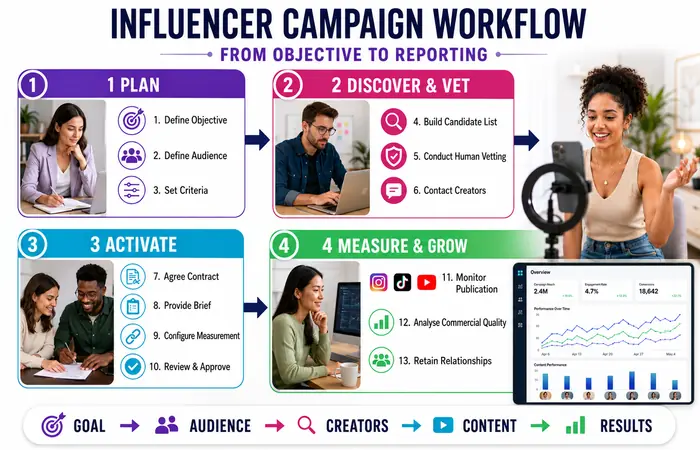
A platform is most useful when it supports a clear operating process.
1. Define one primary objective
Choose awareness, content creation, leads, sales or customer advocacy. Trying to maximise all five in one small campaign produces unclear decisions.
2. Define the audience
Document the intended customer’s location, age range, interests, buying situation and likely objections.
3. Set selection criteria
Agree on minimum requirements before searching. Consider audience relevance, content quality, reputation, posting frequency and previous advertising.
4. Build a broad candidate list
Use discovery filters, marketplace applications, customer records and manual social research.
5. Conduct human vetting
Review recent posts, sponsorship history, comment quality, audience location and any brand-safety concerns.
6. Contact creators
Use personalised outreach. Explain the product, deliverables, timeline, compensation, approval process and intended content usage.
7. Agree on a written contract
Cover deliverables, deadlines, payment, disclosure, usage rights, exclusivity, cancellation, revisions and reporting access.
8. Provide a focused brief
State mandatory factual or legal points, but leave enough creative freedom for the creator to speak naturally.
9. Configure measurement
Set up tracked links, promotional codes, pixels where appropriate, ecommerce integrations and consistent campaign naming before content goes live.
10. Review and approve content
Check claims, brand safety and disclosure without removing the creator’s individual voice.
11. Monitor publication
Confirm that posts appear on time, disclosures are visible and links work correctly.
12. Analyse commercial quality
Compare results against the objective, creator fee, product cost, platform cost and internal labour.
13. Retain effective relationships
Invite suitable creators into longer-term partnerships instead of restarting discovery for every campaign.
What Results Should Businesses Realistically Expect?
Influencer software can improve efficiency, organisation and access to data. It cannot guarantee that a campaign will become popular or profitable.
Performance is affected by:
- Product-market fit
- Creator-audience relevance
- Offer quality
- Creative execution
- Timing
- Landing-page experience
- Product availability
- Tracking accuracy
- Creator reputation
- Paid amplification
- Campaign duration
A first campaign should generally be treated as a controlled test. It can reveal which creator profiles, formats, messages and offers deserve further investment.
Businesses should also expect attribution gaps. A customer may see an influencer video, search for the brand several days later and purchase without using the creator’s code. Conversely, an existing customer may use an influencer code even though the creator did not cause the purchase.
Use platform attribution as one source of evidence alongside web analytics, post-purchase surveys, brand-search trends and customer data.
Influencer Marketing Platform Pros and Cons
| Advantages | Limitations |
| Faster creator discovery | Database information can be incomplete |
| Better audience filtering | Audience estimates are not perfectly accurate |
| Centralised communication | Creators may still prefer email or direct messages |
| Automated content monitoring | Private or temporary content can be difficult to capture |
| Campaign reporting | Attribution models may overstate or understate results |
| Contract and payment organisation | Legal responsibility remains with the advertiser |
| Fraud indicators | No score can prove that every follower is genuine |
| Repeatable workflows | Software does not replace relationship building |
Are Influencer Marketing Platforms Legitimate?
Established influencer marketing platforms are legitimate business tools, but using one does not automatically make every listed creator, audience statistic or campaign safe.
Before subscribing, evaluate:
- Registered company and contact information
- Contract length and cancellation rules
- User permissions and data-security controls
- Social network integrations
- Creator payment procedures
- Customer-support availability
- Reporting methodology
- Data export options
- Ownership of campaign data
- Privacy and regulatory documentation
- Independent customer feedback
Request a live demonstration using a realistic campaign scenario. Ask the provider to show exactly how it identifies creators, obtains data, tracks content and attributes sales.
Businesses should also ensure sponsored content follows US advertising rules. The Federal Trade Commission says material relationships between endorsers and brands should be disclosed clearly and conspicuously. Responsibility cannot simply be outsourced to the creator or software provider. FTC guidance on endorsements and influencers
Influencer Platform Buying Tips
Request an operational demonstration
Do not accept a presentation consisting only of prepared dashboards. Ask the sales representative to create a search, inspect a creator, set up a campaign and produce a report.
Test audience filters
Search for a creator in a niche and location you already understand. Check whether the resulting profiles are genuinely relevant.
Examine data freshness
Ask how frequently profile, audience and content data are refreshed.
Calculate the complete annual cost
Include subscription fees, onboarding, additional seats, contact credits, payment fees, integrations and required service packages.
Check contract flexibility
Some platforms use annual commitments. Confirm renewal timing, cancellation procedure and data-export rights.
Review integration depth
An integration logo does not indicate what data moves between systems. Ask which objects, events and attribution fields are synchronised.
Assess support
Find out whether support includes technical setup, strategic guidance, campaign services or only software troubleshooting.
Run a pilot
When possible, test one representative campaign before migrating the whole programme.
Who Should Use an Influencer Marketing Platform?
A dedicated platform is likely to be useful when a business:
- Runs influencer campaigns every month
- Manages dozens or hundreds of creator relationships
- Needs more reliable audience vetting
- Sends products to many creators
- Has several people reviewing campaigns
- Must track affiliate revenue or coupon codes
- Needs consistent reporting across campaigns
- Works across brands, regions or agencies
- Requires stronger compliance and governance
A small business running two or three partnerships can begin with a spreadsheet, contracts, tracked links and native social analytics. Software becomes valuable when manual administration starts reducing campaign quality or consuming disproportionate time.
Who May Not Need One Yet?
A paid influencer marketing platform may not be economical for:
- Businesses without a defined target audience
- Brands running a single experimental collaboration
- Companies with no staff member responsible for creator relationships
- Businesses unable to provide products, compensation or campaign support
- Teams without web analytics or conversion tracking
- Organisations expecting software to guarantee sales
- Companies that have not established disclosure and approval procedures
In these situations, clarify the strategy and run a small manual pilot first.
Alternatives to Influencer Marketing Platforms
Influencer Marketing Agencies
An agency can manage strategy, recruitment, negotiations, creative coordination and reporting. This is useful when internal time or specialist expertise is limited, although agency fees increase total costs.
Manual Outreach
Businesses can search social platforms, build a spreadsheet and contact creators directly. This offers control and low software expense but becomes difficult at scale.
Affiliate Networks
Affiliate platforms can recruit publishers and creators around performance-based commission. They may provide strong sales tracking but less creative campaign management.
Social Network Marketplaces
Native marketplaces can provide first-party access to creators and platform data. Their main disadvantage is that they usually focus on one social network.
Public Relations Software
PR databases can help identify journalists, experts and online personalities. They are more suitable for media relations than product-seeding and affiliate workflows.
Customer Ambassador Programmes
Existing customers, employees and industry experts can sometimes become more credible advocates than conventional lifestyle influencers. A customer relationship management or referral tool may be sufficient.
Conclusion
Influencer marketing platforms can save on lead times in search, campaign management and reporting but the software should enhance and support the strategy and not provide it.
For those on Shopify there’s easy access via Shopify Collabs. For comprehensive ecommerce discovery and monitoring combined, Modash presents good balance, whereas HypeAuditor comes into its own with audience quality checks. If market place led recruitment is of interest then check out Aspire, for more mature creator campaigns, take a look at GRIN or Upfluence. Sprout Social Influencer Marketing, Later Influence and CreatorIQ serve more established social, analytic and enterprise concerns.
Prior to committing with a platform, make sure you identify a campaign objective, research the discovery data and review total annual cost, and verify the contract terms. Not necessarily the largest database defines the best influencer marketing platform; instead it should assist the team in finding relevant creator, manage creator relationship responsibly and assess results of importance for the business.
Influencer Marketing Platforms Topic Cluster