




A topical authority content strategy helps a website demonstrate genuine knowledge across a defined subject instead of publishing unrelated keyword-based posts. For an Indian business, publisher or marketing website, this means selecting commercially relevant themes, answering the questions people ask at each stage and connecting those answers through a logical content structure.
This technique could lead to better organisation of content, user experience and more importantly search visibility. But one does not expect ranking by publishing tens similar content. You have Quality, originality, Technicality accessibility, Competition, your Website’s reputation etc still come into play .
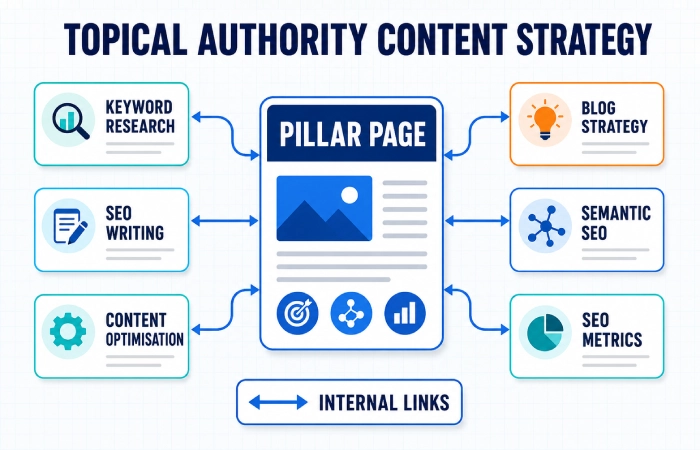
Table of Contents
What Is Topical Authority SEO?
Topical authority SEO is the practice of building a strong collection of useful content around a specific subject. Rather than targeting only one high-volume keyword, a website covers the main topic, its subtopics and the practical questions users may have.
For example, a marketing website could choose “content marketing strategy” as its core subject. It might then publish detailed guides covering keyword research, SEO writing, content optimisation, blogging, measurement and topical authority.
This structure allows readers to move naturally from a broad introduction to more specific guidance. It may also help search engines understand the website’s subject focus. Topical authority itself should not be treated as a guaranteed ranking factor or a shortcut to first-page visibility.
How the Topic Cluster Model Works
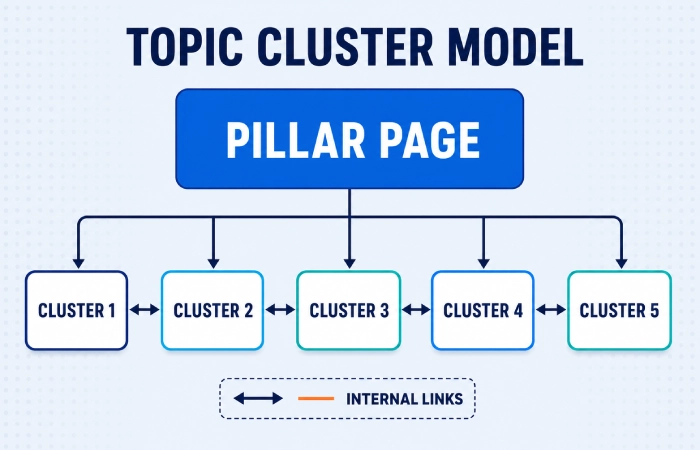
The topic cluster model normally contains three elements:
- A comprehensive pillar page covering the main subject.
- Several cluster articles answering narrower questions.
- Contextual internal links connecting the related pages.
The pillar introduces the full topic without trying to explain every detail. Each cluster page examines one particular need or search intent. Links then help users find the appropriate next resource.
Pillar and Cluster Strategy Example
| Content type | Example keyword | Main purpose | Suggested link direction |
| Pillar page | Content marketing strategy for SEO | Introduce the complete subject | Links to every relevant cluster |
| Cluster page | Keyword research for content marketing | Explain topic selection | Links to pillar and related clusters |
| Cluster page | SEO content writing strategy | Explain content creation | Links to pillar and optimisation guide |
| Cluster page | Content optimisation for SEO | Improve existing pages | Links to pillar and measurement guide |
| Cluster page | Content marketing metrics for SEO | Assess performance | Links back to pillar and useful clusters |
This model is generally more helpful than maintaining a collection of isolated posts with no obvious relationship.
Workflow for Building Content Clusters
1. Select a Focused Subject
Choose a subject that matches the website’s expertise, audience and business goals. A new website should usually begin with a manageable topic instead of trying to cover the entire marketing industry.
2. Identify Search Intent and Questions
Group keywords according to the problem behind each search. Review informational, comparison, commercial and action-based queries separately. Indian audiences may also need locally relevant examples, pricing, platforms or terminology.
3. Map Pages Before Writing
Assign one primary purpose to each proposed URL. This reduces keyword cannibalisation, where multiple pages compete for nearly identical searches.
4. Create the Pillar Page
Publish a clear overview that introduces the subject, answers its main questions and directs readers to more detailed resources.
5. Produce Useful Cluster Articles
Each article should add distinct value. Include practical processes, examples, limitations and evidence where appropriate. Avoid changing only the title while repeating substantially the same advice.
6. Add Contextual Internal Links
* Anchor the pillar from each cluster, back up again to the pillar, and to closely related supporting articles; Don’t use generic anchor text such as “click here”. Google indicates that “good relevant anchor text allows users to predict what the anchor text will be on the landing page” (Google Search Central)
7. Review and Improve
Track impressions, rankings, clicks, engagement and conversions. Update weak sections, consolidate overlapping pages and add missing subtopics when there is a genuine audience need.
Using a Semantic SEO Strategy
A semantic SEO strategy focuses on meaning and relationships rather than repeating an exact keyword. A strong article may naturally discuss audience intent, content architecture, internal linking, expertise and performance measurement because these ideas help explain the subject.
Semantic coverage does not mean inserting a long list of related phrases. Every section should contribute to the user’s understanding. Clear definitions, accurate examples and logical headings are more valuable than forced keyword variations.
Benefits and Limitations
| Potential benefits | Practical limitations |
| Creates a clearer website structure | Requires substantial research and editorial work |
| Helps readers discover related information | Results may take months rather than weeks |
| Supports more natural internal linking | Weak or repetitive clusters add little value |
| Makes content gaps easier to identify | Competitive topics may require stronger reputation and links |
| Encourages consistent subject coverage | Technical SEO problems can restrict discovery |
Realistic Performance Expectations
A small website should not expect immediate traffic simply because it publishes a complete cluster. Search engines must first discover, crawl, index and evaluate the pages. Google explicitly states that following its requirements does not guarantee crawling, indexing or rankings. (Google Search Essentials)
Review early progress through impressions and indexed pages, not rankings alone. Meaningful movement may take several months, particularly on a new domain or within a competitive marketing niche. Continue improving content based on evidence rather than producing large volumes of thin articles.
Frequently Asked Questions
What is a topical authority content strategy?
A topical authority content strategy organises a main subject into a detailed pillar page and supporting cluster articles. The pages are connected through relevant internal links and designed to address different user questions.
How many content clusters should a pillar page have?
There is no fixed requirement. Five to ten strong clusters can be a practical starting point, but relevance and depth matter more than quantity.
Does topical authority guarantee higher rankings?
No. It can improve coverage and site organisation, but rankings also depend on content usefulness, competition, crawlability, website reputation and other search systems.
Can two cluster pages target similar keywords?
They can, provided they serve clearly different intentions. If both pages provide essentially the same answer, combining them may create a stronger resource.
Conclusion
A successful topical authority content strategy combines focused subject selection, useful content clusters, a clear pillar and cluster strategy, semantic coverage and purposeful internal links. It is a long-term method for creating a more coherent website—not a quick ranking technique. Start with one relevant subject, publish genuinely distinct resources and improve the cluster using search and audience data.