





Keyword research for content marketing helps you understand what your intentional viewers want to know, compare or purchase. Instead of choosing topics through estimation, you use search behavior, business relevance and competition data to build a focused content plan.
It doesn’t matter if the keywords are perfectly in place however – they still have to create relevant, fresh, useful content that is easy to access as well as having much more to the point than anything else available currently online on the market.
Table of Contents
What Is Content Keyword Research?
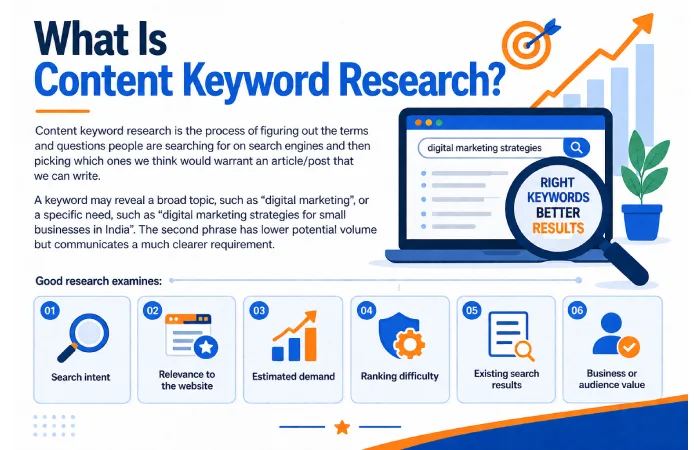
Content keyword research is the process of figuring out the terms and questions people are searching for on search engines and then picking which ones we think would warrant an article/post that we can write.
A keyword may reveal a broad topic, such as “digital marketing”, or a specific need, such as “digital marketing strategies for small businesses in India”. The second phrase has lower potential volume but communicates a much clearer requirement.
Good research examines:
- Search intent
- Relevance to the website
- Estimated demand
- Ranking difficulty
- Existing search results
- Business or audience value
Why Keyword Research for Content Marketing Matters
Keyword research connects editorial decisions with measurable audience demand. It can help a website avoid publishing unrelated articles that attract little qualified traffic.
Its main advantages include better topic selection, clearer page structure and stronger internal linking opportunities. It can also reveal content gaps where competitors answer a question poorly or fail to address an Indian audience.
The limitation is that SEO tools provide estimates rather than guaranteed results. A high-volume keyword may produce little traffic if established websites dominate the results or Google answers the query directly.
Understanding Search Intent Before Choosing Keywords
Search intent describes the result a person expects after entering a query. Most keywords fall into four practical categories:
| Search intent | What the user wants | Marketing example | Suitable content |
| Informational | Learn something | “what is customer acquisition” | Guide or explainer |
| Commercial | Compare choices | “best email marketing tools” | Comparison article |
| Transactional | Complete an action | “buy SEO audit” | Product or service page |
| Navigational | Reach a known destination | “Google Ads login” | Official platform page |
Examine the pages already ranking for the keyword. If most results are educational guides, publishing a short sales page is unlikely to satisfy the same intent.
Primary Keywords and Long-Tail Keywords
A primary keyword represents the central subject of a page. Related long-tail keywords cover narrower questions and situations within that subject.
For example, “content marketing strategy” could be the primary term, while “content marketing strategy for Indian startups” is a long-tail variation. Long-tail phrases often have lower search volume, but they may offer clearer intent and more realistic ranking opportunities.
Keyword Research Workflow
Use the following process for each planned content cluster.
-
Begin With Audience Problems
List the questions customers, readers or sales prospects regularly ask. Organise them around problems rather than around products alone.
-
Expand the Seed Topics
Enter each topic into Google Search, Google Trends, Search Console or a trusted keyword tool. Record related searches, autocomplete phrases and recurring questions.
-
Check Indian Search Interest
Set the target country to India when the tool allows it. Compare regional interest and variations in language, spelling or terminology. Google Trends can compare terms and identify related searches, but its figures show relative interest rather than exact search volume.
-
Analysethe Search Results
Review the first page manually. Note the dominant content format, depth, freshness, authority of competing domains and questions that current articles leave unanswered.
-
Cluster Related Keywords
Group phrases with the same underlying intent on one page. Create separate pages when the user expects substantially different information. This reduces keyword cannibalisation and supports cleaner topic clusters.
-
Prioritiseand Create a Content Brief
Score each cluster using relevance, intent, potential traffic, competition and conversion value. The brief should define the main keyword, supporting questions, recommended headings, internal links and reliable sources.
A Simple Keyword-Prioritisation Framework
| Factor | Question to ask | Suggested weight |
| Topical relevance | Does it fit the website’s marketing niche? | 30% |
| Search intent | Can the page satisfy the expected outcome? | 25% |
| Ranking feasibility | Can the site compete with current results? | 20% |
| Audience value | Will the topic attract suitable readers? | 15% |
| Business value | Can it support a meaningful next step? | 10% |
This framework prevents search volume from becoming the only selection criterion.
Common Keyword Research Mistakes

One common mistake is forcing unrelated keywords into headings. Another is creating several pages for minor variations of the same query. Both practices can make a site less focused.
Other limitations include relying entirely on difficulty scores, copying competitors’ headings and treating keyword density as a ranking formula. Use the primary phrase naturally, but prioritise completeness and readability.
What Results Should You Expect?
A well-researched article is not guaranteed to rank quickly. New or lower-authority websites may need several months to earn stable visibility, particularly for competitive marketing terms.
Measure impressions, average position, clicks and relevant conversions in Google Search Console. Update the article when the intent changes, important information becomes outdated or the page gains impressions without enough clicks. Do not rewrite useful content merely because it has not ranked within a few weeks.
Frequently Asked Questions
What is the best method of keyword research for content marketing?
Begin with audience problems, collect relevant queries, identify search intent and assess the existing results. Cluster terms that require the same answer and prioritise them according to relevance, competition and audience value.
Should every article target one keyword?
Each post is to have one focus/primary keyword – but can cover many closely related questions. Separate pages if the keywords cover the target’s intent of buying to learn etc…
How often should keyword research be updated?
Topics review priority on a 3-to-6-month interval (quicker if dynamic in a quick sector & yearly/more, depending on the topic, if ever green).
Conclusion
Effective keyword research – or when and who you write for- is not just search data-it is about insight into what your readers seek along with your own critical research of top rank results. Target topics, consolidate keywords by user intent, and also manage those expectations. Although, your authority within competitive areas is going to be dictated by the quality and accessibility of your content.