




Published constantly does not mean that your strategy on SEO is going well. The correct measures to have on SEO will determine how your articles reach people in internet, reach qualified traffic and they may become something beneficial for business. Additionally, they may show up where your content is falling to see and topics they must give more and where to concentrate your efforts to create even more valuable content.
The aim is not to monitor every available number. A useful reporting system connects search visibility with user behavior and measurable outcomes.
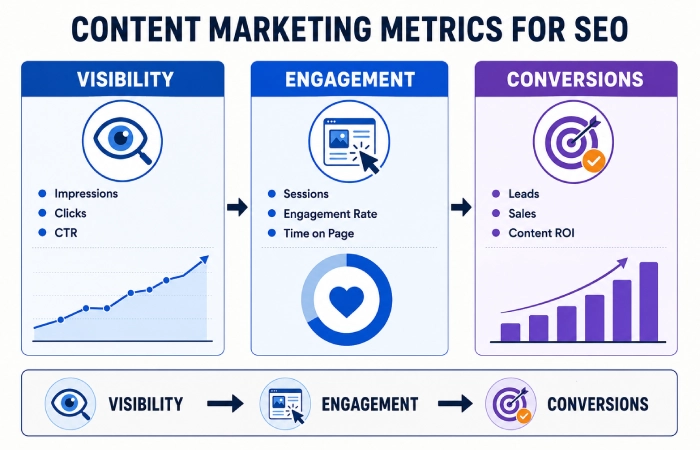
Table of Contents
Why Content Performance Metrics Matter
Content performance metrics turn SEO activity into evidence. Instead of assuming that a higher publishing frequency will produce better results, you can assess each article against a defined objective.
For example, an informational guide may be expected to earn impressions, backlinks and newsletter sign-ups. A service page will usually be judged more heavily on enquiries or qualified leads.
Metrics can help you:
- Find pages gaining or losing organic visibility.
- Identify titles with high impressions but low click-through rates.
- Understand whether visitors engage with the content.
- Compare topic clusters and content formats.
- Decide which pages to update, consolidate or remove.
- Demonstrate the commercial contribution of SEO.
Essential Content Marketing Metrics for SEO
The most useful measurements can be divided into visibility, traffic, engagement, authority and conversion metrics.
| Metric category | Metrics to monitor | What they indicate | Primary tool |
| Search visibility | Impressions and average position | How often and where content appears | Google Search Console |
| Search traffic | Organic clicks and CTR | Ability to attract search visitors | Google Search Console |
| On-site traffic | Organic users and sessions | Volume of visits from search engines | Google Analytics 4 |
| Engagement | Engagement rate and average engagement time | Whether visitors interact with content | Google Analytics 4 |
| Authority | Referring domains and backlinks | External recognition and link equity | SEO backlink tool |
| Outcomes | Key events, leads and sales | Contribution to business objectives | GA4 or CRM |
| Financial return | Revenue, cost and ROI | Commercial efficiency of content | Analytics and accounting data |
Google advises using Search Console as the primary source for Google Search performance and Analytics for behaviour within the website. Search Console clicks and CTR indicate the volume and quality of organic search performance. Google Search Central
Impressions, Clicks and Organic CTR
The impressions column is listing time any given page appears in the search result, while number of clicks tells you how many searches visited the result, and is divided by impression to calculate an average of the CTR below.
Organic CTR = (organic clicks ÷ impressions) × 100
A page which is on the rise for impressions but falling on clicks can be in need of a title tag or a meta description or could just not be a perfect fit for the query searcher’s needs. Do not focus on the overall site statistics and use this very same set of data at your own pace on query, device, country, and page level.
Engagement and Key Events
SEO content analytics should continue after a visitor reaches the website. GA4 an engaged session is one that is more than 10 seconds long with an engaged event or one with 2 page or screen views, the engagement rate is the portion of sessions that meets those criteria Google Analytics Help
Track relevant key events such as:
- Contact-form submissions
- Newsletter registrations
- Product or service enquiries
- Downloads
- Account registrations
- Purchases
Do not treat engagement rate as an independent ranking factor. Use it to understand whether a page satisfies visitors and supports the intended journey.
Content Marketing KPIs by Objective
The right content marketing KPIs depend on what each page is meant to accomplish.
Awareness Content
Monitor impressions, new organic users, non-branded queries and referring domains. These indicators show whether the content is expanding topical reach.
Consideration Content
Track engagement time, internal-link clicks, return visits and newsletter registrations. These metrics indicate deeper interest but do not always produce an immediate sale.
Conversion Content
Measure qualified leads, purchases, conversion rate and revenue attributed to organic visits. Avoid judging every informational article solely by last-click sales because it may assist a later conversion.
How to Measure Content Success
Use the following monthly measurement workflow:
- Define the page objective: Give one primary result and two supporting system of measurement.
- Create a model: Record the last 28 or 90 days of Search Console and GA4 data.
- Segment the results: Evaluate articles by topic cluster, search intent, device and country. Use an India filter where suitable.
- Identify the issue: Establish whether weak performance comes from limited impressions, low CTR, poor engagement or missing conversions.
- Make one meaningful change: Update the search target, introduction, title, secondary evidence or internal links.
- Allow time for evaluation: Compare same periods after the page has been recrawled.
- Record the decision: Keep an update log so performance changes can relate to specific actions.
Content ROI Metrics and Calculation
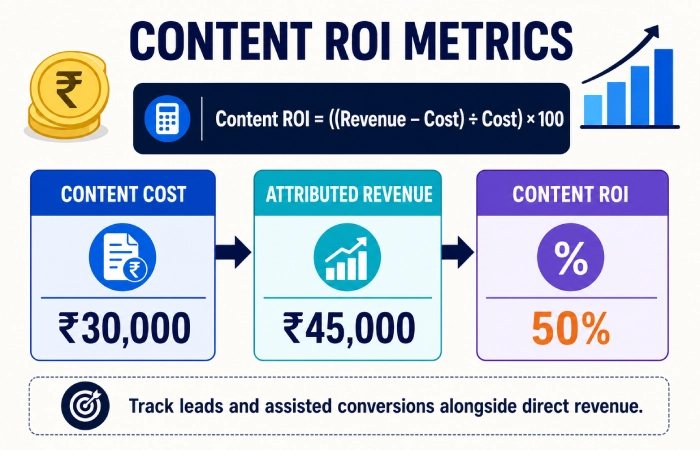
A simple content ROI formula is:
Content ROI = ((revenue attributed to content − content cost) ÷ content cost) × 100
If content costs ₹30,000 and generates ₹45,000 in attributable revenue, the calculated ROI is 50%.
However, attribution has limitations. A person may discover an article through Google and convert days later through email or direct traffic. Review assisted journeys and qualified leads alongside direct revenue.
Performance Expectations and Limitations
It might take weeks or even months for any new content to gain traction on search, even on relatively less-competitive keywords. And even for content that has ranked, the results can change as other factors change like what the competitors are doing or algorithmic changes.
Balanced reporting should recognise both benefits and limitations:
| Benefits | Limitations |
| Reveals improving and declining pages | Attribution is rarely perfect |
| Supports evidence-based updates | Low traffic can produce misleading percentages |
| Connects SEO with business objectives | Average position does not represent one fixed ranking |
| Helps prioritise content investment | Short reporting periods may exaggerate fluctuations |
Avoid declaring success from one traffic spike. Compare consistent time periods and consider seasonality, branded demand, algorithm changes and tracking errors.
Frequently Asked Questions
What are the most important content marketing metrics for SEO?
Generally, these include the most critical: impression, organic clicks, CTR, organic sessions, engagement rate, key events, backlinks, attributed revenue. Ultimately this should align to the page’s goal.
How often should SEO content performance be reviewed?
A monthly review is suitable for most websites. Larger publishers may conduct weekly checks for unusual changes while reserving strategic decisions for monthly or quarterly analysis.
Is average engagement time a ranking factor?
Google does not describe GA4 engagement time as a direct ranking factor. It is an internal diagnostic metric that helps assess whether visitors are meaningfully consuming a page.
Should every article generate conversions?
No. Awareness articles can contribute by attracting relevant visitors, building topical coverage and introducing readers to related commercial pages.
Conclusion
The Best Content Marketing Metrics for SEO comes down to how you can correlate content performance from on-page, to top of search and business bottom line. And if you tie together Search Console to reflect search exposure, GA4 to show people acting on your page, and commercial data points to showcase your returns, then the better results from steady state reporting.