





A successful blog content strategy for SEO is more than a publishing schedule filled with keywords. It finalizes whom each article serves, what question it answers and how it supports the wider website. For India- Inc This will mean paying attention to local search activity and extending reach with content that can compete either at national or international level.
Table of Contents
What Is a Blog Content Strategy for SEO?
An SEO blog strategy is a recognised framework wrapping topic selection, search intent, article creation, internal linking, allocation and performance measurement.
Its purpose is to build beneficial coverage around subjects relevant to business. Rather than publishing non-related posts, the website develops connected sources that help readers move from a wide question to a more exact solution.
Let’s take a real-world marketing example for this; imagine creating an informational cornerstone guide for how to build a content marketing plan and supplementing this guide with associated articles like how to conduct keyword research, how to write SEO articles, how to optimize the articles you create and how to analyze the content’s performance.
Build Your Strategy Around Search Intent
Search intent describes what a person wants to accomplish when entering a query. Most blog searches fall into four categories:
| Search intent | Reader’s objective | Suitable content |
| Informational | Learn or understand | Guides and explainers |
| Commercial | Compare possible solutions | Comparisons and reviews |
| Transactional | Complete an action | Product or service pages |
| Navigational | Reach a known website | Brand or login pages |
Examine the current search results before choosing an article format. If most results are complete guides, a short promotional page is doubtful to satisfy the same viewers.
Understand the Audience Before Selecting Keywords
Create the reader’s definition- their existing knowledge, need for the topic and desired outcome. Some may ask for simple steps (small business owners) others may need raw data and technical details (experienced SEO).
Select one main keyword for a category page and include semantically related keywords and questions around it. Remember not to target the same search intent in a few articles, otherwise the pages will compete against each other.
Blog Content Planning Workflow
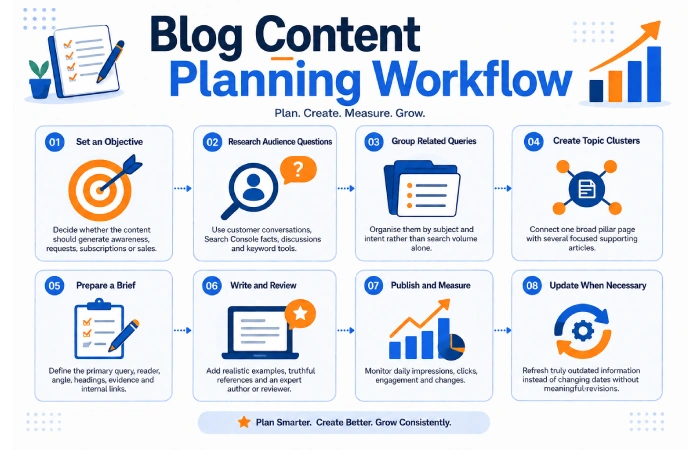
Follow this repeatable process:
- Set an objective: Decide whether the content should generate awareness, requests, subscriptions or sales.
- Research audience questions: Use customer conversations, Search Console facts, discussions and keyword tools.
- Group related queries: Organise them by subject and intent rather than search volume alone.
- Create topic clusters: Connect one broad pillar page with several focused supporting articles.
- Prepare a brief: Define the primary query, reader, angle, headings, evidence and internal links.
- Write and review: Add realistic examples, truthful references and an expert author or reviewer.
- Publish and measure: Monitor daily impressions, clicks, engagement and changes.
- Update when necessary: Refresh truly outdated information instead of changing dates without meaningful revisions.
Use Topic Clusters and Internal Links
A topic cluster gives the blog a clear information structure. Supporting articles should link to the pillar page and to other relevant resources where those links genuinely help readers.
Describe what it is using relevant keywords such as “keyword research for content marketing” rather than something generic such as “click here”. Google advises that crawlable links enable it to find pages and that descriptive anchor text gives context to where it will take the user.
Branding Terminology Explained Within Content
SEO performance also depends on whether readers recognise and trust the publisher. Writers should therefore use brand terminology consistently.
A website that mentions brand identity vs image also needs to state, a business intentionally tells us identity whereas, an audience perceives branding an image as meaning it. A brand vs branding also makes similar statements like; brand perceptions vs brand identity and corporate image vs corporate identity.
These phrases should only appear when they support the article’s subject. Adding unrelated keywords merely to increase coverage can weaken topical relevance.
Quality-Led Content vs Volume-Led Publishing
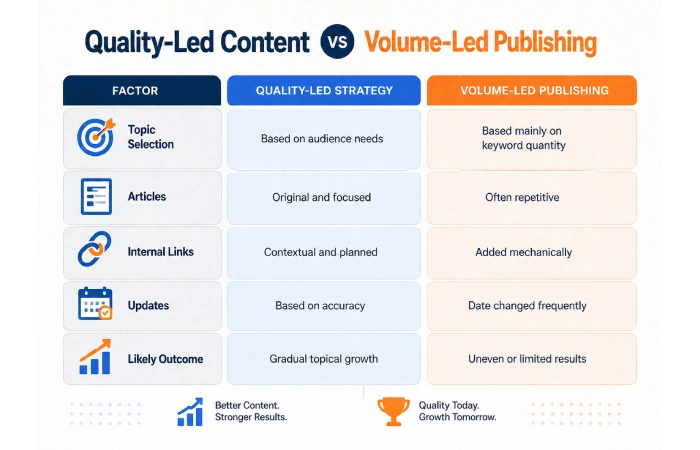
| Factor | Quality-led strategy | Volume-led publishing |
| Topic selection | Based on audience needs | Based mainly on keyword quantity |
| Articles | Original and focused | Often repetitive |
| Internal links | Contextual and planned | Added mechanically |
| Updates | Based on accuracy | Date changed frequently |
| Likely outcome | Gradual topical growth | Uneven or limited results |
Performance Expectations and Limitations
SEO content rarely produces immediate rankings. A newer or less-established website may require several months before a content cluster gains consistent impressions. Competition, site quality, backlinks, crawling, page experience and brand authority can all affect the outcome.
A documented strategy improves consistency and prevents random publishing, but it cannot guarantee first page rankings. It also requires research, editorial review and regular maintenance.
Measure progress through:
- Non-branded organic impressions
- Search click-through rate
- Average ranking trends
- Engaged sessions
- Leads or conversions
- Growth across an entire topic cluster
Avoid judging performance from a single keyword or a few days of data.
Frequently Asked Questions
How many posts should a blog content strategy for SEO include?
There is no fixed number. Start with one strong pillar page and four to eight closely related supporting articles. Expand only when additional content answers a distinct audience need.
How often should blog posts be published?
Choose a schedule your team can maintain without reducing quality. Two well-researched monthly articles may provide more value than daily posts that repeat existing information.
Should old blog posts be updated?
Yes, when facts, examples, links or search intent have changed. Preserve useful material and make substantial improvements rather than altering the publication date alone.
Conclusion
An effective blog content strategy for SEO connects audience research, search intent, topic clusters, useful internal links and measurable outcomes. Beginning with a dedicated subject, publish honestly helpful supporting resources and increase them using real performance data. Ecological growth usually comes from constant quality and clear knowledge not from publishing the high number of articles.