




Acquiring new clients is essential for every business to succeed, and finding potential customers manually as well as gathering details, information, and tracking the sales pipeline require a large deal of the sales representative’s efforts and time. The tools for lead generation automation assist companies in overcoming these challenges by leveraging software that can find out prospective customers, track and find new clients’ contacts, organize all the customer information in a systematized manner, and automate some of the key sales processes.
By enabling the automation to establish more standard lead generation, we get more streamlined in the business and won’t rely so heavily on Excel sheets and personal reminders.
Table of Contents
What Are Lead Generation Automation Tools?
Let’s define Lead generation automation tools are software that automates the repetitive processes of searching for potential clients and managing leads.
Depending on the stage, these gears may help businesses:
- Capture leads from websites and landing pages
- Find potential prospects
- Collect and organise contact information
- Score or qualify leads
- Send automated follow-up messages
- Track customer interactions
- Move leads through a sales pipeline
- Measure campaign performance
It’s not about eliminating human involvement in sales – it’s about automating repetitive tasks to free up your sales teams to have more conversations with your most qualified prospects.
What an Automated Lead Generation Software Works
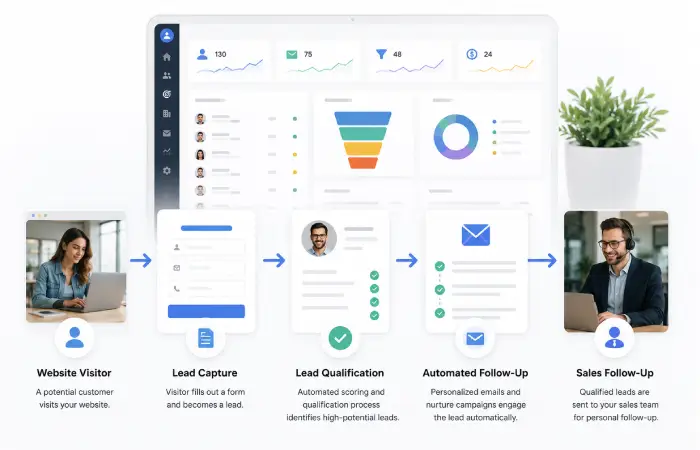
Automated lead generation software generally connects several stages of the lead-generation process.
For example, a visitor lands on a company website. The software can create that person as a lead on a CRM, score them and automatically send out a follow-up email.
A characteristic workflow appearances like this:
Website visitor → Lead capture → Lead qualification → Automated follow-up → Sales conversation
This type of workflow can help businesses respond to enquiries more consistently.
Benefits of Lead Generation Automation Platforms
Businesses can use lead generation automation platforms for different purposes depending on their sales model.
Saves Time
Automation can handle repetitive activities such as data entry, email notifications and basic lead qualification. This reduces the amount of manual administration required by sales teams.
Improves Follow-Up
A lead might be on their final decision but not yet ready to commit the thought of calling every single lead to check in or send an email about that promotion to leads one more time probably makes every sales employee shudder. Automation can alleviate this and ensure that leads don’t just fall through the cracks.
Supports Lead Qualification
Others might provide a notch depending on certain movements like a visit to a website, filling out a procedure or interacting with an email, which lets the sales team to emphasis on the leads who look most talented.
Provides Better Visibility
The Automation platform also is able to monitor origins of the leads as well as tracing their process through the sales cycle, it gives an idea which channels generating a worthwhile prospect to a business entity.
Automated Prospecting Tools
Automated prospecting tools focus on finding and researching potential customers.
The capabilities of prospecting tools vary widely, offering options from company databases and contact information searches to customer segmentation and sales intelligence.
Nevertheless, all organizations should always be careful to ensure data accuracy and the legality and ethicality of the outreach methods.
Automation of prospecting should supplement, not replace, responsible prospecting practices.
Lead Nurturing Automation Tools
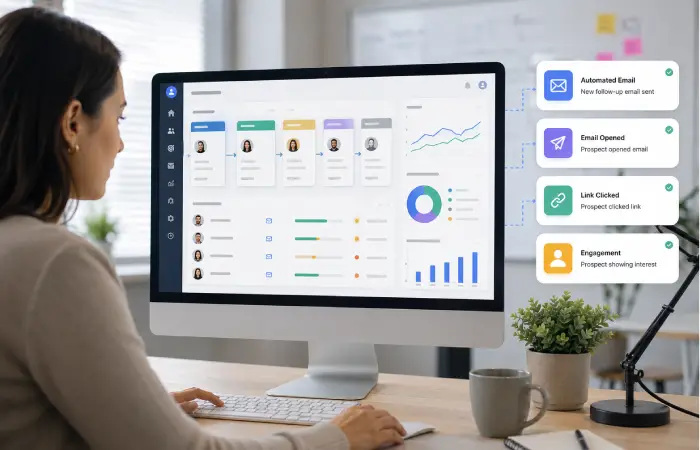
A buyer isn’t ready to buy on every occasion. Automation of nurturing is an automation tool that enables to nurture prospects over the course of time.
When, for example a user is on the fence and downloads a guide, they will start getting emails relating to the guide over the following days and weeks.
If, in this timeframe, a lead then asks for a demo or price-list, the salesperson would be alerted-there is still, for example, an opportunity to offer them what they are looking for.
Sales Lead Automation Software
Sales lead automation software can connect marketing and sales activities within one workflow.
Common features include:
| Feature | Purpose |
| Lead capture | Collect prospect information |
| Lead scoring | Identify higher-priority prospects |
| Email automation | Send scheduled communications |
| CRM integration | Keep customer records organised |
| Sales pipeline | Track lead progress |
| Analytics | Measure lead-generation performance |
For smaller and midsize companies it can actually be more pragmatic to go for software which does not comprise all the features you really will not use, and so is rather not buy in the big complicated one.
How to Choose the Right Automation Tool
Before selecting a platform, consider the following:
- Lead sources: Can it capture leads from your main marketing channels?
- CRM integration: Can it connect with your existing customer database?
- Automation: Does it support useful workflows and follow-ups?
- Reporting: Can you measure leads and conversions?
- Ease of use: Can your team learn it without extensive training?
- Scalability: Will it continue to meet your needs as the business grows?
- Compliance: Does it provide features that support responsible data and marketing practices?
It’s also worth testing a platform before committing to a long-term subscription.
Final Thoughts
Lead generation automation solutions will provide a far more organized and effective structure for identifying, acquiring and caring for leads. Both the initial sales prospecting automation and automated lead nurturing technology tools for your sales operations will enable you to automate routine activities whilst maintaining a human-centric sales function.
The solution varies according to your target audience, your sales cycle, budget and technology in place. If you want to start by automating, the trick is to begin by automating your most labor-intensive, monotonous activities and building processes around that work.