




Funding for social enterprises should be chosen according to what the money will finance and how it can be returned, if repayment or ownership is involved. A short-term working-capital need differs from research for an untested intervention. Using debt for a model with unpredictable revenue can create pressure that harms the mission.
Begin by defining the funding gap, timing and expected outcome.
Table of Contents
Funding for Social Enterprises Guide
| Funding source | Suitable use | Main obligation |
| Trading revenue | Regular operations and gradual growth | Deliver value customers will purchase |
| Grant | Pilots, research or eligible programmes | Follow grant purpose and reporting terms |
| Donation | Public-benefit work | Stewardship and donor accountability |
| Debt | Assets or working capital with predictable cash flow | Repay principal, interest and charges |
| Equity or impact investment | Growth in an eligible company structure | Ownership, governance and return expectations |
| Blended finance | Models needing several forms of capital | Manage different terms and reporting systems |
The best funding for social enterprises is not necessarily the largest amount. It is capital whose terms fit the cash flow and mission.
Funding for Social Enterprises for Beginners: Workflow
- Specify what will be funded.
- Prepare a realistic uses-of-funds budget.
- Separate operating revenue from restricted funds.
- Forecast cash flow under expected and weaker sales.
- Check legal-structure and eligibility requirements.
- Compare repayment, ownership and reporting obligations.
- Verify the provider through official sources.
- Obtain professional advice before signing complex terms.
Never pay an intermediary merely because they promise guaranteed approval. Genuine eligibility does not guarantee selection or investment.
Funding for Social Enterprises in India
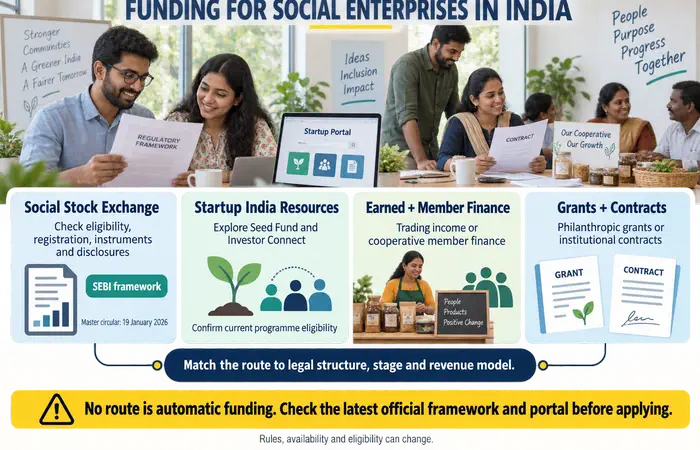
India’s Social Stock Exchange framework operates within the securities-market regulatory system. SEBI issued a consolidated master circular for the framework in January 2026. Eligibility, registration, instruments and disclosure obligations should be checked in the current official framework; the Social Stock Exchange is not an automatic source of money for every mission-led organisation.
Eligible startups may also investigate programmes listed through Startup India, including seed-fund and investor-connect resources. Programme eligibility and availability must be confirmed on the current official portals.
Trading income, cooperative member finance, philanthropic grants and institutional contracts may be more suitable for other structures.
Funding for Social Enterprises Cost and Expectations
Debt cost includes interest, fees, security requirements and late-payment consequences. Equity can involve ownership dilution and influence over decisions. Grants require application, monitoring and reporting time. Even “free” funding has administrative and delivery obligations.
Prepare the cost of raising money as well as the project budget. Founder time spent on applications, due diligence and reports should be visible.
Funding does not repair a weak model automatically. Investors and grant-makers may reasonably ask who benefits, how outcomes will be measured and what happens after the funding period.
Funding for Social Enterprises Examples
A repair enterprise with recurring contracts might consider debt for equipment if expected cash flow can service it. A nonprofit testing a community intervention may seek a restricted grant because the pilot will not generate immediate revenue.
A company developing an assistive product might use founder capital for early validation, grant support for eligible research and investment for later production. Mixing sources can work, but the organisation must track the purpose and conditions of each.
Funding for Social Enterprises Tips
Maintain current accounts, budgets and governance records. Explain both the commercial model and the intended impact. Check whether funding terms could encourage the organisation to move away from harder-to-serve beneficiaries.
A common mistake is raising money before calculating the smallest amount required to reach the next evidence milestone. A smaller, well-defined raise can be more manageable than accepting capital without a clear use.
FAQs
What is the best funding source for a social enterprise?
It depends on legal structure, cash flow, stage and intended use.
Can a social enterprise receive grants and earn revenue?
Potentially, yes. Each source must be permitted, properly recorded and used according to its terms.
Does listing or registering with a Social Stock Exchange guarantee funding?
No. Current eligibility, disclosure and fundraising requirements apply.
Conclusion
Funding for social enterprises should support a costed milestone without placing unsuitable pressure on the mission. Compare sales, grants, debt and investment by their full obligations, not only the amount offered.