





An online advertising agency specializing in online media uses its paid and owned channels to assist brands engage potential customers, often managing campaign planning; media; advertisement creation; landing page building; as well as audience building and conversion.
The Indian company also gets access to specialized talents if they hire agency; without the need of a full-service advertising agency. That does not indicate that every agency will guarantee success. The outcome relies on the offer, market demands, ad finances, advertising procedure, web presentation and quality of ad campaign management.
This guide explains what an agency does, how common pricing models work and how to evaluate providers without relying on sales claims alone.
Table of Contents
What Is an Online Advertising Agency?
An online advertising agency provides services in management of paid-for advertising on search engines, social networks, websites, video services, mobile applications and many other environments.
While many marketing consultancy firms would tell a client what keywords to research or how an audience should be marketed to. This may include targeting by age or interest groups, a typical marketing agency, will likely take a great deal of control over these aspects of a campaign, the bids may need to be set in accordance with a defined budget, ads may need to be created and conversion rates need to be monitored.
Some agencies specialize in one platform or industry. Others offer full-service campaign management across several channels.
The relationship usually involves two separate costs:
- Advertising spending: The amount paid to Google, Meta, LinkedIn or another media platform.
- Agency fee: The amount paid for strategy, setup, management, creative work and reporting.
Businesses should keep these figures separate when comparing proposals.
How Online Advertising Differs from Digital Marketing
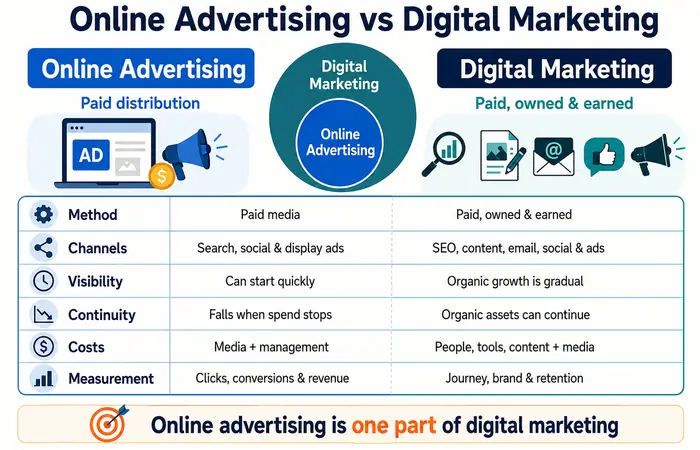
Online advertising is one part of digital marketing. It primarily involves paid distribution, while digital marketing also covers unpaid and owned channels.
| Area | Online advertising | Broader digital marketing |
| Primary method | Paid media placement | Paid, owned and earned media |
| Common channels | Google Ads, Meta Ads, LinkedIn Ads and programmatic media | SEO, content, email, social media and paid advertising |
| Speed of visibility | Campaigns can begin receiving exposure shortly after approval | Organic activity usually develops more gradually |
| Traffic continuity | Traffic normally declines when spending stops | Strong organic assets may continue attracting visitors |
| Main cost | Media spend plus management and production | Staff, technology, content, media and agency costs |
| Measurement | Clicks, conversions, acquisition cost and revenue | Wider customer journey, brand and retention measures |
Paid campaigns can create immediate exposure, but visibility alone is not the same as commercial success. A campaign still requires an appropriate audience, credible offer and functional conversion process.
Online Advertising Agency Services
While the exact remit varies depending on the agency, traditional agencies typically offer a mixture of strategy, creative, media and measurement execution.
Advertising strategy and account audit
Before launching campaigns, the agency should understand the client’s product, customers, margins, locations, sales cycle and previous marketing results.
An initial audit may be examined:
- Existing advertising accounts
- Historical campaign performance
- Conversion-tracking quality
- Website and landing pages
- Competitor positioning
- Search demand
- Audience data
- Creative assets
- Sales follow-up process
- Customer acquisition economics
The purpose is to identify constraints before spending more money. If the website does not work properly on mobile devices, increasing advertising expenditure may simply increase the number of visitors encountering the same problem.
Media planning and budget allocation
Media planning determines where, when and how the advertising budget will be used.
The agency may divide the budget between high-intent search advertising, social discovery campaigns, remarketing and experimental channels. Allocation should reflect the business objective rather than an agency’s preferred platform.
A local emergency repair service may benefit from search advertising because customers actively seek immediate help. A new fashion label may require visual social advertising to create awareness before shopper’s search for the brand.
Campaign setup
Setup work can include:
- Structuring campaigns and advertisement groups
- Researching keywords and negative keywords
- Building target audiences
- Selecting locations and schedules
- Configuring budgets and bidding
- Writing advertisement copy
- Uploading images or videos
- Creating product feeds
- Connecting website events
- Establishing naming conventions
- Testing advertisements before launch
A clean account structure makes future reporting and optimization easier.
PPC advertising agency services
A PPC advertising agency focuses on pay-per-click campaigns, particularly search advertising. The advertiser is generally charged when someone clicks the advertisement, although other pricing and bidding methods are also available.
PPC management may cover:
- Search-term and keyword research
- Keyword match types
- Negative-keyword management
- Advertisement copies testing
- Bid and budget management
- Location and device adjustments
- Shopping or product-feed campaigns
- Landing-page recommendations
- Conversion tracking
- Competitor and impression-share analysis
Search advertising is useful for capturing existing demand. It is less effective when people are not yet aware of the category or do not search for the solution.
Social media advertising agency services
They manage paid social media campaigns across various networks such as; Facebook, Instagram, Linkedin, Pinterest and other relevant ones.
Its work may include audience strategy, creative production, video variations, lead forms, catalogue advertising, remarketing and campaign optimization.
Social campaigns generally interrupt rather than answer an active search. The creative must therefore explain the relevance of the offer quickly.
Meta’s advertising tools include website pixels, Conversions API connections, application events and offline-conversion integrations. These can improve measurement, but their use requires appropriate technical implementation and responsible handling of customer data.
Display, video and programmatic advertising
Display campaigns place visual advertisements across websites and applications. Video campaigns can run through YouTube, social networks and connected media environments. Programmatic buys enable automated purchase of ad space based on audience, contextual and bidding. These formats lend to awareness and remarketing and broad audience growth.
These formats can support awareness, remarketing and broad audience development. Their direct conversion rates may be lower than those of high-intent search campaigns, so performance should be evaluated against the correct objective.
Creative development
Many agencies produce static images, videos, copy, carousels and other advertisement formats. Creative quality is especially important on social and video platforms.
A useful creative-testing process varies one major element at a time, such as:
- Opening message
- Customer problem
- Product benefit
- Evidence or testimonial
- Visual format
- Call to action
- Offer or price framing
Producing more variations is not automatically better. The agency should explain what each variation is designed to test.
Landing-page optimization
Sometimes one can have an ad the works and draw in the perfect customer however one might lose out if your webpage is not quick, uninteresting, or unsuccessful.
Landing-page support may include improvements to:
- Message consistency
- Mobile usability
- Page speed
- Forms and checkout
- Calls to action
- Pricing information
- Trust signals
- Product explanations
- Objection handling
- Conversion-event tracking
Agencies may provide recommendations, create pages internally or work with the client’s development team. The contract should state who is responsible.
Conversion tracking and analytics
Measurement determines whether a campaign creates a meaningful business result. Basic tracking may record forms, purchases, calls or application installations.
More advanced arrangements can connect advertisements with:
- Qualified leads
- Sales meetings
- Offline purchases
- Subscription renewals
- Customer lifetime value
- CRM opportunities
- Product-level revenue
- Profit or contribution margin
Platform-reported conversions should be compared with the client’s analytics, CRM, ecommerce and financial records. Different systems often produce different totals because they use different attribution rules and conversion windows.
Reporting and analysis
A report should explain performance, not merely export platform charts.
Useful reports normally show:
- Media spend
- Relevant conversion volume
- Cost per conversion
- Conversion rate
- Revenue or pipeline value
- Return on advertising spending
- Performance by channel or campaign
- Important changes
- Tests completed
- Work planned for the next period
Reporting intervals can be daily, weekly, fortnightly, or monthly. Some campaigns that require high spending and run for short periods may necessitate a more frequent level of monitoring.
Online Advertising Agency Workflow
A structured workflow helps both parties understand how campaigns move from planning to improvement.
1. Discovery and business assessment
The agency learns about the product, customers, geographical reach, margins, competitors and sales process.
The client should provide accurate information. If an agency does not know which leads eventually become customers, it may optimize for cheap forms rather than valuable enquiries.
2. Goal and KPI definition
The agency and client agree on a primary objective. Examples include online purchases, qualified leads, application installations or booked consultations.
Supporting metrics are then selected. For a lead-generation campaign, these might include:
- Landing-page conversion rate
- Cost per lead
- Qualified-lead rate
- Cost per qualified lead
- Lead-to-sale rate
A cheap lead is not necessarily a useful lead.
3. Tracking preparation
Conversion events, analytics, campaign parameters and CRM connections are configured and tested before launch.
The business should retain administrative control of important advertising and analytics properties. Agencies can be granted appropriate partner or manager access. Google’s manager-account system, for example, allows organizations to share access and control permission levels without transferring the underlying business account.
4. Research and media planning
The team research audiences, keywords, competitors and channel suitability. It then produces a media plan covering platforms, budgets, formats and expected testing periods.
Any forecast should be presented as an estimate. It is not a guarantee.
5. Campaign and creative production
The agency builds the campaigns, prepares advertisements and obtains client approval where required. Regulated industries may need additional legal or compliance review.
6. Controlled launch
Campaigns are launched with budgets that provide enough data without exposing the business to unnecessary risk. The team checks delivery, destination URLs, tracking and lead quality soon after launch.
7. Learning period and optimization
Advertising systems and managers need data before making confident changes. Keywords may be optimized, audiences, placements, creativity, bids, budgets or landing pages. It’s difficult to work out what caused the outcome when changing many of the main variables daily.
Changing several major variables every day makes it difficult to determine what caused the result.
8. Reporting and business feedback
The agency reports campaign results while the client supplies feedback about lead quality, sales and customer value.
This feedback loop prevents optimization towards platform metrics that do not reflect commercial outcomes.
9. Expansion or correction
Budgets can be expanded when results are sufficiently stable and unit economics remain acceptable. Poor-performing activity should be corrected, redesigned or stopped instead of being maintained merely to preserve spending.
Online Advertising Agency Pricing in India
Agency pricing differs according to campaign complexity, number of platforms, advertising spend, creative requirements, geography and reporting needs. Google Ads budget guidance
The following figures are broad planning ranges rather than fixed market rates.
| Pricing component | Indicative range in India | What may be included |
| One-time account setup | ₹10,000–₹75,000+ | Research, tracking plan and campaign construction |
| Small-business monthly retainer | ₹15,000–₹50,000 | Management of a limited campaign scope |
| Growing-business retainer | ₹50,000–₹1,50,000+ | Multiple channels, testing and deeper reporting |
| Percentage of media spend | Approximately 8%–20% | Campaign management linked to advertising spend |
| Creative production | ₹2,000–₹25,000+ per asset or project | Static advertisements, motion graphics or video |
| Landing-page development | ₹15,000–₹1,00,000+ | Design, copy, development and tracking |
| Analytics implementation | ₹15,000–₹1,50,000+ | Events, tag management and platform integration |
Actual quotations may fall outside these ranges. A local freelancer managing one search campaign has a different cost structure from an agency producing video advertisements across several countries.
Monthly retainer
A fixed retainer gives the agency a predictable fee. This model works well when the scope and expected workload are clearly defined.
The agreement should specify including channels, campaigns, creative quantities, meetings, reports and landing-page work.
Percentage of advertising spend
The agency receives a percentage of the media budget. The fees grow as spending increases, which can accommodate greater management requirements.
However, this model may reward higher spending even when increased investment is not appropriate. Clients should still use performance and profitability thresholds.
Performance-based pricing
The fee may depend partly on leads, purchases, revenue or another result. This appears attractive, but the definition of a qualified outcome must be precise.
The agency does not control every part of the sales process. Product availability, pricing, call response times and sales-team performance can affect results.
Hybrid pricing
A hybrid arrangement combines a base retainer with an additional performance or spending component. It can balance minimum service requirements with shared incentives.
What should a quotation clarify
Ask whether the proposal includes:
- Media spend
- Applicable taxes
- Campaign setup
- Tracking implementation
- Creative production
- Copywriting
- Landing pages
- Software charges
- Reporting
- Additional platform fees
- Account migration
- Notice period or termination costs
A low management fee can become expensive, when necessary, work is billed separately.
Online Advertising Agency for Small Business
An online advertising agency for small businesses should be able to work within limited budgets without spreading them too thinly.
A small business often benefits from concentrating on one customer segment, one offer and one or two channels. Running small campaigns across six platforms may produce too little data on any platform to support dependable decisions.
When an agency may be useful
Agency support may make sense when:
- Paid advertising already generates sales but needs specialist management
- The business lacks time or expertise to manage campaigns
- Conversion tracking is unreliable
- Several advertising platforms need coordination
- Campaign mistakes could waste a meaningful budget
- The company requires regular creative testing
- Management needs clearer performance reporting
When an agency may not be the right choice
Business may not be ready when:
- The product has not been validated
- The advertising budget is too small to generate useful data
- Margins cannot support paid customer acquisition
- No one can respond to enquiries promptly
- The website or payment process is seriously broken
- The owner expects guaranteed sales immediately
- The agency fee would consume most of the available campaign budget
In these situations, limited consulting, tracking support or an initial pilot may be more suitable than a full monthly retainer.
How to Choose an Online Advertising Agency
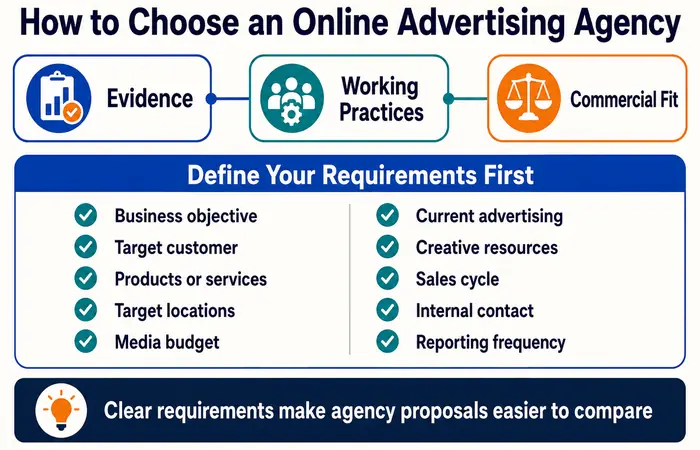
A strong selection process examines evidence, working practices and commercial fit.
Define your requirements first
Before contacting agencies, document:
- Business objective
- Target customer
- Main products or services
- Target locations
- Approximate media budget
- Current advertising activity
- Available creative resources
- Expected sales cycle
- Internal contact person
- Required reporting frequency
This makes proposals easier to compare.
Look for relevant experience
Industry experience can reduce the learning curve, particularly in regulated or specialized sectors. It should not be the only criterion.
Ask what the agency managed in the cited case study. A logo displayed on a client page does not prove responsibility for paid campaigns.
Request comparable case studies
A useful case study includes the initial problem, campaign period, approximate scope, measurement method and result.
Without understanding the context behind these percentages, it can be easy to be tricked. For instance, improving your monthly sales from three to one is a gain of 200%, but is still very small numbers on their own.
Evaluate the discovery process
A reputable agency asks about margins, sales force, sales potential, lead source quality and history before making any performance claims.
Watch out if all a person talks about is how much is being spent or guarantees a return without ever getting close to what your actual business operations have for offer!
Ask who will manage the account
The senior salesperson may not be the person performing daily work. Ask about the account manager, platform specialist, creative team, analyst and backup arrangements.
Clarify how many accounts each specialist manages and how often campaigns are reviewed.
Confirm account ownership
The client should normally own the advertising accounts, analytics properties, pixels, product feeds, audiences, landing pages and creative assets created with its budget, subject to the contract.
Provide the agency with managed access instead of sharing personal passwords. Google Ads manager accounts support linked access and permission controls; Meta also provides organizational and business access mechanisms.
Review measurement capability
Ask how the agency will define and verify conversions. For lead generation, determine whether it can connect campaigns with qualified opportunities rather than recording every form as equally valuable.
For ecommerce, ask whether reporting covers product returns, cancellations, discounts and margin where relevant.
Assess communication
Agree on:
- Main contact person
- Meeting schedule
- Reporting format
- Response times
- Approval workflow
- Escalation process
- Emergency campaign controls
Frequent messages do not automatically mean effective management. The aim is timely, decision-relevant communication.
Run a structured pilot
A pilot can test working compatibility before a long commitment. It should have a defined scope, adequate budget, suitable duration and agreed evaluation method.
A two-week test may be insufficient for a business with a three-month sales cycle. Match the pilot period to the buying journey.
Agency Comparison Checklist
| Evaluation factor | Questions to ask | Warning sign |
| Strategy | How will you choose channels and audiences? | Recommend the same platform to every client |
| Measurement | How will leads or sales be verified? | Reports click as the main business result |
| Ownership | Who owns the accounts and data? | Agency insists on exclusive ownership |
| Pricing | What is included and excluded? | Important charges are unclear |
| Experience | Can you show a comparable case? | Uses vague client logos without evidence |
| Team | Who performs the day-to-day work? | Delivery team is not disclosed |
| Reporting | What decisions will report support? | Sends automated dashboards without analysis |
| Forecasting | Which assumptions support the forecast? | Guarantees a particular return |
| Compliance | How are advertisement rules reviewed? | Dismisses industry or disclosure requirements |
| Exit process | What happens when the contract ends? | No written handover procedure |
Performance Expectations and Realistic Timelines
Online advertising can begin generating impressions and clicks quickly, but dependable commercial learning takes longer.
First two weeks
The team normally checks delivery, search terms, tracking, advertisement approval, early engagement and obvious budget problems.
Initial results can be volatile. Small datasets should not be treated as a permanent performance benchmark.
First one to three months
The agency should learn which audiences, keywords, creative messages and landing pages produce stronger results. The business should begin supplying lead-quality and sales feedback.
Accounts with low conversion volumes may need longer to produce reliable patterns.
Three to six months
There may be enough evidence to improve budget allocation, expand successful campaign areas and develop more advanced creative tests. Seasonal changes and market conditions still need consideration.
What an agency cannot guarantee
An agency cannot reasonably guarantee:
- First position in every advertising auction
- A fixed number of sales regardless of budget
- Immediate profitability
- Identical performance every month
- Accurate attribution of every customer
- Protection from platform-policy or algorithm changes
- Success for an uncompetitive product or offer
Google’s own Performance Planner describes forecasted effects of budget changes but explicitly notes that actual results vary by advertiser. Forecasts should therefore guide planning rather than be presented as promises.
Pros and Limitations of Hiring an Agency
| Potential advantage | Corresponding limitation |
| Access to channel specialists | Requires an additional management fee |
| Faster setup and troubleshooting | Agency still needs client information and approvals |
| Regular campaign monitoring | Attention may vary with team workload |
| Structured creative testing | Production can increase costs |
| Cross-channel reporting | Attribution remains imperfect |
| Knowledge from multiple accounts | Methods may become overly standardized |
| Easier scaling | Higher spending does not always remain efficient |
An agency relationship works best as a partnership. The provider manages media expertise, while the client contributes product, customer, sales and operational knowledge.
Legitimacy, Transparency and Warning Signs
An online advertising agency is not automatically reliable because it holds a platform badge, appears in a directory or displays large client logos.
Positive credibility signals
Look for:
- Registered business information
- Named team members
- Clear scope and pricing
- Verifiable case studies
- Secure access practices
- Transparent campaign reporting
- Written data and privacy terms
- A defined handover process
- Honest discussion of uncertainty
- Appropriate platform and industry knowledge
Warning signs
Proceed carefully if an agency:
- Guarantees a specific return before reviewing the account
- Asks for full payment without a written scope
- Refuses to provide client access
- Creates all assets under its exclusive ownership
- Uses unexplained advertising charges
- Reports only impressions and clicks
- Hides search terms, placements or campaign structure
- Buys questionable traffic
- Uses misleading claims or fabricated testimonials
- Cannot explain how conversions are measured
- Pressures the business into a long contract immediately
Businesses can also examine active Facebook and Instagram advertisements using the publicly accessible Meta Ad Library. This can help verify whether an agency’s advertised work or client activity appears consistent with its claims, although it does not show the complete campaign strategy.
Advertising Compliance and Data Responsibility
Advertising content must comply with platform rules, applicable Indian law and relevant industry requirements. Additional restrictions may apply to healthcare, finance, gambling, alcohol, political advertising and other sensitive categories.
India’s Advertising Standards Council of India publishes self-regulatory guidance covering truthful advertising and disclosures. The advertiser remains responsible for claims made in its promotions even when an agency creates or places them.
Data responsibilities are equally important. Agencies may handle customer lists, conversion records, website events and behavioral information. Contracts should define:
- Which data is collected
- Why it is required
- Who can access it
- Where it is stored
- Which platforms receive it
- How long it is retained
- What happens after termination
- Who handles deletion or access requests
A business should obtain appropriate legal advice for its own circumstances rather than if an advertising platform or agency automatically provides full compliance.
Alternatives to a Full-Service Agency
In-house advertising specialist
An employee may develop deeper product knowledge and work closely with sales and operations. The business must still provide training, tools and specialist support.
Freelancer
A freelancer can be suitable for a limited platform or budget. Availability, creative capacity and continuity should be assessed carefully.
Consultant with internal execution
A consultant can provide strategy, audits and periodic reviews while the internal team operates campaigns. This approach works when the business has execution capacity but needs senior guidance.
Self-managed campaigns
Small, simple campaigns can be managed internally using platform tools. Google Ads, for example, lets advertisers choose and adjust their own campaign budgets. Self-management still requires time for learning, tracking and optimization.
Hybrid team
A business can retain strategy, analytics or customer knowledge internally while outsourcing media buying or creative production. Clear division of responsibilities is essential.
Frequently Asked Questions
What does an online advertising agency do?
An online advertising agency plans, launches, and manages paid media campaigns for businesses across various digital platforms. Services may include audience and market research, media planning and buying, ad creative development and management, landing page creation, analytics tracking and optimization, and reporting.
How much does an online advertising agency cost in India?
Retainer fees for small businesses can range from ₹15,000-₹50,000 per month, while campaigns that are multi-platform or complex may run ₹50,000-₹1,50,000 or more. The actual advertising spend will be paid directly to the advertising platforms, and charges for creative, landing pages, and tracking may be additional.
Does agency pricing exclude the advertising budget?
Yes.
Your advertising budget is paid directly to platforms such as Google and Facebook; agency fees are paid for their services and expertise.
A good agency proposal should clearly outline both amounts. How long does it take for online advertising to show results? Campaigns can begin running shortly after they are set live, but it usually takes at least several weeks to a few months for the agency to refine and optimize campaigns to show consistent or desirable results.
It will depend heavily on the number of available leads or purchases to drive, your advertising expenses, the competitiveness of your industry, and your target audience’s customer journey.
Is a PPC advertising agency right for every business?
PPC requires search demand to target that users may act on-where a conversion or lead would justify the cost of the click.
If your products are too early or have very little search awareness, you may first need social media, content or even offline promotion before seeing significant returns from PPC advertising.
Should the business owner own its advertising accounts?
You should maintain ownership of your advertising accounts and provide the agency with managed access only. This ensures control over account data and continuity should your relationship with an agency cease in the future.
Can an online advertising agency guarantee sales or ROAS?
They should not provide unqualified guarantees for specific commercial outcomes.
They can optimize performance given available budget and conditions, but the ultimate result is influenced by market conditions, consumer behavior, your offer, your sales process, and your product’s market desirability.
What’s included in a monthly agency report?
It’s vital to receive a detailed report every month detailing your spend, leads generated or sales, cost per lead or cost per sale, any revenue attributable to the campaign, key findings, what tests have been run, and where opportunities lie.
Any limitations on tracking or data should also be disclosed.
Conclusion
In conclusion, to identify the best online advertising agency in India or elsewhere, don’t just look at the fee. Invest time to understand who the team is, whether they appreciate your business model, have reliable measurement in place, share account access transparently and discuss both potential upsides and down-sides honestly.
Indian businesses should start by setting realistic goals for the desired cost of customer acquisition then investigate potential advertising partners who share appropriate industry expertise, have transparent fee structures, respect customer data ownership and involve qualified personnel in performing the actual work.
While a capable digital advertising team can improve campaign efficiency and help prevent wasteful spending, it ultimately cannot substitute for market demand, strong user experience or a compelling offer. Therefore, a combination of real, defined acquisition costs, consistent tracking, and consistent communication from your partner will produce the best results.
Online Advertising Agency Resource Hub
Explore practical guides for choosing an online advertising agency, understanding its services, comparing pricing and selecting the right specialist agency.
Online Advertising Agency
A complete guide to online advertising agencies, their services and how they help businesses manage paid campaigns.
How to Choose an Online Advertising Agency
Learn how to compare agencies based on experience, strategy, reporting and campaign goals.
Online Advertising Agency Services
Understand the paid search, display, social media, creative and reporting services agencies provide.
Online Advertising Agency Pricing
Compare common pricing models, management fees, advertising budgets and additional campaign costs.
Online Advertising Agency for Small Business
Discover how small businesses can select affordable agency support and control advertising costs.
PPC Advertising Agency
Learn how PPC agencies plan, manage and optimise paid search advertising campaigns.
Social Media Advertising Agency
Explore agency services for paid campaigns across major social media platforms.