

Last Updated: September 2, 2026
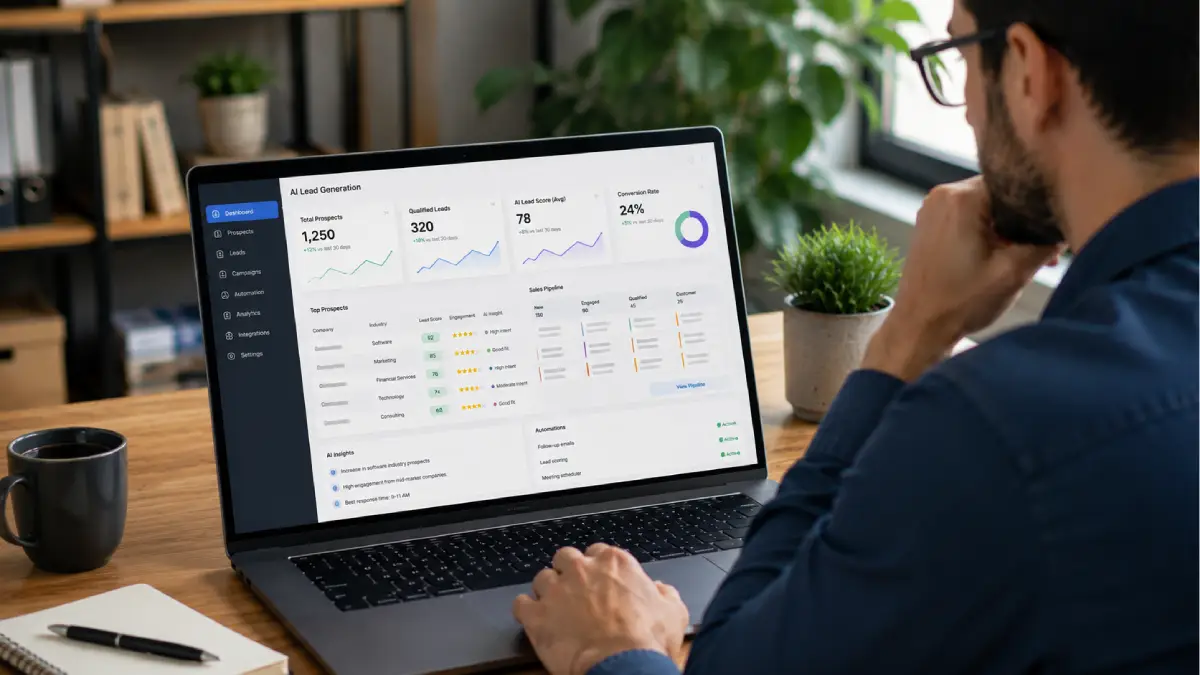
Identifying quality leads is a challenging, time-consuming task for small companies who lack adequate sales resources. AI lead generation for small businesses can aid in identifying suitable prospects through the use of sophisticated software which offers prospect discovery, lead qualification, task automation, and identification of prospects with a higher chance of becoming customers.
Table of Contents
What Are AI Lead Generation Tools for Small Businesses?
AI-driven lead generation tools leverage artificial intelligence in support of different stages of the lead generation funnel. Depending on your AI lead generation tool, features range from doing background research to customers to collecting prospect information to personalizing messages to scoring and ranking leads, helping your sales team identify which prospects to prioritize in your efforts.
Instead of having employees manually conduct repeated research in the traditional manner,AIcan help take on some of that workload by performing analysis on that massive amount of data.
Nonetheless, AI should provide support to the sales function, and not the entire replacement of human decision-making.
How AI Lead Generation Works
A typical AI-powered lead-generation process can look like this:
Find Prospects → Collect Data → Analyse Leads → Qualify Prospects → Outreach → Follow-Up
For example, a small software firm might target their ideal customer on the basis of their industry, company size and location. Then the AI can use this definition to find companies that fit these characteristics.
Sales representatives can then analyse and then decide whom to contact after filtering out inappropriate ones.
This way, can prospect in a more organised and systematic manner, while employees can find more time to talk and build relationship.
AI Led Generation Software: Key Features
Modern AI lead generation software can provide several useful capabilities.
Prospect Research
AI can help identify companies and professionals that match specific criteria. This can reduce the time required for manual prospect research.
Lead Scoring
Some platforms analyse available information and assign scores to prospects. A higher score may indicate that a lead fits the company’s target customer profile more closely.
Personalised Outreach
AI can help sales teams create customised messages based on a prospect’s company, role or business needs. Messages should still be reviewed to ensure that they are accurate and genuinely relevant.
Data Organisation
AI-powered platforms can help organise customer records and identify missing or outdated information.
AI Tools for Finding Leads
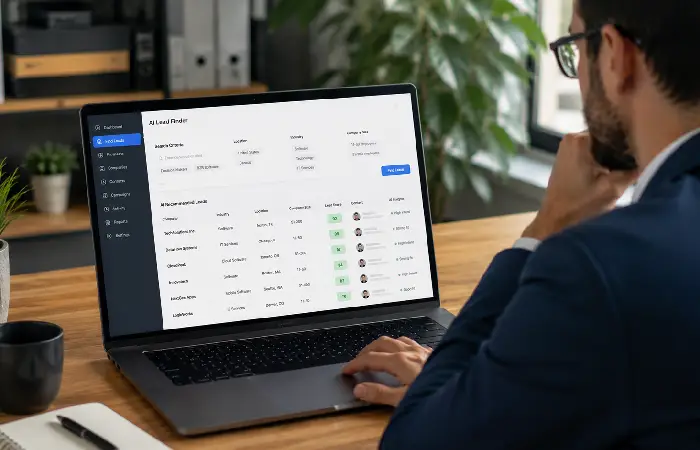
Businesses can use AI tools for finding leads to discover potential customers based on predefined characteristics.
Useful search criteria may include:
- Industry
- Company size
- Geographic market
- Job position
- Business model
- Technology used
- Revenue range
Instead of creating a very broad prospect list, businesses should define an ideal customer profile first.
For example, a small marketing agency might target e-commerce companies with 10–50 employees in a specific market. More precise criteria can produce a more relevant prospecting list.
Automated AI Lead Generation
Automated AI lead generation can connect multiple stages of the sales process.
A basic workflow could automatically:
- Identify potential prospects
- Add qualified contacts to a CRM
- Categorise prospects
- Assign lead scores
- Trigger follow-up tasks
- Notify sales staff about promising opportunities
Automation can save time, but businesses should monitor these workflows regularly. Incorrect data or poorly configured automation can result in irrelevant outreach.
AI Sales Prospecting Tools
AI sales prospecting tools are most effective for businesses that are accustomed to expending resources on researching leads.
There are many such tools which can assist sales teams find prospects, analyse information about companies and also find important accounts.
The ultimate benefit that this offers to the sales profession is efficiency. Instead of digging for days to find appropriate targets, sales professionals are able to use AI to identify target companies and then use their attention and resources on those targets.
Businesses must still verify important info before contacting a view.
AI Led Qualification Tools
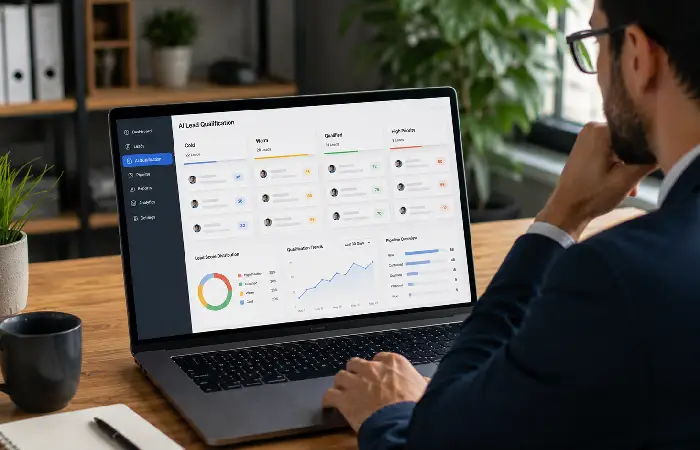
Not every person who submits a form or responds to an email is ready to buy. AI lead qualification tools can help businesses distinguish between different types of prospects.
For example, leads could be categorised as:
| Lead Type | Meaning |
| Cold | Limited buying signals |
| Warm | Shows some interest |
| Qualified | Matches the target customer profile |
| High Priority | Strong buying signals |
This classification can help sales teams decide where to spend their time.
Benefits of AI Lead Generation for Small Businesses
AI can provide several practical benefits:
- Reduce repetitive research
- Save sales-team time
- Identify relevant prospects
- Improve lead prioritisation
- Support personalised communication
- Automate routine workflows
- Organise prospect information
- Make sales processes easier to measure
The value depends heavily on the quality of the underlying data and how well the business integrates AI into its existing workflow.
Things to Consider Before Using AI
AI lead-generation software isn’t automatically better simply because it uses artificial intelligence.
Before choosing a platform, consider:
- Data accuracy
- CRM integration
- Pricing
- Automation limits
- Ease of use
- Privacy requirements
- Available customer support
- Human review capabilities
Businesses should also avoid sending large volumes of automatically generated messages without checking their relevance and accuracy.
For guidance on responsible use of AI systems, businesses can review Google’s AI guidance.
Final Thoughts
These AI lead generation tools can simplify small business prospecting, from spotting new clients and managing existing details to scoring opportunities and automating low-value sales work. Your plan would be to make best use of both human intelligence and the processing power of artificial intelligence.
Clarifying that sweet spot of a small client and opting for tools tailored to your process are the beginning of that, just make sure to evaluate the results.AI assistance for small business, if appropriately implemented, may also be practical.